Showing posts with label Western Films. Show all posts

Saturday, July 6, 2019

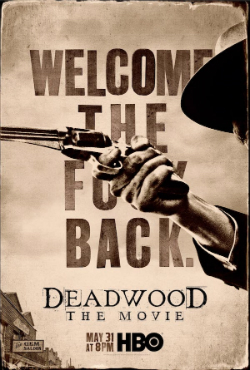
Deadwood: The Movie


In 1889, as the town of Deadwood celebrates South Dakota’s new statehood, Calamity Jane Canary (Robin Weigert) returns to rekindle a romance with Joannie Stubbs (Kim Dickens), now the owner of the Bella Union casino/brothel. George Hearst (Gerald McRaney), a gold-hungry mining magnate turned U.S. Senator from California, returns as well to pursue land for new telephone lines. Unfortunately for him, the land’s owner, Charlie Utter (Dayton Callie), refuses to sell. Meanwhile, Seth Bullock (Timothy Olyphant), once more a U.S. Marshal keeps the peace while his business partner, Sol Starr (John Hawkes), must contend with his lover Trixie’s (Paula Malcomson) antagonism toward Hearst. Finally, Trixie’s former employer, saloonkeeper Al Swearengen (Ian McShane), is suffering from liver failure. A sudden death threatens to throw the entire town into upheaval once again.

When HBO’s Deadwood series ended in 2006 after a three-season run, it was disheartening not only because there were more stories left to tell but because the then-finale was grim even by the harsh standards of this show: Hearst, having bullied and murdered his way to controlling the area’s gold mines and political offices, leaves victorious as everyone else must pick up the pieces. A follow-up movie was long-rumored, yet it seemed like it would never happen right up until the point when it actually did. Deadwood: The Movie never quite approaches the series at its best, but it is still a welcome and rewarding experience.

Astonishingly, given the decade-plus gap between series and film, the latter was able to return nearly all of the former’s cast (the major exceptions being the late Powers Booth and Titus Welliver, who was busy appearing in Bosch). Even more astonishingly, series creator David Milch wrote the script while battling the effects of Alzheimer’s. His dialogue remains sharp and retains Deadwood’s unique blend of profanity and lyricism. The returning talents allow for a strong sense of continuity, and the movie feels like it easily could have been a flash-forward episode from 2007 with everyone in old-age makeup.

With that being said, there are places where maintaining this continuity strains belief. Doc Cochran (Brad Dourif) was last seen as a middle-aged man suffering from tuberculosis in 1879 yet appears alive and well ten years later. Wu (Keone Young) has picked up little additional English in the intervening years, and Tom Nuttall (Leon Rippy) and “General” Fields (Franklin Ajaye) remain in town despite their historical inspirations having moved on.

This is not to say that there is no character development. The Bullock of the series was a notorious hothead while the movie finds him somewhat more rational (albeit no less formidable in a gunfight). Ill health having brought an end to his throat-slitting days, Swearengen takes on an almost grandfatherly aspect, albeit one couched in foul-mouthed pragmatism. Malcolmson and Weigert steal the show, however, as Trixie and Jane experience the most growth. The former, Swearengen’s top-earning prostitute when the series opened, is an expectant mother and the town’s moral compass, fearlessly calling out Hearst’s past misdeeds despite the potential dangers of doing so. The latter, who spent much of the series a drunken mess as she mourned the death of mentor Wild Bill Hickock, regains both confidence and competence. On the opposite end of the spectrum, so much of the series seemed to revolve, directly or indirectly, around the plight of widowed woman of wealth Alma Garrett (Molly Parker) that her diminished importance here is a strange sight.

Television has pushed plenty of boundaries since Deadwood went off the air in 2006, and what was once raw and shocking may have lost a measure of potency. Even in a vacuum, however, there is an inescapable sense that the movie’s plotting plays it safe, sacrificing surprise for satisfaction. And yet, if this truly is the end, it’s a fitting send-off: one that brings some measure of closure without resorting to cheap or cheesy remedies.

Saturday, May 13, 2017

The Magnificent Seven

When mining baron Bogue (Peter Sarsgaard) threatens a town for its land and kills those who oppose him, Emma Cullen (Haley Bennett), the wife of one of his victims, contacts warrant officer Sam Chisolm (Denzel Washington) to hire gunfighters to come to the town’s aid. Chisolm then recruits gambler Joshua Faraday (Chris Pratt), Confederate veteran marksman Goodnight Robicheaux (Ethan Hawke), Goodnight’s knife-throwing friend Billy Rocks (Lee Byung-hun), Mexican outlaw Vazquez (Manuel Garcia-Rulfo), religious mountain man Jack Horne (Vincent D’Onofrio), and exiled Comanche warrior Red Harvest (Martin Sensmeier). These seven will lay their lives on the line to protect the town against Bogue and his mercenary army, but will it be enough?

Remaking a classic Western (itself an Americanization of Seven Samurai) is a dicey proposition, but 2007’s 3:10 to Yuma showed that it can be successfully done. That and the talented cast were enough to give this reboot of John Sturges’ 1960 film of the same name some hope, even if the director (Antoine Fuqua) and screenwriter (Nic Pizzolato) seemed an ill fit (both are better known for their work in the crime genre). Then again, Fuqua directed Washington to an Oscar and coaxed a solid performance out of Hawke, so how bad could this be? In a word, fairly.

A predictable (even for those who haven’t seen the original) script and uneven performances doom this version to quickly-forgotten mediocrity. Washington acquits himself well, coming across as unflappable in a role formerly occupied by Yul Brynner. Chris Pratt is no Steve McQueen though, nor does this movie allow him to really be Chris Pratt: Faraday isn’t given enough wisecracks to compensate. Hawke tries to give Robicheaux a touch of pathos, but it’s sloppily handled while D’Onofrio’s high-pitched, screaming, scripture-quoting bear of a tracker is simply ridiculous. While it wouldn’t have taken much to improve upon Eli Wallach’s dated bandito cliché from the original film, Sarsgaard nevertheless gives a terribly hammy performance as a walking embodiment of everything people blame on capitalism.

There are, however, a few bright spots here. Some of the dialogue is in Mexican and Comanche, lending the film a bit of credibility. The ending makes good use of the original movie’s majestic theme. And the climactic defense of the town scene, is suspenseful and well-choreographed.

Given Hollywood’s affinity for unnecessary remakes, it would be difficult to single out The Magnificent Seven on those grounds, but familiarity and cheesiness make this more of a mediocre six.


6.0/10

Wednesday, January 6, 2016

The Hateful Eight

In the middle of a Wyoming blizzard, Maj. Marquis Warren (Samuel L. Jackson), a former Union officer turned bounty hunter, happens across a stagecoach hired by an acquaintance, John “The Hangman” Ruth (Kurt Russell), who is transporting Daisy Domergue (Jennifer Jason Leigh) to Red Rock so that he can collect $10,000 and she can hang for murder. The two are later joined by Chris Mannix (Walton Goggins), an ex-Confederate militiaman who claims to be the sheriff-elect of Red Rock. With the snow intensifying, the party holes up at Minnie’s Haberdashery where they encounter Bob, the Mexican caretaker (Demian Bichir), Oswaldo Mobray, Red Rock’s well-mannered hangman (Tim Roth), notorious Confederate Gen. Sandy Smithers (Bruce Dern), and stoic cowboy Joe Gage (Michael Madsen). The more time they spent snowed in, the more old tensions rise, and the more Ruth begins to suspect that one or more of the men is an imposter in league with Domergue.

More than two decades into his filmmaking career, and even the non-fan will likely know of Quentin Tarantino’s calling cards: stylized, unrepentant violence and profanity, dark comedy, elevated B-movie/genre film concepts, 60s-80s pop music (regardless of when the film is set), and clever nods to cinematic history. Suffice it to say, this isn’t everyone’s cup of tea, but even Tarantino’s detractors shouldn’t mistake him for a one-trick pony. The past decade saw him break from a personal revenge tale (Kill Bill) to examine the larger societal implications of war (Inglourous Basterds) and slavery (Django Unchained) in his typically excessive fashion. His latest offering, The Hateful Eight, changes trajectory once again, ditching an “issue” focus (and its attendant controversy) in favor of telling a story on a smaller scale. That he is able to get so much mileage (nearly three hours’ worth, and none of it dull) from such a staggeringly simple premise – a bunch of shady characters are snowed in together – is a testament to how much he has honed his craft.

Part of the reason The Hateful Eight works as well as it does is the fluidity with which it changes gears. The first third of the film functions as part classic Western, part seriocomic stage play. Legendary composer Ennio Morricone contributes a chillingly dramatic score and a Russell, with an epic moustache, channels his inner John Wayne. Meanwhile, every entrance into the stagecoach – and later, the lodge – begets a recurring joke. It’s hard not to laugh at a room full of louts clamoring for the door to be nailed shut to keep the cold out. But then, as the film moves into its latter half, the tension ramps up dramatically, the long-expected violence finally commences, and another influence emerges: the paranoid terror of John Carpenter’s The Thing. Unlike many movies that try to juggle tonal shifts, this one gets it right: when it’s funny, it’s funny, and when it’s grisly, it’s grisly. One does not undermine the other.

The cast is comprised mostly of recurring Tarantino players (Jackson, Roth, Madsen, etc.) with a few new faces, and by and large, they are a great fit. Jackson gets one of his best roles in years as the ruthless, cunning Warren, made likeable only by the targets of his wrath. Goggins supplies hillbilly exuberance, Leigh is captivatingly vile, and even poor James Parks, as a put-upon stagecoach driver, handles his role well. If there is one weak link here, it’s Channing Tatum: though his character speaks multiple languages, his Southern accent is distractingly bad.

Even with all it has going for it, there are moments where Tarantino’s dedication to excess is a liability. Did he really need to repeat dialogue in exaggerated slow motion? Did he really need to insert himself as a previously-unheard narrator in the middle of the film? Did he really need that much vomiting? One might point to this as Tarantino being Tarantino, but one might also expect a 52-year-old to steer clear of antics that would earn him a high-five from a 15-year-old.

Despite this, The Hateful Eight is immensely watchable. The dialogue is sharp, the score and casting are inspired, and with nothing resembling a hero in sight, you’ll find yourself rooting for one or more of the bad guys.


8.25/10

Friday, December 28, 2012

Django Unchained


Slave couple Django (Jamie Foxx) and Broomhilda (Kerry Washington) are split up by a spiteful master and sold separately at auction. Django is freed from his new owners by Dr. King Schultz (Christoph Waltz), a German dentist-turned-bounty hunter who needs him to spot his latest quarry. In exchange for partnering up, Schultz promises Django money, his freedom, and the chance to save Broomhilda from her new owner, the suave but sadistic Calvin Candie (Leonardo DiCaprio).

An epic Blaxploitation Spaghetti Western set in the Deep South seems like something hypothesized during a drunken party game, but for Quentin Tarantino, it’s par for the course. In many ways, Django Unchained is the ultimate Tarantino film. It combines the director’s love of 70s genre movies (the title pays homage to the classic Italian Western Django, and that film’s star, Franco Nero, cameos here), shocking violence and brutality (to an almost cartoonish level of excess), off-kilter banter (a group of proto-Klansmen engage in an internal bitchfest about whether their hoods are worth wearing due to the obstructed vision), and a distinctive soundtrack (where else would Ennio Morricone rub elbows with Rick Ross and John Legend?). The resulting amalgamation is clearly not for everyone, but for those who are not put off by it, there is a lot to like here.

Despite the ugliness of its subject matter, Django Unchained is beautifully shot. Whether it’s the serenity of a snowy winter, the grandeur of a Southern plantation, or the blood-stained halls of a shot-up mansion, the film leaves a distinct visual impression. That, coupled with the aforementioned soundtrack, helps perpetuate Tarantino’s legacy as a stylistic maestro.

The characters, like the content, are similarly repellant, but the performances, though uneven, feature a few gems. Waltz gives the best turn here. His bounty hunter is jovial, irrepressible, and, ironically, the film’s moral center. Foxx fills the lead role well enough, but he never hits the emotional highs one would expect. His is a perpetually controlled fury that manifests itself solely in the (admittedly, really cool) rapid pull of a trigger. On the other end of the spectrum, DiCaprio shamelessly overacts as Candie: genteel one moment, a raving psychopath the next. His partner-in-exaggeration is none other than Samuel L. Jackson, who looks like just came from filming a rice commercial. As Candie’s head of household, Jackson’s Stephen vacillates between toadying yes-man (his public persona) and maliciously cunning (in private). Then there’s poor Kerry Washington, who is given little to do here save for mutter a few lines in German and look frightened. While some of the cast were clearly just along for the ride, the motley assemblage of names and faces (look for Don Johnson and Jonah Hill, among others) makes this worth watching for curiosity alone.

Much has been said for how Django Unchained approaches the issue of slavery.  Tarantino has taken his share of hits for making such an unorthodox film on the subject, especially one that is often so uncomfortably funny. But just as Inglourious Basterds showed us vis-à-vis the Holocaust, there is a deeper message that lies beyond the director’s audacity. In Django Unchained, the dehumanizing effect of slavery looms large throughout. Whether it’s Django’s numbness to the suffering of the myriad slaves he encounters or Stephen’s years of internalized racism, the evil of the institution is amplified rather than downplayed (as Tarantino’s critics have alleged).

With a nearly three-hour run time and buckets of gore and blood, Django Unchained will test your limits as a viewer. But if you can hang on without getting bucked from the proverbial horse, it’s one hell of a ride.

8.25/10

Sunday, December 26, 2010

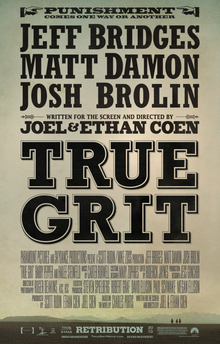
True Grit

When her father is murdered by hired hand Tom Chaney (Josh Brolin), 14-year-old Mattie Ross (Halie Steinfeld) hires notorious U.S. Marshal Reuben “Rooster” Cogburn (Jeff Bridges), a one-eyed drunk of notoriously mean temperament, to help bring Chaney to justice. They form an uneasy alliance with La Boeuf (Matt Damon), a proud Texas Ranger who has been pursuing Chaney in connection with another crime.


Remaking a film whose lead actor won an Oscar for the role seems like a tall order, but for the Coen Brothers, anything cinematic is possible. The 1969 version of True Grit featured arguably the best performance of John Wayne’s career and supporting turns by the likes of Robert Duvall and Dennis Hopper. Nevertheless, the 2010 version surpasses it in every way.


The biggest difference between the two is the Coens’ decision to hew closely to the source material, Charles Portis’ novel. The novel is told through Mattie’s eyes as an adult narrator, which gives her an increased role and the film a rather different tone. The Coens also preserved a lot of the novel’s dialogue, leading to plenty of laugh-out-loud moments as deadpan remarks (“You are not La Boeuf,” Rooster observes as a bearskin-clad stranger approaches) and puffed-up prose. Lastly, not having to worry about filling The Duke’s shoes allows The Dude to interpret Rooster Cogburn in his own fashion. The result is a buffoonish, broken-down drunk who can nevertheless get the job done with amazing efficiency when the stakes are raised.


Bridges’ co-stars are every bit as good. Damon’s easily offended La Boeuf has comic relief trappings, but he’s still credible as a man of action. Ditto Brolin’s Chaney, a poorly regarded lout who is nevertheless a menace. Curiously, the role of gang leader Ned Pepper (Duvall in the original version) is played by Barry Pepper, who makes the most of his brief screen time.


However, the film is truly buoyed by Steinfeld, a relative newcomer who more than holds her own. She approaches Mattie with poise and makes the character almost admirable without betraying the book’s vision. The cinematic Mattie is still headstrong, insistent, and brave beyond her years, but not quite as insufferable as the literary narrator.


The look and sound of the film are top-notch thanks to the return of frequent Coen collaborators Roger Deakins (cinematography) and Carter Burwell (music). There is a good amount of frontier violence here, but True Grit has nothing on the Coens’ last foray out west (No Country For Old Men).


Whether it’s dark comedy or stark drama, an homage-laden original or a faithful adaptation, the Coen Brothers have proven in recent years that they are capable of writing and directing just about any kind of film. Where True Grit ranks among their other films is a matter of fan opinion (the competition is stiff, to say the least), but it singlehandedly defies the notion that remakes of decent flicks will be inherently inferior.


8.25/10

Sunday, June 27, 2010

The Shooting

Upon his return to an Old West mining camp, ex-bounty hunter Gashade (Warren Oates) learns from his dim-witted friend Coley (Will Hutchins) that his brother has been implicated in a murder. The two are then hired by a mysterious young woman (Millie Perkins) to lead her to a town called Kingsley. Along the way, they are joined by Spear (Jack Nicholson), an ominous hired gun. As water and horses run low, mistrust grows among the reluctant traveling companions.


Produced by Nicholson, written by Carole Eastman, and directed by Monte Hellman, The Shooting is a gem of a low-budget Western that nearly never got made. Oates’ clashes with Nicholson and Hellman, Nicholson’s insistence on sticking to a $75,000 budget, and an inability to find a distributor almost doomed this project to the status of “might have been.” Fortunately, like other chaotic, free-wheeling productions of the 1960s, it came together and defied expectations.


To start with, The Shooting is incredibly tense. The pace is slow, but the repetitive, Hitchcockian score and the rugged desert landscapes create an almost palpable sense of mounting suspense and paranoia from start to finish. This is the kind of movie where the viewer feels like anything could happen.


Though dialogue is minimal, the cast is more than game. Oates is in good ornery form as Gashade and a young Nicholson is downright creepy as Spear. Perkins – Hellman’s next door neighbor – portrays the unnamed woman with an air of haughty determination, while Hutchins gives Coley a nervous, wide-eyed energy.


All of these elements very nearly compensate for the fact that the film has virtually no plot in the traditional sense. The backstory is hazy at best and what happens on screen is frequently left unexplained. The sense of mystery obviously heightens the drama, but not knowing the where and the why of the journey will leave some viewers all too conscious of the fact that they are being manipulated. Additionally, the ending offers an interesting twist, but some will undoubtedly think a bigger payoff is in order.


Often cited as the first Acid Western, The Shooting is a tense, sparse, difficult slice of existential filmmaking rendered all the more impressive by the challenges behind its creation.


7.75/10