Showing posts with label Comedy Films. Show all posts

Monday, July 17, 2023

Asteroid City


In the 1950s, a television host (Bryan Cranston) introduces an adaptation of the play Asteroid City by esteemed playwright Conrad Earp (Edward Norton). Set at a military science installation in the desert, the play is centered on a Junior Stargazer convention to honor the inventive wizardry of a group of teen geniuses. They are joined by their parents - the emotionally numb war photographer and recent widower Augie Steenbeck (Jason Schwartzman), the famous yet guarded actress Midge Campbell (Scarlett Johansson), and others – as well as June Douglas’s (Maya Hawke) elementary school class, singing cowboy Montana (Rupert Friend) and his band, the astronomer Dr. Hickenlooper (Tilda Swinton), Augie’s disgruntled father-in-law Stanley (Tom Hanks), a motel manager (Steve Carell), and General Gibson (Jeffrey Wright), who is overseeing the convention. Another arrival (from the skies) upends the status quo for everyone. Meanwhile, amid scenes from the play, the playwright and lead actor foster a relationship while the director (Adrien Brody) loses one.


Wes Anderson’s latest film bears many of his trademarks: precocious yet alienated kids, nostalgia, a huge ensemble cast, an Alexandre Desplat score, and a distinctive visual style (the play scenes are in bright, highly saturated color while the frame story/interludes are in sharp black and white). To this, he adds hearty doses of retrofuturism, pandemic quarantine metaphors, and metatextual commentary on the process of creation. It is, like most of Anderson’s oeuvre, divisive (one person’s artistry is another’s puzzling pretension), and, truth be told, less than the sum of its parts, but for anyone with any appreciation for Anderson’s usual tricks, there is still a lot to like here.


For starters, the film handles its insanely talented cast well. Even the smaller roles are memorable and distinctive (a barely recognizable Carell fills in for a missing Bill Murray). These include all of the above plus Matt Dillon as a mechanic of questionable competence and Margot Robbie (barely recognizable as well) as an actress whose scene was cut. In some cases, the casting gleefully subverts expectations: Swinton, who so capably portrays an ice queen, is warm and encouraging as she bonds with the stargazers while the oft-genial Hanks gives Harrison Ford a run in the grumpiness department. The constant deadpanning is a source of humor (along with recurring visual puns like a never-ending police chase and a Looney Tunes-appropriate roadrunner), but though many characters are exaggerated in one way or another, those with the greatest presence also have the greatest complexity. Schwartzman plays Augie as enigmatically detached yet Augie’s actor Jones Hall in his usual anxious manner, trying desperately to find an “in” into the character. Johansson’s Midge, the subject of exploitation as well as adulation, is deeply unhappy despite her fame.


While the quirky characters and the striking aesthetics are enough to hold our attention, Asteroid City is narratively underbaked. The circumstances that bore it (COVID quarantine and its resulting detachment) left an imprint on the production, but the film never really rises to full-on satire. While the interlude scenes provide context for the audience, they also rob the play-within-the-movie of scenes that may potentially help it gel. Perhaps as an overcorrection, the cast awkwardly chants a mantra at the end. “You can’t wake up if you don’t fall asleep” isn’t an unworthy message though the delivery leaves something to be desired.


Asteroid City will not win over any Wes Anderson converts and may even test the patience of his fans, but it is worth seeing for the cast alone. It may not hold up to a lot of scrutiny, but then again, neither did the Atomic Age sci-fi that it artfully evokes.

Sunday, January 8, 2023

The Menu


Margo (Anya Taylor-Joy) accompanies enthusiastic foodie Tyler (Nicholas Hoult) to the Hawthorn, an exclusive restaurant situated on a private island. They are joined by a food critic (Janet McTeer), a movie star (John Leguizamo), and other wealthy elites for an extravagant meal prepared by world-renowned chef Julian Slowik (Ralph Fiennes). But as the evening progresses, it becomes clear that the only thing Slowik really plans to serve is revenge.


Directed by Mark Myold, The Menu is part thriller, part darkly comedic social commentary. It’s aesthetically impeccable with a handful of strong performances and several hilarious and unnerving moments, but Will Tracy’s script with its underwritten characters and clumsy messaging is tough to swallow.


The Menu’s opening – insufferable rich folks board a boat for an island getaway that blows up in their faces – will seem familiar to anyone who saw fellow 2022 release The Glass Onion. However, whereas Rian Johnson’s cast of scoundrels was amusingly audacious, this group is largely forgettable. There are the aforementioned critic and actor, a trio of Wall Street bros, a perpetually drunken older relative, etc. Leguizamo playing a boorish has-been actor doesn’t strain the imagination (interestingly he based his performance on horrible memories of working the Steven Segal) though anyone could have played this role (and it was actually written with Daniel Radcliffe in mind). Hoult’s character is an exception to this bland stereotyping as Tyler vacillates between giddy excitement and sociopathic indifference to the growing danger around him. He’s ultimately too pathetic to be truly disturbing, however.


The movie’s attempt at thematic resonance is another misfire. A straightforward eat-the-rich bromide, while tired, would have at least been coherent. The Menu, however, seems to want to both validate that message while simultaneously pushing its antithesis. In addition to being unhinged, Slowik is by his own admission complicit in everything he rails against.


Despite these flaws, The Menu is a far cry from a disaster. Fiennes is in peak form here, playing Slowik as both deranged and wounded, monstrous yet all too human. Though her character is hampered by the aforementioned script problems, Taylor-Joy is often the film’s anchor, acting as an audience surrogate by calling out the excesses all around her. Hong Chau also does good work as Elsa, Slowik’s maitre’d who follows him with steely resolve and cult-like devotion.


Moreover, for all of its muddled messaging, The Menu’s means of delivery is wickedly funny. Slowik’s acts of vengeance embody all of the pretension and visual spectacle we associate with haute cuisine. In one moment, guests are served tortillas with embarrassing moments printed on them; in another, a sommelier’s description of a bottle includes notes of regret. The dish descriptions that follow each of the movie’s “courses” are another pitch-black highlight.


The Menu is a satisfying main with an unpalatable side. Eat and enjoy what you can of it, ignore the rest, and hope that nothing gets stuck in your teeth.

Tuesday, November 29, 2022

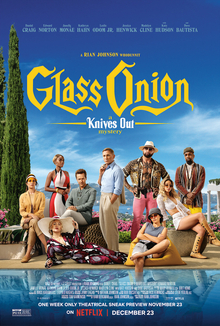
Glass Onion: A Knives Out Mystery


Tech billionaire Miles Bron (Edward Norton) invites his close friends to his private island for a birthday celebration and a murder mystery. The group includes his company’s lead scientist Lionel Touissant (Leslie Odom Jr.), Connecticut governor Claire Debella (Kathryn Hahn), fashion model-turned-designer Birdie Jay (Kate Hudson) and her beleaguered assistant Peg (Jessica Henwick), men’s rights streamer Duke Cody (Dave Bautista) and his girlfriend/assistant Whiskey (Madelyn Cline), and embittered former business partner Andi Brand (Janelle Monae). Also joining the fray is renowned detective Benoit Blanc (Daniel Craig). But when Blanc learns that Bron never invited him, he suspects the eccentric host’s game might give way to a real murder, especially when Andi brings the guest’s entanglements with Bron’s shady dealings to light.


Rian Johnson’s 2019 hit Knives Out was an uproarious take on the Agatha Christie-style murder-in-a-manor. This sequel, connected only by Blanc’s appearance, takes more cues from “destination” murder mysteries such as Death on the Nile (with a touch of Murder by Death thrown in). It isn’t nearly as tightly constructed or clever as the first film, but it’s still plenty entertaining.


As with its predecessor, Glass Onion boasts a cast of A-listers spinning characters that range from hypocritical to over-the-top horrible into comedic gold. Hudson’s unfiltered, witless Birdie Jay makes the Jersey Shore cast seem urbane, Bautista’s perpetually gun-toting Duke is a Tucker Carlson Tonight reject whose vileness is tempered by pathetic desperation. The usually excellent Hahn isn’t given nearly as much to work with, but her (presumably Democratic) climate warrior politician funded by corporate cash extends Johnson’s penchant for skewering everyone.


The three juiciest parts, however, are also the best acted. Craig continues to thrive as a Southern-fried Poirot, alternating between embarrassing discomfort, brilliant (if pompously delivered) deduction, and sheer annoyance at the stupidity of others. The multitalented Monet makes the most of what turns out to be a dual role, playing each with distinction and conviction. Norton, is, on the surface, a transparent riff on Elon Musk, which would make him, a hyper-ambitious glory hog with no sense of restraint. His moments of affability and abject cowardice round the character, and there’s an interesting meta-layer to the casting (Norton being both highly intelligent and talented and very difficult to work with).


Despite the cast’s charisma, the striking island setting, and Nate Johnson’s (the director’s cousin) exciting score, Glass Onion’s plot is powered, to an alarming extent on contrivance, the mid-movie reveal being the most egregious example. For every hint that Rian Johnson is able to slip under the radar, there also seems to be one that is an obvious tell. This makes for a movie that is not nearly as narratively gripping as the first Knives Out, and the ending’s attempt at catharsis feels forced.


Netflix is due at least one more Knives Out film, and so we may see Blanc interact with even more impeccably cast deplorables before long. Their ability to make us laugh seems a given, but the ingenuity of the murder that engulfs them seems considerably less certain.

Monday, March 8, 2021

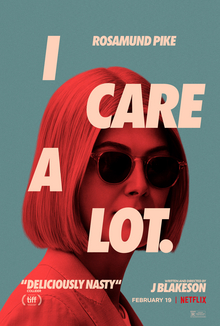
I Care a Lot


Marla Grayson (Rosamund Pike) is a scammer who conspires with an equally crooked doctor (Alicia Witt) to get seniors declared incompetent and herself appointed their legal guardian. After transferring them to a nursing home, she gradually sells off their assets and pockets the proceeds. Marla and her partner Fran (Eliza Gonzalez) find seemingly the perfect target in Jennifer Peterson (Dianne Wiest), but it turns out their mark is the mother of a dangerous gangster (Peter Dinklage) who is none too pleased to learn of the deception.


Writer/director J Blakeson’s attempt to combine dark comedy, social commentary, and crime thriller isn’t particularly successful on any of those fronts, but it does feature a magnetic lead performance. Recalling her earlier work in Gone Girl, Pike is again convincing as a ruthless serpentine narcissist schemer. Marla is loathsome yet impressively implacable and efficient.


While Pike is the standout here and has plenty to work with, several of her castmates make do with limited opportunities. Dinklage tries to rise above his underwritten part and is still able to convey so much with a simple facial expression. Similarly, Jennifer’s journey from overwhelmed sad sack to threat-barking quasi-prisoner is a testament to Wiest’s range.


Unfortunately, weak writing and an uneven tone undermine all of their efforts. From the beginning, I Care a Lot plays fast and loose with the very real issue of elder abuse with Isiah Whitlock as a judge either too gullible or too corrupt to be believed. However, Marla’s manipulations are artful enough to distract us from these contrivances. Even they cannot salvage the film’s second half, which morphs into an action movie, takes a turn toward the even more improbable, and ends on a cliched and heavy-handed note.


Viewed holistically, I Care a Lot tries and fails to do what Better Call Saul has been able to pull off for several seasons: make viewers care about an amoral manipulator while upping the stakes without losing a comedic edge. Watch this movie for Pike’s devilish turn as Marla, but be prepared to be disappointed otherwise.


Thursday, August 6, 2020

Jojo Rabbit


Toward the end of World War II, Jojo Betzler (Roman Griffin Davis), a naïve and idealistic ten-year-old German boy, joins the Hitler Youth. “Adolf,” a version of Hitler himself (Taika Watiti, who also wrote and directed), appears as Jojo’s supportive imaginary friend. One day, Jojo discovers Elsa Korr (Thomasin McKenzie), an older Jewish girl whom his mother Rosie (Scarlett Johansson) has been secretly hiding in their home. Though they start off mutually hostile and distrustful, the more he gets to know Elsa, the more Jojo begins to question Nazi beliefs, infuriating Adolf.


On paper, a dark comedy adaptation of Christine Leunens’ earnest novel Caging Skies sounds like a tasteless trainwreck in the making. However, Jojo Rabbit largely works in spite of its alienating premise, adding the hilarity and audacity of Blazing Saddles-era Mel Brooks and the quirky precociousness (and bright color scheme) of Wes Anderson’s Moonrise Kingdom to a familiar Anne Frank tale. Jojo Rabbit leans fully into its absurdity, yet it does so while still offering biting digs at Nazism’s vicious idiocy.


These dual purposes are perhaps best represented by Waititi’s take on Hitler. The director, a self-described "Polynesian Jew," sports a bad German accent (as does much of the cast) and plays the dictator as disarmingly chipper throughout the first half of the movie. The remove from the historical Hitler is such that the audience is always aware that “Adolf” is a figment of a Nazi-indoctrinated child’s imagination, and the portrayal gradually gets darker and angrier as Jojo wises up.


For his part, Davis makes quite an impression in his debut role, giving Jojo a believable mix of vulnerability, gullible innocence, and put-on Aryan superiority. Sam Rockwell, so often the sleazy racist imbecile, gets a nice change-of-pace here as Captain Klenzendorf, who runs the Hitler Youth camp. Rather than the sadistic ideologue one would expect in that position (Rebel Wilson as his female counterpart is truer to that type), Klenzendorf bumbles around apathetically, his indifference masking his bravery as a soldier and his closeted (until the end) sexuality. Unfortunately, the women aren’t given quite as much to work with. Elsa’s character is somewhat thinly drawn though McKenzie does a great job of trolling Davis by feeding him ridiculous myths about Jews to see what he will believe. Johansson’s Rosie is compassionate, brave, and not afraid to smack Klenzendorf around, but she doesn’t have a lot of screentime.


If the comedic elements don’t already do so, the fact that Jojo Rabbit offers the Nazi-adjacent a sympathetic viewpoint will strike some as morally irresponsible. It’s not an unwarranted criticism inasmuch as its one that overlooks the film’s satirical intent. As with Blazing Saddles, at the end of the day, the racists are made to look bad, and they lose.


Friday, April 17, 2020

Parasite


The Kims are a poor family struggling to make ends meet. Min (Park Seo-joon), a college student and friend of Ki-woo Kim (Choi Woo-Shik), recruits the latter to take over for him as an English tutor for Da-hye Park (Jung Ji-so), a high school student from an upper-class family. After getting his sister, Ki-jung (Park So-dam), to forge university credentials for him, Ki-woo is hired by the Da-hye’s gullible mother, Yeon-gyo (Cho Yeo-jeong). Ki-woo, now answering to “Kevin,” begins a secret romance with Da-hye and talks Yeon-gyo into hiring his American-educated cousin “Jessica” (actually, Ki-jung) as an art therapist for her young son, Da-song (Jung Hyeon-jun). Before long, the Kims have inserted themselves into the Park household, using underhanded means to get rid of existing servants who stood in their way. However, their scheming threatens to come back to bite them.

As 2013’s underrated Snowpiercer demonstrated, director Bong Joon-ho has a knack for visually striking cross-genre filmmaking laced with social commentary. While Parasite is a very different film, it carries on in that same tradition. Unfortunately, its critical acclaim and subsequent backlash have complicated a discussion of the film’s merits, which is almost as much of a robbery as what’s depicted on-screen.

Parasite begins as a dark comedy before morphing halfway through into a tense thriller and, ultimately, a tragedy. These tonal shifts can be jarring, but they make for an experience that is more than the sum of its parts. It also helps that the cast does a great job of shifting gears. As Mr. Kim, Song Kang-ho spends the first half of the movie as a shrewd but utterly shameless (albeit amusing) bum only to later settle into nihilism and regret. He’s matched by Jang Hye-jin as Mrs. Kim, an acid-tongued woman posing as a kindly housekeeper, and by Lee Jeong-eun as her predecessor in that role, a seemingly dutiful matron harboring a huge secret.

Though this film doesn’t match Snowpiercer as a visual spectacle, it still benefits from tight editing and aesthetics that reinforce the class divide. The Kims’ semi-basement apartment is small and cramped while the Parks’ house is large, bright, and airy. So too does a picturesque sunny day contrast with vicious rain the evening before as one family’s cause of celebration is another’s reminder of loss.

Given this unsubtle treatment of theme, it would be tempting to read Parasite as a work of eat-the-rich resentment in the vein of Joker, but to do so would be to ignore the complexities at play here. The Kims’ situation renders them sympathetic, but they are also liars and predatory schemers who screw over even other working-class folks. On the other hand, with the exception of Mr. Park (a condescending snob), the Parks are nice people, but, as Mrs. Kim notes, this is because they can “afford to be.” Ultimately, it is the film’s refusal to stereotype its characters that elevates it from predictable propaganda into more engaging fare.

Wednesday, January 1, 2020

Knives Out


The day after his 85th birthday party, highly successful mystery writer Harlan Thrombey (Christopher Plummer) is found dead. While the police are convinced that it was a suicide, an unknown client has hired famed private detective Benoit Blanc (Daniel Craig), who thinks otherwise. After interviewing Harlan’s family, Blanc finds no shortage of potential suspects as the Thrombeys, financially dependent on the old man, were cut off shortly before his death. The lone exception seems to be Harlan’s nurse and confidant, Marta Cabrera (Ana de Armas), who uncontrollably vomits after lying. Enlisting a reluctant Marta as his Watson, Blanc digs for the truth while Marta maneuvers to protect her own family.

Writer/director Rian Johnson took a lot of flack (some deserved, some not) for his narrative choices in Star Wars: The Last Jedi, but his next film finds him on much surer footing. Funny, tense, and stylish, Knives Out is his strongest effort since his debut film Brick, and just as that provided a refreshing take on hardboiled noir, so too does Knives Out revitalize the murder-in-a-mansion mystery.

Though there are shades of Sleuth and Gosford Park, Knives Out owes its biggest debt to Agatha Christie as Blanc, like Poirot, is a bigshot detective with a funny accent (a Foghorn Leghorn drawl in this case) who methodically works his way toward a solution. However, this is as much Marta’s film as it is Blanc’s, and the Thrombeys’ treatment of her (welcoming until the chips are down, dependent yet patronizing, etc.) parallels well-off white America’s relationship with immigrants. Subtle it is not, but at least Johnson’s heavy-handedness doesn’t play favorites: the progressive snowflake college student (Katherine Langford) and her lefty lifestyle guru mom (an overly tanned Toni Collette) are skewered just as much as the alt-right troll teen (Jaeden Martell) and his un-PC parents (Rikki Lindholme and, in a reprisal of their relationship from Midnight Special, Michael Shannon), aunt (a fierce, power suit-clad Jamie Lee Curtis) and uncle (a sleazy, bearded Don Johnson).

Admittedly, Craig’s accent takes some getting used to, but the cast is otherwise game. As Blanc, Craig seems to vacillate between puffed-up baffoon and quirky but brilliant sleuth. De Armas plays Marta with a blend of guile and anxiety that keep her believable and sympathetic (despite the script’s attempts to sanctify her). In flashback scenes, Plummer seems to be having fun as a vivacious, kindly patriarch who is done suffering fools even if they be blood. One of the more amusing performances is an against-type turn from Chris Evans (best known these days as Captain America), who plays the sneering, loutish wastrel of an eldest grandson. Add an exasperated Lakeith Stanfield as a by-the-book cop, Noah Segan (Johnson’s most frequently cast actor) as his starstruck partner, and Frank Oz as an unflappable will-reading attorney, and there are no weak links here.

Johnson has always been a bold stylist, and while the confines of a mansion don’t allow for the spectacle of The Last Jedi or even Looper, Knives Out is still a good-looking film, replete with his signature quick cuts/odd angle shots and abetted by a score from Nathan Johnson (the director’s cousin). Because of this aesthetic and technical prowess and his love of a twist ending, Johnson is sometimes labeled a style-over-substance guy. It’s an unfair label though a few narrative contrivances (Marta’s vomiting, the way that medication and narcotics are presented, etc.) do position Knives Out as not quite as clever as it presents itself to be.

Fresh, fun, and endearing despite (or perhaps because of) a cast of loathsomely selfish individuals, Knives Out is a sharp commentary-as-mystery that more than cuts the mustard.

Monday, June 17, 2019

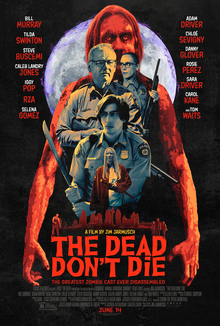
The Dead Don't Die


In small-town Centerville, police chief Cliff (Bill Murray) and deputies Ronnie (Adam Driver) and Mindy (Chloe Sevigny) face petty crimes, such as the alleged theft by survivalist Hermit Bob (Tom Waits) of ornery Farmer Miller’s (Steve Buscemi) chickens. But when polar fracking sends the earth off its axis, strange things begin to happen, culminating with the dead returning to life. Now facing a zombie epidemic, Centerville must rely on its overmatched police force, a film-loving gas station owner (Caleb Landry Jones), a well-provisioned hardware store owner (Danny Glover), and a bizarre, sword-wielding Scottish mortician (Tilda Swinton).

Though The Dead Don’t Die is the first wide theatrical release of writer/director Jim Jarmusch’s nearly four-decade career, it is no mainstream affair. Outrageous characters, lackadaisical pacing, dark humor work to preserve Jarmusch’s idiosyncratic style, and those who have grown to appreciate it will find plenty to like here. On the other hand, the uninitiated may find themselves wondering what the hell they just watched.

As mentioned, The Dead Don’t Die is not a tightly plotted film. It takes its time establishing characters and setting, the aesthetics never fully reinforce the danger that the story suggests, and it all builds to an abrupt conclusion many will find unsatisfying. It’s central conceit (polar fracking = purple moon and zombies) is ludicrous even by the standards of the genre, and its criticism of consumer culture – the zombies cry out for coffee and wifi rather than brains – is laughably (in both senses of the word) heavy-handed. One is better off viewing this as a parody of clumsy speculative message movies than such a movie in its own right.

Of course, there is an all-too-easy antidote to the film’s various lapses and transgressions: don’t take it too seriously. Freed from expectations, The Dead Don’t Die is a lot of fun. Murray is in peak deadpan form for most of the film until exasperation overtakes him at the end, and he is matched, underreaction for underreaction, by Driver. Swinton showcases her immense versatility by playing her insane (Zelda was practicing her swordplay before any inkling of zombies) role with gusto. Not only are there fine performances, but there are also recurring jokes (zombie victims are repeatedly speculated to be the results of predation by one or more wild animals by each party to discover them), visual gags (6’2” Driver speeds to the scene of a crime in small smart car, and amusing allusions (RZA plays a deliveryman for “WuPS.” Then there’s the oft-played (and, in-universe, oft-debated) title song by country crooner Sturgill Simpson. Love it or hate it, its presence is the glue that holds this film together.

Despite its higher-than-usual profile and very recognizable cast, The Dead Don’t Die is hardly Jarmusch’s opus, and those unaccustomed to his quirks will find it all the more trying. But for anyone inclined to forgive its meandering and goofiness, it’s a genuinely funny zombie comedy that is worth watching for the cast alone.

Thursday, February 7, 2019

The Death of Stalin

In 1953, after Soviet leader Joseph Stalin (Adrian McLoughlin) suffers a cerebral hemorrhage, his inner circle vies to replace him. Interior minister Lavrentiy Beria (Simon Russell Beale), the brutal head of the secret police, vies to consolidate power with deputy premier Georgy Malenkov (Jeffrey Tambor) as his pliable puppet. They are opposed by ambitious reformer Nikita Krushchev (Steve Buscemi) while foreign minister Vycheslav Molotov (Michael Palin), Stalin’s beloved daughter Svetlana (Andrea Riseborough), drunken buffoon son Vasily (Rupert Friend), and others are caught in the middle.

Written and directed by Armando Iannucci, The Death of Stalin has a divisive premise: Soviet atrocities as black comedy and nary an attempted Russian accent to be found. Some will see this as a tasteless and inaccurate attempt to make light of atrocities. However, a truer-to-history take may very well have been unbearably depressing. For those who can stomach Iannucci’s idiosyncratic approach, The Death of Stalin offers an equal amount of amusement and discomfort delivered by a capable cast.

Performances here are deceptive: many characters initially come across as exaggerated caricatures only to later reveal a more genuine (for better or worse) core. Buscemi plays Krushchev as mercurial and power-hungry yet also human enough to be disgusted by his more barbarous foes: essentially, this is his Boardwalk Empire character born again in Moscow. Tambor is hilariously ineffectual as the pliable, indecisive Malenkov, who nevertheless recognizes the impossibility of his position. Beale’s Beria makes for an inviting target for the enmity of political opponents and the audience alike: a scheming sadist and rapist who was somehow even worse in real life. Among the supporting roles, Jason Isaacs stands out as the medal-chested Marshal Zhukov, whose defeat of the Nazis emboldens him to troll everyone with aplomb while Olga Kurylenko lends steely defiance to Maria Yudina, a dissident musician.

This cast is given no shortage of quality material to work with, some invented and some only seeming as if it was. There’s Stalin commanding his cronies to join him in watching a Western, a room full of the political elite bumbling to decipher his dying gesture of pointing to a painting, Zhukov punching a drunk and ranting Vasily, and rival factions trying to literally outrun each other to appear at Svetlana’s side. The comedy is tempered by the realization that people were killed for the “crimes” of being in the general vicinity when Stalin expired, something the film acknowledges but relegates to a background event.


In keeping with history, the end of the movie finds Krushchev triumphant and his opponents vanquished albeit with an up-and-coming Leonid Brezhnev looking over his shoulder, ready to start the cycle of scheming and betrayal anew. This futility helps imbue the The Death of Stalin with a biting, fatalistic edge. Ultimately, it makes for questionable history but a darkly amusing look at ruthless politicians trying to out-bastard one another to victory.

Tuesday, July 10, 2018

Ant-Man and the Wasp

After “borrowing” a size-changing suit to help an on-the-run Captain America, Scott Lang (Paul Rudd), a former thief/divorced dad who dabbles in heroics as Ant-Man, is confined to house arrest. He is whisked away from under the noses of the FBI by the suit’s inventor, Hank Pym (Michael Douglas), and Pym’s daughter/Scott’s ex-girlfriend, Hope van Dyne (Evangeline Lilly). They believe that Hope’s presumed-dead mother Janet (Michelle Pfeiffer) may still be alive, and they aim to construct a machine to retrieve her from the quantum realm. This plan requires them to deal with unscrupulous black market technology dealer Sonny Burch (Walton Goggins), and it also puts them in the crosshairs of Ghost (Hannah John-Kamen), a molecularly unstable masked assassin who keeps phasing in and out of tangibility. Running low on options, Pym is forced to turn to an old friend-turned-rival (Laurence Fishburne) who may still harbor a grudge.

Positioned as a light-hearted breather after the hype, grandeur, and gravitas of Avengers: Infinity War, Ant-Man and the Wasp has “minor film” written all over it. After all, it’s a (mostly) earthbound tale devoid of megalomaniacal threats to the cosmos, and its lead characters, while likable, don’t rate a ton of name recognition. Given these relatively low expectations, Ant-Man and the Wasp is better than it needs to be even if it never fully escapes its “minor” status.

As with the first Ant-Man film, there is an emphasis on fun. Returning director Peyton Reed has crafted a fluid film full of both visual humor (Pym’s case of Hot Wheels cars becomes a portable garage thanks to his size-changing technology) and competently choreographed action. The script (courtesy of Rudd, Chris McKenna, and others) is high on humor, mocking Lang’s loser status and leaving plenty of room for banter. One running joke sees Lang’s ex-con pals argue with Burch’s syringe-wielding associate over whether the contents of said syringe constitute a truth serum.

As with the first film, Ant-Man and the Wasp boasts both winning performances and paper-thin characterization. Rudd continues to project affability as a devoted father and quasi-inept hero, and Douglas’s Pym remains prickly. Michael Pena is back too as Lang’s motor-mouthed business partner Luis, a character that walks a thin line between hilarious scene-stealer and annoying and insensitive caricature. Among the new additions, Kamen is a definite upgrade from the previous film’s derivative Yellowjacket. Ghost is a more complex character with more sympathetic motivations. Fishburne and the underrated Pfeiffer are welcome presences, but their roles barely transcend cameos.

Despite being given more prominent billing and more screen time, however, Lilly’s character is arguably mishandled. We get to see more of the Wasp in action (where her breathless combat competence contrasts, rather heavy-handedly, with Lang’s bumbling), but outside of the suit, Hope misses her mother, is vaguely miffed at Scott, and…that’s about it. Rather than actually develop a female superhero, this film seems content to simply give the appearance of having done so.

Though it does offer a few hints as to Marvel’s post-Infinity Wars plans, Ant-Man and the Wasp is best viewed as a self-contained experience. Through that lens, it is a perfect summer popcorn flick: humorous, heartfelt, and forgivably lightweight.


7.75/10 

Tuesday, May 22, 2018

Deadpool 2

After an experimental cancer treatment leaves Special Forces veteran Wade Wilson (Ryan Reynolds) deformed, insane, and capable of healing from any injury, he becomes the costumed mercenary Deadpool. But when personal tragedy strikes, a despondent Wade finds himself searching for purpose. He reluctantly forges a friendship with Russell (Julian Dennison), a troubled teenage mutant with pyrokinetic abilities. Meanwhile, Cable (Josh Brolin), a cybernetic soldier from the future, has lost his wife and daughter to an older Russell’s wrath. He travels back in time to kill Russell before the teen turns murderous, leading Wade to recruit a team to protect his young friend.

2016’s Deadpool pulled a coup of sorts, transforming an absurdist, self-referential comic book into a successful R-rated action-comedy. In this follow-up, the novelty of seeing The Merc with the Mouth on the screen has worn off, but it’s still a highly entertaining outing.

As with the previous film, Deadpool 2 is not for the young or squeamish. There is plenty of violent slapstick and crude humor to go around, and several characters bite the dust in morbidly amusing ways. However, this irreverence is tempered by a surprising amount of sentimentality. Wade’s love for Vanessa (Morena Baccarin), suicidal despair, and eventual concern for Russell are all played straight, and the franchise’s friendly rivalry with the Wolverine films sees Deadpool try to consciously eclipse Logan’s more poignant moments.

Reynolds continues to do excellent work in the title role, shifting from fourth wall-breaking wisecracks to inventive threats to heartfelt declarations, all with equal conviction. It helps that he is given plenty of great lines courtesy of writers Rhett Reese and Paul Wernick. The duo directed this film as well, and though they replaced a special effects pro in Tim Miller, Deadpool 2’s aesthetics don’t seem to suffer much for it. The action sequences remain fast and fluid.

The supporting cast features exactly the right mix of personalities for Reynolds to play off of. Among the returning allies, Brianna Hildebrand’s Negasonic Teenage Warhead continues to cast a disapproving side-eye, Stefan Kapcic’s Colossus continues to try to make a hero out of Wade (though even he has limits), and formerly timid taxi driver Dopinder (Karan Soni) seems eager to get in on the action. Newcomer Zazie Beetz brings both snark and competence to her role as luck-manipulating mutant Domino. Brolin’s casting as Cable was somewhat controversial given the other rumored candidates, his lack of towering height, and the fact that he is already voicing another Marvel character (which Wade, of course, lampshades – “Zip it, Thanos” indeed). Though arguably not the best possible choice, Brolin still does the character justice, and his grim gravitas makes Cable an effective foil for Wade’s antics.

Deadpool 2’s plot, however, seems like little more than a contrivance to bring these characters together. Derivative and creatively barren, it shamelessly samples The Terminator, Looper, and other sci-fi action fare. Granted, Deadpool fans likely didn’t pick this flick for its story, but even by those low standards, this is a weak link.

Funny and filthy, thrilling and touching, Deadpool 2 packs a lot of entertainment into its two hours. A rumored follow-up – X-Force – may have trouble meeting expectations when the bar has already been set this high.


8/10

Friday, March 10, 2017

Offbeat Loneliness Cinema: The Lobster and Swiss Army Man

It is an unfortunate truism that the bigger and farther-reaching a problem is, the more easily it lends itself to a film. War movies and natural disaster movies have been done countless times, yet as Hacksaw Ridge most recently demonstrated, that well has yet to run dry. But take a problem more personal, more intimate, and smaller in scope, and as a filmmaker, you will have your work cut out for you. If you are lucky, your tale will be moving and relatable. If you are not careful, however, you risk littering the screen with solipsistic whining. Loneliness falls into this latter category of problems, but that didn’t stop two films of recent vintage – 2015’s The Lobster and 2016’s Swiss Army Man – from exploring it anyway.


The Lobster takes its name from its protagonist, a shortsighted architect named David (Colin Farrell) whose wife recently left him. David is taken to a hotel and given 45 days to find a partner, or he will be turned into an animal of his choosing. During his stay, he is fed pro-relationship propaganda, befriends a limper (Ben Whishaw) and a lisper (John C. Reilly), and tries to court a heartless woman before realizing his perfect match (Rachel Weisz) may exist among a fiercely independent colony of loners out in the woods.

Though its premise may be a tough sell, Yorgos Lanthimos’s film gets by on its absurdist sensibility. There is an exaggerated, European-accented formality that permeates the film. Everything from dialogue to acts of violence come across as stilted and uncomfortable, which speaks volumes about the rules-obsessed world that David occupies. The hotel, for instance, doesn’t allow masturbation, bisexuality, or half-sizes in clothing whereas the loner colony punishes romance and makes members dig their own graves. If Brazil is 1984 by way of Monty Python, then The Lobster is Brazil by the way of Samuel Beckett. Though certainly off-putting at times, it’s an effectively deep black comedy aided by a lonely, desperate, frumpy Farrell, obliterating the typecasting of his youth.


Daniel Kwan and Daniel Scheinert’s Swiss Army Man explores a similar theme – what it means to be alone in contemporary society – in a very different way. Here, Hank Thompson (Paul Dano) is a marooned man on the verge of hanging himself when a corpse (Daniel Radcliffe) washes ashore. Dubbing the corpse Manny, Hank uses its flatulence to propel it across the water like a jetski. As Manny gradually begins to come back to life, Hank befriends him and tries to teach him the ways of the world. They are eventually motivated to try to return to civilization by their shared love for a woman named Sarah (Mary Elizabeth Winstead).

If The Lobster derives humor from its stiltedly awkward restraint, Swiss Army Man attempts to do likewise from its complete lack of it. Flatulence, erections, and other things a twelve-year-old boy might find amusing all factor prominently here, making the film seem the bastard offspring of Cast Away and Dumb and Dumber. The abundance of crass stupidity makes the movie’s moments of genuine introspection, intended as heartfelt, hard to take. The fault lays not with the actors – Dano is an enthusiastic but bumbling Hank and Radcliffe’s bizarre, occasionally wooden performance suits his “dead” character well – but rather with a script that asks us to understand and sympathize with characters it has inadequately developed. While Swiss Army Man deserves some plaudits for the boldness of its approach, it should also serve as a reminder that not all gambles are worth taking.

The Lobster: 7.75/10

Swiss Army Man: 6.25/10

Sunday, August 28, 2016

Hail, Caesar!

In the early 1950s, Hollywood fixer Eddie Mannix (Josh Brolin) must defuse a variety of situations while contemplating an offer to become a Lockheed executive. A twice-divorced swimming starlet (Scarlett Johansson) is pregnant, a singing cowboy actor (Alden Ehrenreich) has been shoehorned into a period drama role to which he is ill-suited, and twin gossip columnists (Tilda Swinton) hound him with threats and inquiries. Things go from bad to worse when leading man Baird Whitlock (George Clooney) disappears from the set of a high-budget epic set in ancient Rome and a group called The Future demands $100,000 for his safe return.

Though their oeuvre is definitely diverse, the Coen Brothers have long had an affinity for screwball comedies and old-timey Hollywood. Both are on full display here to the extent that Hail, Caesar! is little more than one long homage. It also happens to be a fitfully funny skewering of many of the same conventions that it seems to praise, something which may have sailed over the heads of dismissive viewers who lacked exposure to the big studio productions of the 1940s and 1950s.

Despite featuring a real person (Mannix was an infamous longtime MGM executive) as its protagonist, Hail, Caesar! is by no means a biopic. It presents an entirely fictional narrative that is laced with shout-outs to real happenings and popular Hollywood myths. The big-name cast, which includes Johansson, Ehrenreich, Swinton, Clooney, Ralph Fiennes, and Channing Tatum, convincingly channels Esther Williams/Loretta Young, Roy Rogers/Gene Autry, Hedda Hopper/Louella Parsons, Charlton Heston/Kirk Douglas/Robert Taylor, George Cukor, and Gene Kelly, respectively. Not only are the mannerisms spot-on, but the film is well-costumed and rich with period detail.

Of course, this wouldn’t be a Coen Brothers film if everything was played straight, and it certainly isn’t here. Witness Ehrenreich’s groan-inducing inability to lose his Southern accent, Tatum’s exaggeratedly homoerotic dance sequence from a Navy musical, or Swinton’s (both of her characters) progressively ostentatious hats, and you’ll get a good idea of Hail Caesar’s sensibility. Even when the film attempts to tackle more serious issues – religious iconography in cinema, Communist influence in Hollywood, the morality of the studio system – it does so mercilessly and irreverently.

And yet, for as fun as this film is, there is no getting around the pointlessness of its convoluted plot. This is less a coherent story and more a collection of shenanigans that Mannix (who is a deadpan tough guy everywhere but at home or in a confessional booth) has to mop up, and little is resolved by the end. A previous Coen Brothers film, Burn After Reading, concluded by having characters wonder aloud what just happened and what they could possibly learn from the experience. Viewing Hail, Caesar! will leave you thinking much the same.

Even viewed charitably, Hail, Caesar! does not rank toward the top of the brothers’ output. However, if you have any appreciation for or recollection of classic Hollywood, this reference-laden send-up is likely to leave you entertained.

7.75/10

Wednesday, February 3, 2016

More Reunion Cinema: Aging Rock Star Edition


A few months ago, I noted that movies have an insulting tendency to treat frayed familial relationships as something that can be fixed during a long-awaited trip home. The formula is predictable and transparent: tense/angry/awkward confrontation followed by somebody snapping followed by an epiphany followed by an apology (implicit or otherwise) and viola, things are different now. Two more films from this past year – Ricki and the Flash and Danny Collins – tried their hand at this premise, and while they showed some unexpected nuance in places, both still engage in some predictably shallow navel-gazing with regard to the complexity that is family.

The twist in both these outings is that the titular protagonists are past-their-prime musicians. Ricki (nee Linda, played by the always-great Meryl Streep) walked out on her family years ago to pursue her rock star dreams, ended up releasing one album, and now plays the bar circuit while working a register at a Whole Foods knockoff. She’s drawn back home when her ex (Kevin Kline) informs her that their newly-divorced daughter (Mamie Gummer, Streep’s real-life spawn) is having a rough time. Danny (Al Pacino, whose usual haminess suits the character for once and is balanced by a healthy dose of genuine affability), in comparison, hit both higher highs and lower lows, becoming a much more successful musician (one who can fill arenas with the AARP crowd despite not having written new songs in decades) albeit one with more vices and a son he never even got to know before abandoning. His reason for reuniting is also more aggrandized: his manager (Christopher Plummer) unearths a letter of encouragement written to him years ago by John Lennon, which prompts Danny to get his act together. As far-fetched as this premise sounds, it actually happened to singer Steve Tilston – life is strange.

While both movies follow predictably redemptive arcs, what sets them apart is the absence of loud, messy drama. Yes, Gummer’s character angrily confronts her absent mother, but blames her medication and reconciles (to an extent) relatively quickly. And Danny’s grown son (played by the usually hot-headed Bobby Canavale) is none-too-pleased to see him, but nary a window is broken nor a death threat muttered.

Avoiding histrionics helps to ground these films and show a broader range of reaction to parental alienation, but it also has some adverse effects. In the case of Ricki and the Flash, the end product is light to the point of fluffy at times, a disappointment given what the director (Jonathan Demme) and writer (Diablo Cody) are capable of. Danny Collins, on the other hand, fills the void by giving us Hope (Giselle Eisenberg), Danny’s hyper, high-pitched granddaughter. The character is meant to have ADHD and we are meant to sympathize and find her endearing, but she comes across as both unbearably annoying and a questionable representation of the condition.

It is unlikely that Hollywood will develop a take on family dramedy that doesn’t grossly oversimplify any time soon, but these two films at least don’t watch like retitled rehashes of forgettable fare. Both are flawed and both feature engaging leads, but Danny Collins’ superlative supporting cast (Plummer, Cannavale, Annette Benning, and a quick – but plot-important – Nick Offerman appearance) gives it the edge.

Ricki and the Flash: 6.75/10

Danny Collins: 7.5/10