Showing posts with label Crime Films. Show all posts

Tuesday, November 29, 2022

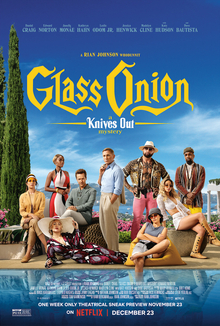
Glass Onion: A Knives Out Mystery


Tech billionaire Miles Bron (Edward Norton) invites his close friends to his private island for a birthday celebration and a murder mystery. The group includes his company’s lead scientist Lionel Touissant (Leslie Odom Jr.), Connecticut governor Claire Debella (Kathryn Hahn), fashion model-turned-designer Birdie Jay (Kate Hudson) and her beleaguered assistant Peg (Jessica Henwick), men’s rights streamer Duke Cody (Dave Bautista) and his girlfriend/assistant Whiskey (Madelyn Cline), and embittered former business partner Andi Brand (Janelle Monae). Also joining the fray is renowned detective Benoit Blanc (Daniel Craig). But when Blanc learns that Bron never invited him, he suspects the eccentric host’s game might give way to a real murder, especially when Andi brings the guest’s entanglements with Bron’s shady dealings to light.


Rian Johnson’s 2019 hit Knives Out was an uproarious take on the Agatha Christie-style murder-in-a-manor. This sequel, connected only by Blanc’s appearance, takes more cues from “destination” murder mysteries such as Death on the Nile (with a touch of Murder by Death thrown in). It isn’t nearly as tightly constructed or clever as the first film, but it’s still plenty entertaining.


As with its predecessor, Glass Onion boasts a cast of A-listers spinning characters that range from hypocritical to over-the-top horrible into comedic gold. Hudson’s unfiltered, witless Birdie Jay makes the Jersey Shore cast seem urbane, Bautista’s perpetually gun-toting Duke is a Tucker Carlson Tonight reject whose vileness is tempered by pathetic desperation. The usually excellent Hahn isn’t given nearly as much to work with, but her (presumably Democratic) climate warrior politician funded by corporate cash extends Johnson’s penchant for skewering everyone.


The three juiciest parts, however, are also the best acted. Craig continues to thrive as a Southern-fried Poirot, alternating between embarrassing discomfort, brilliant (if pompously delivered) deduction, and sheer annoyance at the stupidity of others. The multitalented Monet makes the most of what turns out to be a dual role, playing each with distinction and conviction. Norton, is, on the surface, a transparent riff on Elon Musk, which would make him, a hyper-ambitious glory hog with no sense of restraint. His moments of affability and abject cowardice round the character, and there’s an interesting meta-layer to the casting (Norton being both highly intelligent and talented and very difficult to work with).


Despite the cast’s charisma, the striking island setting, and Nate Johnson’s (the director’s cousin) exciting score, Glass Onion’s plot is powered, to an alarming extent on contrivance, the mid-movie reveal being the most egregious example. For every hint that Rian Johnson is able to slip under the radar, there also seems to be one that is an obvious tell. This makes for a movie that is not nearly as narratively gripping as the first Knives Out, and the ending’s attempt at catharsis feels forced.


Netflix is due at least one more Knives Out film, and so we may see Blanc interact with even more impeccably cast deplorables before long. Their ability to make us laugh seems a given, but the ingenuity of the murder that engulfs them seems considerably less certain.

Saturday, October 2, 2021

Sopranos Review Round-Up: The Many Saints of Newark, Talking Sopranos, and Off the Back of a Truck

 I was a teenager in New Jersey when The Sopranos revolutionized television drama during its original run. I didn’t fully grasp the intricacies of what I was watching – that would come later – but there was something relatable beyond the adjacency of the setting. Most of the show’s main characters were of my parents’ generation rather than my own, but their children, Meadow and A.J., embodied many of the seeming contradictions Millennials faced: well-provided for yet ill-prepared to deal with the world, pushed to avoid repeating the mistakes made by their parents yet resented for not being more like those parents, offered both possibilities and a relentless pressure to fulfill them.


Since the last episode aired in 2007, The Sopranos has been analyzed, dissected, lauded, scorned, queried, referenced, revered, parodied, and dismissed more times than I care to count. As influential as it has been, that much is to be expected. Less anticipated, however, has been its renaissance. It has been a streaming favorite amid the pandemic, particularly – and perplexingly – among those too young to have seen it the first time it aired. Then again, given how well Tony’s “I’m getting the feeling that I came in at the end” speaks to contemporary concerns, perhaps that is not perplexing after all.


Amid this resurgence, several cast members launched podcasts, several books were written and released, and the seeming mirage of a prequel movie actually became a reality. These media run the gamut from the virtuosity of Uncle Junior belting out “Core ‘ngrato” to the ineptitude of Vito’s attempt at honest carpentry, but even at their lowest points, they are at least fascinations for Sopranos fans.


The Many Saints of Newark


In 1967, New Jersey mob soldier Richard “Dickie” Moltisanti (Alessandro Nivola) serves as a mentor to his young nephew, Tony Soprano (William Ludwig), especially after Tony’s father Johnny (Jon Bernthal) is sent to prison. Four years later, Johnny is released, Dickie and Joanne are parents to a young son, Christopher, and Tony (Michael Gandolfini) is an intelligent but trouble-prone teen concerned about his depressed mother Livia (Vera Farmiga). Meanwhile, Harold (Leslie Odom Jr.), one of Dickie’s former number runners, has come back to form a Black syndicate to wrest control from the Italians. While Dickie’s uncle Sally (Ray Liotta) encourages him to stay out of Tony’s life to avoid corrupting him, it may be too late for either of them.


Ever since the cut-to-black ending of The Sopranos final scene, demand has run high for some kind of follow-up. Series creator David Chase’s reluctance and series star James Gandolfini’s 2013 death made a continuation impossible, but it didn’t preclude a prequel. To a certain extent, The Many Saints of Newark delivers, showing younger versions of many of the series regulars and at least hinting at what led them to where they are when we first met them in 1998. But amid the copious amounts of fan service lurks another, arguably more interesting movie that looks at the 1967 Newark riots and their impact on the status quo via the lens of organized crime. The extent to which these two aims interrupt rather than complement one another speaks to an identity crisis that keeps The Many Saints from reaching its full potential though there are still moments in which it shines.


If nothing else, The Many Saints excels as a period piece, capturing the 1960s and 1970s with Scorsese-like detail. Chase (who co-wrote with Larry Konner while Alan Taylor directed) has always been something of an obsessive music fan, and it shows here. While his selections fit the mood (or, in one case, hilariously and darkly subvert it), they are so omnipresent during the film’s first half hour or so that The Many Saints plays like an awkward musical. This, coupled with some questionable writing, lends credence to the idea that Chase’s biggest creative contributions to The Sopranos were as a big-picture conceptualist while a lot of the episode-to-episode brilliance came from the likes of Terence Winter and others. At the very least, Taylor’s direction is sharp and assertive. This is a stylishly violent movie though not (again, save for the case previously alluded to) cartoonishly so.


Even with the dedication to fan service as something of an impediment, some of the cast members do an excellent job. Nivola has the luxury of playing someone long dead when the series began, and so he has more freedom to define who Dickie Molitisanti was. We see in him many shades of Christopher, a series regular (who narrates the film from beyond the grave – a cheap gimmick that Michael Imperioli nevertheless salvages). Dickie is violent and jealous and impulsive but also aware that there is more to life than being a wiseguy and is driven to achieve it. Harold, who morphs from ally to enemy, is in many ways his mirror image: a criminal who experiences a social awakening of sorts and decides to take his shot. Given the paucity of Black characters in the original series, his deuteragonist role (until that spot is usurped by Tony) is a welcome addition.


Among those in the “younger versions of established characters” camp, Farmiga and Corey Stoll (Tony’s conniving Uncle Junior) had some of the biggest shoes to fill (Nancy Marchand and Dominic Chianese, respectively) yet did some of the best work here. Farmiga’s Livia is still brimming with toxic negativity, yet she is not the monster she will become by the time of Marchand’s portrayal. Farmiga humanizes her enough to offer some semblance of hope for redemption even though we know it is not meant to be. For his part, Stoll nails Junior’s pettiness, irritiablity, and sense of his own importance as well as his look and mannerisms. It’s a shame that a character with some of the best dialogue in the original series is reduced to a series of catchphrases (even if the infamous “varsity athlete” line was laugh out loud funny), but that’s no fault of the actor.


Of course, Michael Gandolfini taking over for his late father had arguably the biggest shoes to fill of all, but to everyone’s collective relief, Tony isn’t the main character here. Gandolfini the younger did a commendable job embodying younger Tony even if he’s slightly too old for the role. Then again, this is far from the movie’s only transgression against the established timeline. In the original series, Silvio Dante (Steven Van Zandt), Tony’s longtime friend and consiglieri, is implied to be a peer no more than a few years older. Here, the 1960s/70s version is played by a 30-something John Magaro with a combover, and he calls Tony “kid.” That Magaro is doing a caricature of a mobster caricature doesn’t help matters. Liotta very nearly falls into this category of distractingly bad as well. As Dickie’s abusive jerk of a father, Aldo, he’s one-note detestable, turning in a lazy performance full of superficial bluster. But then he also plays Sally, who is both quirkier (he’s a Miles Davis fan) and more contemplative, showing that maybe Liotta wasn’t just going through the motions for a paycheck after all.


The Many Saints of Newark ends in a way that brings everything full circle while still leaving questions unanswered. Chase, ever the pessimist, shows children fighting to avoid becoming their parents and failing, and that, coupled with the change in setting and exploration, however brief, of social context, lends at least some substance to what is otherwise an awkwardly nostalgia-heavy affair. Fans of the series will likely find The Many Saints worse than the weakest of the show’s episodes, and yet, as a side story/supplement, it’s oddly indispensable.


Talking Sopranos


One of several Sopranos podcasts to emerge during the past few years, Talking Sopranos is hosted by series regulars Michael Imperioli and Steve Schirripa, who interview crew, fellow cast members, and others while providing recaps of every episode.


At the heart of Talking Sopranos is a great joke albeit one that wears thin quickly: Michael and Steve are the complete opposites of their characters…and each other. While Christopher Moltisanti was an impulsively violent failed writer frustrated about his place in the world, Imperioli is an accomplished writer and actor with an intellectual’s low-key bearing. And while Bobby Baccala was the sensitive butt of many jokes (at least until his latter-season rank up), Schirripa is the quintessential abrasive New York loudmouth. The two needle each other endlessly, which is amusing to a point, but they (or, more accurately, Steve) have an annoying tendency to lose the thread. For every insightful and amusing guest interview, there are those marred by rote questions and unwarranted interruptions. The episode analysis fares no better, often spiraling into pointless segues. Admittedly, some of the show biz anecdotes shared are gold, but even at their best, they stretch out each episode’s run time to a frustrating degree.


I have invested enough time in Talking Sopranos to see it through to the end, and for the patient, it does offer occasional rewards, but you should think twice before taking the plunge.


Off The Back of a Truck: Unofficial Contraband for the Sopranos Fan


While other Sopranos books focus their energies on episode analysis and behind-the-scenes trivia, Nick Braccia’s 2020 offering carves out a unique niche by trafficking in Sopranos-adjacent lore. It discusses the cultural context (crimes, food, music, and fashion) that informed the show as well as its big and small screen antecedents (I credit it for getting me interested in the first season of Wiseguy) while also exploring The Sopranos’s subsequent impact. There are favorite episode run-downs here too, as well as series death rankings, and while some of the picks are debatable, even the worst is more thoughtful and informed than the typical vapid top-ten clickbait cluttering the Internet. Some Sopranos fans may find the amount of “side content” distracting and tedious, but for those who have already heard the behind-the-scenes stories, it is precisely this unique focus that gives Off the Back of a Truck value. Credit Braccia for going where other books won’t.
Monday, March 8, 2021

I Care a Lot


Marla Grayson (Rosamund Pike) is a scammer who conspires with an equally crooked doctor (Alicia Witt) to get seniors declared incompetent and herself appointed their legal guardian. After transferring them to a nursing home, she gradually sells off their assets and pockets the proceeds. Marla and her partner Fran (Eliza Gonzalez) find seemingly the perfect target in Jennifer Peterson (Dianne Wiest), but it turns out their mark is the mother of a dangerous gangster (Peter Dinklage) who is none too pleased to learn of the deception.


Writer/director J Blakeson’s attempt to combine dark comedy, social commentary, and crime thriller isn’t particularly successful on any of those fronts, but it does feature a magnetic lead performance. Recalling her earlier work in Gone Girl, Pike is again convincing as a ruthless serpentine narcissist schemer. Marla is loathsome yet impressively implacable and efficient.


While Pike is the standout here and has plenty to work with, several of her castmates make do with limited opportunities. Dinklage tries to rise above his underwritten part and is still able to convey so much with a simple facial expression. Similarly, Jennifer’s journey from overwhelmed sad sack to threat-barking quasi-prisoner is a testament to Wiest’s range.


Unfortunately, weak writing and an uneven tone undermine all of their efforts. From the beginning, I Care a Lot plays fast and loose with the very real issue of elder abuse with Isiah Whitlock as a judge either too gullible or too corrupt to be believed. However, Marla’s manipulations are artful enough to distract us from these contrivances. Even they cannot salvage the film’s second half, which morphs into an action movie, takes a turn toward the even more improbable, and ends on a cliched and heavy-handed note.


Viewed holistically, I Care a Lot tries and fails to do what Better Call Saul has been able to pull off for several seasons: make viewers care about an amoral manipulator while upping the stakes without losing a comedic edge. Watch this movie for Pike’s devilish turn as Marla, but be prepared to be disappointed otherwise.


Wednesday, February 3, 2021

The Little Things


Joe Deacon (Denzel Washington) is a Kern County sheriff’s deputy. Previously a Los Angeles homicide investigator, his commitment to his last case led to a heart attack and a divorce. Dispatched back to LA to collect evidence, Deacon joins Jimmy Baxter (Rami Malek), a LASD detective who is investigating a series of murders reminiscent of one of Deacon’s old cases. With the FBI poised to take over the investigation, Deacon and Baxter make one final push to solve it. Will Deacon’s mentorship give Baxter the boost he needs or lead him down the same self-destructive path?


Writer/director John Lee Hancock first conceived of The Little Things decades ago, and it shows. Not only does it have the feel of a 1990s crime thriller, but it also echoes several films in the genre. The opening cat-and-mouse car chase down a darkened California highway calls to mind a particular scene in Zodiac while pieces of Se7en, The Pledge, and Insomnia also seem embedded in this film’s DNA.


Given the cast involved, one can be forgiven for expecting the performers to elevate the material. Sadly, for the most part, they don’t. Washington, the lone exception, is excellent, as usual. When we first see Deacon, he seems affable enough and at ease with his new role, but the more time the film spends with him, the more apparent that he is still an obsessively driven mess. As Baxter, Malek is subdued to the point of blandness for most of the film before taking a turn toward the end. The third Oscar winner of the bunch, Jared Leto, shows up as prime suspect Albert Sparma, a long-haired weirdo who delights in trolling the investigators. It’s a distractingly showy performance, and the character comes across as an obvious red herring.


Derivative as it may be, The Little Things is mostly competently, if unremarkably, made. It’s atmospheric, boosted by a tense Thomas Newman score. The last third sees Hancock try to move beyond genre cliches to probe the psychological toll the investigations have exacted on the investigators, but the film does so in a rather convoluted way.


All told, The Little Things offers a few bright spots for genre fans, but it is also far more forgettable than its assembled talents suggest it should be.


Wednesday, May 20, 2020

Uncut Gems


New York City jeweler Howard Ratner (Adam Sandler) has a gambling addiction, a massive debt to his brother-in-law Arlo (Eric Bogosian), a soon-to-be-ending marriage to Dinah (Idina Menzel), and an affair with much younger employee Julia (Julia Fox). His associate Demany (Lakeith Stanfield) introduces him to basketball star Kevin Garnett, who takes an immediate liking to a large uncut opal that Howard has acquired. Soon the jeweler begins to concoct a longshot betting scheme that will make his troubles go away, if Arlo’s goons don’t get the better of him.

Directed by the Safdie Brothers, Uncut Gems is kind of a throwback to a gritty 1970s crime drama albeit with more humor and a contemporary setting. These derivations do little to enhance it, however, and it often comes across as a reminder of how better – or at least how different – a film it could have been if other artistic choices were made.

Sandler, a divisive actor, is actually the least of the problems here. He does an excellent job of embodying Howard, and the character is a bit of a departure from his usual idiot manchild shtick. However, Howard still makes for a highly unsympathetic protagonist. Lacking both the pathos of Mark Wahlberg in The Gambler or the cunning and charisma of Leonardo DiCaprio in The Wolf of Wall Street, Sandler’s take on a morally compromised protagonist is a pushy, annoying, slimy loser. He isn’t helped by a supporting cast that leans heavily into stereotype territory, squandering the talents of Menzel, Stanfield, and Judd Hirsch. Amusingly, Garnett (superstitious) and The Weeknd (flirtatious and egotistical) play less-than-flattering versions of themselves, but Fox (a subversion of a gold-digger) and Bogosian (exasperated and put-upon despite being the nominal aggressor) are probably the most interesting characters here.

Aesthetically, the film sadly mistakes bustle and bombast for texture. There is an almost constant stream of chatter, and not since Birdman’s constant drumming has a score (by Daniel Lopatin in this case) felt so distracting and obtrusive. The film’s closing shot consciously mirrors one of its opening shots, lazy visual shorthand for making a thematic connection.

There are moments of tension and excitement here, and the Safdie Brothers have obvious vision and passion for their subject matter. However, the same holds true for Spike Lee, whose underrated (and, in some ways, equally excess-prone) 25th Hour suggests that a New York film about a fringe criminal confronted by the consequences of his actions needn’t be this hard to like.  

Wednesday, January 1, 2020

Knives Out


The day after his 85th birthday party, highly successful mystery writer Harlan Thrombey (Christopher Plummer) is found dead. While the police are convinced that it was a suicide, an unknown client has hired famed private detective Benoit Blanc (Daniel Craig), who thinks otherwise. After interviewing Harlan’s family, Blanc finds no shortage of potential suspects as the Thrombeys, financially dependent on the old man, were cut off shortly before his death. The lone exception seems to be Harlan’s nurse and confidant, Marta Cabrera (Ana de Armas), who uncontrollably vomits after lying. Enlisting a reluctant Marta as his Watson, Blanc digs for the truth while Marta maneuvers to protect her own family.

Writer/director Rian Johnson took a lot of flack (some deserved, some not) for his narrative choices in Star Wars: The Last Jedi, but his next film finds him on much surer footing. Funny, tense, and stylish, Knives Out is his strongest effort since his debut film Brick, and just as that provided a refreshing take on hardboiled noir, so too does Knives Out revitalize the murder-in-a-mansion mystery.

Though there are shades of Sleuth and Gosford Park, Knives Out owes its biggest debt to Agatha Christie as Blanc, like Poirot, is a bigshot detective with a funny accent (a Foghorn Leghorn drawl in this case) who methodically works his way toward a solution. However, this is as much Marta’s film as it is Blanc’s, and the Thrombeys’ treatment of her (welcoming until the chips are down, dependent yet patronizing, etc.) parallels well-off white America’s relationship with immigrants. Subtle it is not, but at least Johnson’s heavy-handedness doesn’t play favorites: the progressive snowflake college student (Katherine Langford) and her lefty lifestyle guru mom (an overly tanned Toni Collette) are skewered just as much as the alt-right troll teen (Jaeden Martell) and his un-PC parents (Rikki Lindholme and, in a reprisal of their relationship from Midnight Special, Michael Shannon), aunt (a fierce, power suit-clad Jamie Lee Curtis) and uncle (a sleazy, bearded Don Johnson).

Admittedly, Craig’s accent takes some getting used to, but the cast is otherwise game. As Blanc, Craig seems to vacillate between puffed-up baffoon and quirky but brilliant sleuth. De Armas plays Marta with a blend of guile and anxiety that keep her believable and sympathetic (despite the script’s attempts to sanctify her). In flashback scenes, Plummer seems to be having fun as a vivacious, kindly patriarch who is done suffering fools even if they be blood. One of the more amusing performances is an against-type turn from Chris Evans (best known these days as Captain America), who plays the sneering, loutish wastrel of an eldest grandson. Add an exasperated Lakeith Stanfield as a by-the-book cop, Noah Segan (Johnson’s most frequently cast actor) as his starstruck partner, and Frank Oz as an unflappable will-reading attorney, and there are no weak links here.

Johnson has always been a bold stylist, and while the confines of a mansion don’t allow for the spectacle of The Last Jedi or even Looper, Knives Out is still a good-looking film, replete with his signature quick cuts/odd angle shots and abetted by a score from Nathan Johnson (the director’s cousin). Because of this aesthetic and technical prowess and his love of a twist ending, Johnson is sometimes labeled a style-over-substance guy. It’s an unfair label though a few narrative contrivances (Marta’s vomiting, the way that medication and narcotics are presented, etc.) do position Knives Out as not quite as clever as it presents itself to be.

Fresh, fun, and endearing despite (or perhaps because of) a cast of loathsomely selfish individuals, Knives Out is a sharp commentary-as-mystery that more than cuts the mustard.

Saturday, November 30, 2019

The Irishman


From a nursing home, an elderly Frank Sheeran (Robert DeNiro) recounts his involvement in the American underworld. A World War II veteran and truck driver, Sheeran begins selling stolen wares to the Philadelphia mob before graduating to arson and finally “painting houses” or murder-for-hire. As his star rises, he abandons his first marriage, becomes more active in his local union, and befriends two very powerful figures: Scranton mafia boss Russell Bufalino (Joe Pesci) and Teamsters president Jimmy Hoffa (Al Pacino). Though allied at first, Hoffa and the mob have a falling out, which puts Sheeran uncomfortably in the middle. Years later, predeceased or abandoned by everyone once close to him, he divulges the missing labor leader’s fate.

The first Scorsese-DeNiro-Pesci film in nearly a quarter-century (and the first Scorsese-Pacino pairing ever), The Irishman should have been the kind of film that studios salivate over, but instead, its production was nearly as long and tortured as the story it depicts. First, there are plenty who are skeptical of Sheeran’s account, which came to light when his lawyer, Charles Brandt published it as the book I Heard You Paint Houses in 2004, the year after Sheeran died. Next, it took a considerable amount of cajoling to bring Pesci out of retirement. And then, no studio wanted to foot the bill for the special effects needed to digitally de-age the leading trio of septuagenarian actors. Thus, what would have been a leading Oscar contender in bygone days became a delayed Netflix release.

This ignominy aside, however, The Irishman is a thing of beauty to behold aesthetically, dramatically, and narratively. Scorsese’s eye for period detail remains very much intact as he and his collaborators recreate the look and feel of the Kennedy and Nixon eras. The soundtrack is thoughtfully curated as well, but in place of Goodfellas’ Eric Clapton-backed murder montage or Casino’s operatics, The Irishman’s pivotal moment – the drive to pick up an unsuspecting Hoffa on the day of his final meeting – is marked by silence.

The choice to go quiet instead of loud is a mark of maturity, and it’s one that extends to the film’s themes. Previous gangster fare has a tendency to glamorize its subjects no matter how vicious it ultimately reveals them to be, and Scorsese’s films have been no exception. Henry Hill may have fallen from grace by the end of Goodfellas, but that he was able to thumb his nose at being a solid citizen says something about the lofty perch he once occupied. Sheeran, however, is denied even this fleeting sense of nostalgic grandeur. By the end of The Irishman, he is in failing health and truly alone. One can take issue with how little screen time women have in the film – Anna Paquin, as Sheeran’s disapproving daughter says maybe a dozen lines – but they nevertheless serve as a powerful rebuke to the idea that Sheeran’s way of life was for some family-affirming greater good.

Given the cold nuance of the film’s approach, a cast best known for showy performances (to put it lightly, in Pacino’s case during the past two decades) would seem a strange fit, but Scorsese evidently commands enough respect to get the most out of his performers, and in turn, they remind audiences of what they were capable of before they reached the point of self-caricature. DeNiro, who is of average height, captures the much-taller Sheeran’s shambling movements, his soldier’s stoicism, and the hints of anguish that peek through the veneer all quite believably. As the charismatic yet belligerent Hoffa, Pacino gets to do his fair share of yelling, but the performance is far from one-note. He captures the man’s vanity and bigotry as well as his amiability toward children and belief in the righteousness of his cause. Perhaps the biggest surprise here is Pesci, best known for playing corrosive, diminutive psychopaths who immeasurably complicate the lead gangsters’ lives. Instead, he plays Bufalino as shrewd and calculating, a man whose quietly whispered request could have ten times the impact of one of Tommy Devito or Nicky Santoro’s worst outbursts. Ironically, the specter of Pesci’s past roles shows up here in the form of Anthony “Tony Pro” Provezano, a short-but-volatile mobster whose prison contretemps with Hoffa fuels much of the second-half conflict. Tony Pro is played without an impeccable accent by the Englishman Stephen Graham in a turn that calls to mind his Boardwalk Empire work (as a young Al Capone) minus any hint of likeability.

For all these strengths, however, The Irishman does have several noticeable faults. For starters, it is very long, even by the standards of gangster epics. The three-and-a-half-hour runtime and leisurely pacing demand patience, and even the committed will find themselves wondering if Thelma Schoonmaker (Scorsese’s longtime editor) couldn’t have trimmed fifteen minutes or so. The much-discussed de-aging technology is also a miss albeit not a catastrophic one. DeNiro never looks any younger than his mid-40s even when Sheeran is supposed to be, and it is difficult to buy Pacino seeming even that young.

A gripping exploration of the mythology of midcentury American power and the corruption that underpinned it told through the eyes of a bloody-handed fixer, The Irishman is a slow but masterfully executed assault on the very idea of innocence. If this is the last time that Scorsese gets to work with any of these leads, then the film, like a rival cab company that Sheeran sees to, is going out with a bang.

Wednesday, November 6, 2019

El Camino: A Breaking Bad Movie


After being liberated from Aryan gang captivity by his dying former partner Walter White (Bryan Cranston), reluctant meth cook Jesse Pinkman (Aaron Paul) wants nothing more than to disappear and start a new life. Ed (Robert Forster, in his last role), a vacuum cleaner salesman/professional disappearer can make that happen, but Jesse will need to get his hands on more money first. Jesse’s deranged former captor Todd (Jesse Plemons) left behind a stash, but unfortunately, Jesse isn’t the only one in search of it.

Six years after wrapping up Breaking Bad, series creator Vince Gilligan brought back much of the old gang (the aforementioned, plus Jesse’s bumbling friends Badger and Skinny Pete as well as fan favorite troubleshooter Mike all make appearances) to explore the aftermath of Walter’s last stand. Given that spinoff series Better Call Saul has stepped into the void in the meantime, El Camino is less of a “must” and more of a “why not,” but it does provide a redemptive arc for a character that the series left in a very dark place.

Appropriately, El Camino is as much a triumph for Paul as its story is for Jesse. Freed from Cranston’s shadow, Paul delivers an impressively complex performance, relying on gesture and expression to capture Jesse’s haggard desperation while also portraying the same character’s cockier, younger self in flashback scenes. Speaking of flashbacks, Plemons is once again singularly unsettling as Todd: an unfailingly polite, friendly, murderous monster utterly without a conscience or any social awareness.

Amid these strong characterizations, the film’s antagonists – a pair of money-grubbing Aryan-connected petty thugs – are lacking in menace and gravitas. We see them as a nuisance rather than a menace, as if Gilligan has played his “more dangerous than they look card” one too many times before. Similarly, Jesse’s mad scramble for money and freedom carries great personal stakes but few broader implications. We never get the sense that his choices are going to cause planes to collide, for instance.

These movie-to-series comparisons are as unfair as they are inevitable, and though it is equally unfair to consider El Camino strictly on its own merits, it nevertheless makes for an entertaining two hours shot with the tense, stylish gusto one can expect from the franchise.

Wednesday, March 28, 2018

Car-Themed Crime Capers: Baby Driver and Logan Lucky

There was a time when a car-themed action movie was not an invitation to low expectations. The original Vanishing Point trafficked in a search for meaning and existential themes as much as it did in chase sequences while the original Gone in 60 Seconds, though low-budget and amateurish, showed a remarkable amount of ambition for a small, independent project. Even the first Smokey and the Bandit, cheesy relic that it may be, had plenty of off-kilter charm. These artifacts contrast heavily with today’s self-plagiarizing and self-parodying franchise fare (think Fast and the Furious/Transporter) where cool cars serve as signifiers of anti-heroism and little else.

Fortunately, a pair of 2017 films have made some inroads into reversing this trend. In Edgar Wright’s Baby Driver, the titular protagonist’s prowess behind the wheel is as much a burden as a blessing. The nature of his work also ensures that for every bright red Subaru Impreza he pilots, he also cruises around in far less conspicuous rides. Meanwhile, in Steven Soderbergh’s Logan Lucky, the nominal hero isn’t a hotshot driver. His sister, who operates a borrowed Ford Shelby GT, comes closer to fitting the bill, but her leadfooted proclivities are identified as a potential liability rather than an asset. Both movies work to subvert car flick expectations in interesting ways and are quite entertaining in their own right.

Baby Driver’s Baby (Ansel Elgort) is a young man stricken with tinnitus from the car wreck that killed his parents. He constantly listens to music on his iPod to drown out the ringing in his ears, often while he serves as a getaway driver for heists organized by Doc (Kevin Spacey), to whom he owes a debt. A chance meeting with a waitress, Debora (Lily James), gives Baby a shot at an honest life, but Doc has other ideas.

Aside from his collaborations with Simon Pegg, Wright is perhaps best known for directing Scott Pilgrim vs. The World, and Baby Driver calls that film to mind in its use of music and over-the-top sensibility. Almost all of Baby Driver is synched to Baby’s playlists, and the selection is impressively varied. Everything from Simon & Garfunkel to Queen to Danger Mouse makes an appearance, and the timing is impeccable. The action is well-choreographed albeit often ludicrous, and the same can be said for some of the performances. Jamie Foxx walks a thin line between hilarious and terrifying as the violently unstable robber Bats, and while Spacey might be a despicable human being, he remains a fine actor, adding layers of complexity to the overbearing boss-type that he has played many times before.

That said, James’s role is underwritten and Elgort is all too often overshadowed by the star power that surrounds him. This is also a style-over-substance movie, and while its style is original, fluid, and highly engaging, one wishes there was more than just genre clichés at its heart.

Speaking of familiarity, Logan Lucky can’t help but call to mind Soderbergh’s previous work as it plays like a cross between his Ocean trilogy and Talladega Nights. Newly laid off from his construction job at Charlotte Motor Speedway, Jimmy Logan (Channing Tatum) conspires with his one-handed war veteran brother Clyde (Adam Driver) and sister Mellie (Riley Keough) to rob the Speedway during a big race. To succeed, the siblings will need to break veteran safecracker Joe Bang (Daniel Craig) out of jail, but things become complicated when Bang insists on the participation of his idiot brothers.

Though it lacks Baby Driver’s verve, Logan Lucky is hardly an unstylish film. Soderbergh deploys his usual array of quick cuts, montages, and editing tricks. Both David Holmes’s score and a soundtrack featuring the likes of Loretta Lynn and Patsy Cline fit the film’s setting and on-screen action.

While Logan Lucky’s script (courtesy of the mysterious “Rebecca Blunt,” a possible pseudonym for the director and/or his wife Jules Anser) has its share of funny lines, the movie also derives quite a bit of humor from its casting. From Tatum playing against type as something of a loser to a bleach blond Craig as a redneck savant to Driver (an actual Marine veteran best known for playing the arch nemesis kin to a one-handed warrior) to NASCAR ace Carl Edwards as a state trooper, there are plenty of unexpected, amusing, and inspired choices.

And yet for something that was supposed to momentous – Soderbergh’s return after a well-publicized 2013 retirement – Logan Lucky can’t help but feel like a minor work, an enjoyable movie though not an impactful one. Moreover, the absence may be enough to make the director’s old tricks seem new again, but one hoping for something new may feel a bit let down.

With ninth and tenth installments in the works, we’re in no danger of running out of Fast and Furious films any time soon, and their brand of boisterous brainlessness will continue to cast a large shadow. However, as Wright and Soderbergh have shown us, we needn’t take “car movie” as a synonym for skippable.

Baby Driver: 8/10

Logan Lucky: 7.75/10

Sunday, January 15, 2017

Live by Night

Joseph Coughlin (Ben Affleck), the son of a powerful Boston police officer (Brendan Gleeson), returns from World War I disillusioned and becomes a stickup artist. He is reluctantly drawn into a mob war between Albert White (Robert Glenister) and Maso Pescatore (Remo Girone) despite insisting that he is an outlaw, not a gangster. Following a doomed affair with White’s girlfriend Emma Gould (Sienna Miller), Coughlin agrees to head up Pescatore’s bootlegging operation in Tampa alongside friend Dion Bartolo (Chris Messina). It isn’t long before they establish a power base and Joe falls in love with Graciela (Zoe Saldana), the charitable sister of his Cuban importer. While Joe dreams of a casino and a position of comfortable security, disapproving locals, a still-vengeful Albert, and an increasingly demanding Maso all threaten to undo his success.

Ben Affleck’s ascendance as a director began a decade ago with another Dennis Lehane adaptation, Gone Baby Gone, so having him bring to screen another work by his fellow Bostonian seemed a no-brainer. Unfortunately, Live by Night seems a bit too content to coast on its pedigree. Though not a flop, it is also, given the talent involved, not all that it could have been.

As a director, Affleck maintains a sharp eye for detail. Tommy guns, fedoras, and sleek roadsters exude period-appropriate style while the Georgia coast fills in admirably for the Florida one. These sunny scenes contrast nicely with the urban grit of the film’s Boston-based beginning. All told, aesthetically, Live by Night does not disappoint.

The acting isn’t quite up to the same standard across the board, but there is no shortage of experienced hands here. Though a bit too old for his role, Affleck convincingly gets across Joe’s pragmatism and conviction that he can simultaneously be a criminal and a decent person (hence the sleep by day/live by night metaphor of the title). However, in their scenes together, he is clearly upstaged by Elle Fanning as the Tampa police chief’s drug addict-turned-evangelist daughter, a would-be antagonist that Fanning plays quite sympathetically. Saldana and Messina make the most of their underwritten roles, and Glenister makes Albert quite a loathsome thug. On the other hand, the miscast Miller’s Irish accent is distractingly inconsistent, especially compared to the authentic one sported by Gleeson (who is rock-solid as the stern, disapproving patriarch). Affleck, wisely, sticks to a standard Boston accent rather than affect a sure-to-be embarrassing attempt at a brogue.

Ironically, given Affleck’s screenwriting Oscar and Lehane’s Edgar awards, the writing may be the weakest element here. While the film and the book on which it was based both explore the nature of spiritual as well as financial and political corruption and provide Joe with an arc, there is quite a bit here that is formulaic or rushed. Live by Night is actually the second book in a trilogy, and had its predecessor, The Given Day, been filmed first, Joe’s disdain for authority and turn to crime would be better understood in context. Even without the added background, this film could have certainly done more to build its relationships. Joe and Graciela, a Boston crook and an Afro-Cuban-Floridian philanthropist, seem to fall a little too easily for one another, and that’s still more that can be said for how Joe (“lace curtain Irish”) and Emma (“shanty Irish”) end up together. Add to this some moments of canned sentimentality, and Live by Night loses some luster.

Were it brought to life by anyone else, Live by Night would be a perfectly serviceable gangster yarn, but as an Affleck film, it comes as a letdown. A longstanding element of comic book lore is that being Batman has caused Bruce Wayne’s social life and business dealings to suffer at times. Perhaps playing Batman (in the upcoming Justice League and a solo film) has taken a similar toll on Affleck.


7.5/10

Saturday, September 26, 2015

Black Mass

In the mid-1970s, James “Whitey” Bulger (Johnny Depp), leader of South Boston’s Winter Hill Gang, reconnects with John Connolly (Joel Edgerton), an old friend from the neighborhood who is now an FBI agent. Bulger agrees to supply Connolly with information to crush the Mafia in exchange for protection from prosecution. Given a wide berth as an FBI informant, Bulger increases his power and influence, dropping several bodies along the way all while Connolly and Bulger’s state senator brother Billy (Benedict Cumberbatch) turn a blind eye.

Given the similar subject matter, Scott Cooper’s adaptation of Dick Lehr and Gerard O’Neill’s book invites an obvious comparison to The Departed. Mentioning Cooper and Martin Scorsese in the same breath is not nearly as blasphemous as it sounds. The former, like the latter, has a good eye for period detail, a good ear for period music, and a penchant for going to uncomfortable places. But whereas The Departed, boosted by a crazed Jack Nicholson as a fictionalized Bulger, dared to have some fun, Black Mass is, as the title indicates, a somber affair from beginning to end.

Serious, however, is not synonymous with dull, at least not in this context. Depp’s Bulger oozes menace, and all who come into contact with him seem like they are one wrong word away from eating a bullet. Thanks to heavy makeup and a convincing accent, Depp is able to completely disappear into the role. Shedding the vestigial pluckiness of Jack Sparrow, he plays Bulger as brutal, calculating, and ruthlessly opportunistic (The lip service paid to familial devotion and the well-documented racism that was excised from the film make Bulger more human but no less villainous).

Such is the magnitude of his evil that nearly every other character (save for an innocent wife and a few straight arrow Feds) comes across as both a victim and a complicit enabler. Connolly, a career climber and wannabe tough guy, advocates for Bulger to a ludicrous degree, but even this can be read as his slavish determination for upholding the values of his neighborhood. Steve Flemmi (Rory Cochrane), Kevin Weeks (Jesse Plemmons), and Johnny Martorano (W. Earl Brown), Bulger’s Winter Hill accomplices, are reduced to mere underlings despite being stone cold killers in their own right. Even Billy Bulger (played ably by Cumberbatch, despite the poor physical resemblance), who spends most of his brief screen time glad-handing voters and avoiding any discussion of his brother’s activities, seems, for all his clout, a man with his hands permanently glued over his ears.

This overstatement serves dramatic purposes well though it does undercut the film’s veracity, as do some fudging of names and dates. A bigger issue here is the paucity of secondary characters, particularly women. While the Winter Hill muscle comes across as somewhat flat, that’s more than can be said for Bulger’s paramour Lindsay Cyr (Dakota Johnson), who drops out of the film relatively early with minimal impact, or for Flemmi’s naïve, doomed street-walking stepdaughter Deborah Hussey (Juno Temple). Only Marianne Connolly (Julianne Nicholson), John’s conflicted wife, shows any kind of agency.

Despite these shortcomings, Black Mass remains a harrowing look at the man who dominated a city and its inhabitants for nearly two decades as well as all those who allowed that to happen. It may not be everyone’s cup of chowdah, but it gives the ghosts of Southie their due.


8/10

Thursday, October 16, 2014

Gone Girl

On their fifth wedding anniversary, Amy Elliott Dunne (Rosamund Pike), the wife of writer-turned-bar owner Nick Dunne (Ben Affleck) goes missing under suspicious circumstances. As the police investigate the disappearance, Nick commits some social blunders under media scrutiny, and Amy’s hidden diary points to a once-happy marriage that has since deteriorated into hostility and fear. Though suspicion falls on Nick, Amy’s ultimate fate may not be what it seems.

Directed by David Fincher and scripted by Gillian Flynn from her own best-seller, Gone Girl is both a solidly crafted piece of cinema and an enigmatic disappointment. Fincher is a master stylist, the movie is sharply written, and the cast exudes competence, yet the film never quite grips its audience to the fullest extent.

This failure to go for the jugular is born of both perspective and pacing. In the novel, readers are treated to dueling unreliable first-person narrators, and characters come to life in the discrepancies between the accounts. On film, we get traces of this – Amy gets a diary voiceover and the camera often follows Nick – but the amusingly sordid confessionals are largely lost. Further, while the film has plenty of tense moments (a shocking discovery toward the middle, a bloody act of desperation toward the end), that tension isn’t sustained through the second half. There is an episodic quality here that undermines what is at stake. We should feel the walls closing in on our protagonist, but we never fully get that sense of pending doom.

These flaws mar what is otherwise a very well-executed film. The cast is beyond reproach. Affleck, a real-life hate-magnet for many, seems born to play Nick, a character that embodies both sides of the laid-back nice guy/smug jerk dichotomy. Pike never fully gets across the bubbly naiveté of Amy’s diary narration, but she otherwise nails the character’s otherworldly cleverness and limitless determination. Among the supporting roles, Neil Patrick Harris is appropriately creepy as Amy’s obsessive ex, Kim Dickens delivers a healthy dose of skepticism as a dogged detective, and even the usually clownish Tyler Perry does quality work here as a media-savvy high profile lawyer. There is nary a weak link to be found.

In addition, although Fincher fails to impart the same spark here that made his past thrillers so gripping, Gone Girl is far from stylistically limp. There is a convincing sense of place as the film hops from New York to Missouri and beyond, and the few violent set pieces are visually arresting. Frequent collaborators Trent Reznor and Atticus Ross supply a score that  is handily unsettling when it needs to be.

Ultimately, Gone Girl may have more resonance for those unacquainted with the source material. The novel’s twists – and twistedness – were punches to the reader’s gut, and the film, faithful as it is, offers familiarity to cushion the blows. Even with this diminished thrill, there is still a lot to really like here, just not enough to love.


8.25/10 

Sunday, September 21, 2014

The Drop

In Brooklyn, unassuming Bob Saginowski (Tom Hardy) tends bar for his Cousin Marv (James Gandolfini), the former owner who was pushed out by ruthless Chechen gangsters. The bar occasionally serves an underworld money drop, and a recent robbery leaves the Chechens angry and suspicious. Meanwhile, Bob finds himself caring for an abused and abandoned puppy brought to him by the mysterious Nadia (Noomi Rapace). Though he is reluctant at first, Bob takes to the dog, whom he dubs Rocco. Dog ownership brings Bob closer to Nadia, but it also invites trouble in the form of Eric Deeds (Matthias Schoenaerts), Rocco’s psychotic former owner.

Though modern Brooklyn has gentrified in recent years, the borough remains a go-to backdrop for mean streets and shady doings. That The Drop would make use of this locale is no surprise. That it would do it so well despite its pedigree is a bit of a shocker. Writer Dennis Lehane, who adapted his short story “Animal Rescue” is a diehard Bostonian while director Michael Roskam is a Belgian making his American film debut. Add to that a cast led by an Englishman and a Swede, and it’s amazing how convincing this film pulls off “the neighborhood.”

Of course, sense of place isn’t the only asset here. The pacing is wonderfully taut with nary a wasted minute (at least until the last five or so). Roskam’s camera work and Marco Beltrami’s score work to imbue paranoid tension. Watching the goings-on leaves you with the unavoidable sense that something terrible is going to happen, but Lehane’s story cleverly plays with whom the audience expects to find in the crossfire.

This misdirection is made possible by Hardy’s complex, layered performance. Like his idol Gary Oldman, Hardy has proven capable of incredible transformation, and he slips seamlessly into his role here. We see Bob as something of a laid-back loser, but we also know, through bits of dialogue and pivotal gestures (he seems awfully handy with saran wrap) that there is more to him than meets the eye.

Hardy is very nearly equaled by Gandolfini, who makes his last performance a memorable one. At first, the bearded, balding Marv seems like an anti-Tony Soprano, a washed-up schlub grubbing for lost respect. However, the two characters actually have quite a bit in common. Like Tony, Marv is a bad man made sympathetic by his generosity toward friends and family and the presence of even worse people around him. And like Tony, Marv will lie, scheme, and use violence for personal gain, all while still garnering his share of apologists and defenders.

The remaining portrayals are somewhat less glowing. Rapace gives Nadia some street smarts and mystique, but her accent slips to a distracting degree. Schoenaerts plays Deeds like a pathetic-if-volatile mental case rather than a classic bully, which makes him simultaneously easier to believe and to dismiss. John Ortiz, the cast’s rare actual Brooklynite, plays well off of Hardy as a sly detective who knows more than he lets on.

If there is one knock against The Drop, it is that it isn’t transformative. It doesn’t deconstruct or rehabilitate the crime film or call attention to the genre the way that Goodfellas did, and there is an air of familiarity about it. It is less “epic” and more “story,” but it is a story that is told nearly perfectly.


8.25/10

Wednesday, August 27, 2014

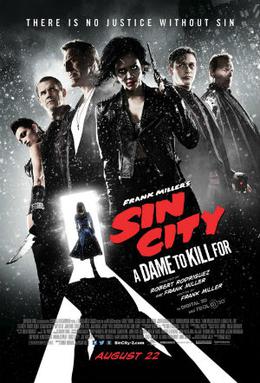
Sin City: A Dame to Kill For

In sordid Basin City, corruption and violence are a way of life. Johnny (Joseph Gordon-Levitt), a hotshot young gambler, rolls into town to challenge the powerful Senator Roarke (Powers Boothe) in high-stakes poker, but there is more than money up for grabs for both men. Dwight McCarthy (Josh Brolin), a repentant private detective looking to leave his old life behind, gets sucked back in when old flame Ava Lord (Eva Green) seeks his help. He knows she can only lead to trouble, but he just can’t help himself. Exotic dancer Nancy Callahan (Jessica Alba) is haunted by memories of Detective Hartigan (Bruce Willis), who sacrificed himself to keep her safe. Gradually losing her sanity, Nancy tries to find a way to avenge Hartigan by taking out the man responsible for his downfall: the untouchable Roarke. In the midst of all this stands Marv (Mickey Rourke), an unhinged bruiser who helps the innocent and punishes the guilty in supremely bloody fashion.

In 2005, director Robert Rodriguez staged a coup when he faithfully – and successfully – translated comic book writer Frank Miller’s paean to hard-boiled noir to the big screen. After a lengthy nine-year wait, this continuation continues to remain faithful to Miller’s vision albeit with less success this time around.

At first glance, the drop-off is puzzling. A Dame to Kill For retains many of the previous film’s key players (Rourke, Boothe, Alba, Willis, Rosario Dawson, and others return) with a few substitutions (Brolin for Dwight Owen, Dennis Haysbert for the late Michael Clark Duncan) and new faces (Green, Gordon Levitt, Christopher Meloni). It also retains the original’s style and sensibility, which is to say bleak, ultra-violent, and visually striking. But what was novel (a pitch-black digital underworld) in 2005 has lost a bit of its luster in 2014.

Another shortcoming here is the confusing continuity. Like its predecessor, a Dame to Kill For consists of loosely connected vignettes (the title story is taken from the comics; the others are new creations penned by Miller himself) that share characters and themes. Some are set prior to episodes in the first film while others take place several years later. Trying to keep up with who is supposed to be dead or alive or intact or disfigured at any given point becomes a laborious task.

The quality of the episodes themselves varies. In the title story, Brolin offers a different (re: less cool and composed, more struggling to keep it together) take on Dwight than Owen albeit not an inferior one. Williamson lends some more depth to the character Manute, a hulking-but-eloquent enforcer whereas Meloni’s casting echoes his most famous television-cop role. Green tries her damndest to pull off a stole femme fatale, but her French accent is occasionally distracting, and she seems too young to have such a sordid past. Rumored choices Angelina Jolie and Rachel Weisz may have fared better here.

Johnny’s tale – “The Long Bad Night” – is probably the strongest piece here. Gordon-Levitt turns in a strong performance as a cocksure young man who knows a lot more than he lets on. His antics win the admiration-turned-loathing of Roarke, which allows Booth to add a veneer of affability to what was previously a one-dimensionally malevolent character (the faux-chumminess actually makes him more dastardly). The episode also treats us to a rare, humorous Christopher Lloyd cameo as a degenerate back-alley doctor.

“Nancy’s Last Dance” features both some of the strongest acting and weakest plotting of the whole film. Nancy may expose herself for a living, but she is a complex, tormented character, and Alba shines in plumbing the depth of her guilt, self-awareness, and suffering. It’s also nice to see Willis back even if he’s only here for a brief appearance, and Rourke is having a blast as Marv. But the machinations of Nancy’s revenge are both overly simplistic (and insulting to her character development), and the hint of the supernatural the film drops toward the end undermines the payoff.

A Dame to Kill For satisfies on a visceral level with its stylish brutality, but it still comes across as a missed opportunity. Had it not taken so long to produce, had more of the original casting choices worked out, had Miller not entered a period of decline as a writer, this may have been on par with the original. Instead, it’s a somewhat disappointing – but still worthwhile – slice of sequeldom.


7.5/10

Monday, April 28, 2014

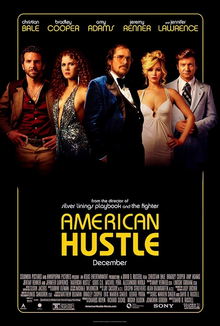
American Hustle

Con artists Irving Rosenfeld (Christian Bale) and Sydney Prosser (Amy Adams) are coerced by ambitious FBI agent Richie DiMaso (Bradley Cooper) into procuring additional arrests. They concoct a scheme to bribe Carmine Polito (Jeremy Renner), the good-natured mayor of Camden, NJ, using a fake Arab sheikh (Michael Pena). As the scheme grows to involve more money and the involvement of congressmen and mobsters, Irving and Richie feud over Sydney, and Irving’s jealous wife Rosalyn (Jennifer Lawrence) threatens to ruin everything.

Directed by David O. Russell and scripted by Eric Singer, this freewheeling take on the ABSCAM scandal boasts an impressive cast and an irrepressible sense of fun. Despite this, its bombast too often gets the better of it.

At its core, American Hustle is a study in contrasts. Irving may be an adulterous conman, but he operates with prudence and concern for those around him while DiMaso the crusading lawman is arrogant and unfettered. Both characters are done justice by their actors, especially Bale (who is nearly unrecognizable as a heavyset, balding New Yorker). Contrasts exist too among the female leads: the faux-English Sydney manipulates with class while wife and mother Rosalyn is ignorant and uncouth. While Adams’ accent is hit-or-miss, Lawrence continues to showcase her range, playing Rosalyn as abrasive and ditzy but not without sympathy. Other acting highlights include Robert DeNiro as a high-ranking Mafioso and Louis CK as DiMaso’s beleaguered boss.

While the banter between these combustible, diametrically opposed personalities is frequently funny, it also proves to be a distraction. ABSCAM was a complex scandal with massive ramifications. Amid the bickering and relationship drama, however, it occasionally comes across here as a mere background event. This makes the film’s infrequent moments of tense drama – such as Irving coming to grips with a broken friendship and marriage or DiMaso finally realizing just how badly he’s screwed up – tough to take seriously.

All told, American Hustle is a fun ride, but neither as well-crafted nor as memorable as its prodigious hype suggests.


7.75/10

Saturday, March 29, 2014

The Counselor


Impressed by the extravagance of his eccentric friends Reiner (Javier Bardem) and Malinka (Cameron Diaz), the unnamed counselor (Michael Fassbender), a successful criminal defense attorney, partners with cartel middleman Westray (Brad Pitt) to import drugs from Mexico. But when the deal goes bad, the counselor, his fiancée Laura (Penelope Cruz), and everyone around them find themselves in grave danger.

Perhaps more so than any film in recent memory, The Counselor is less than the sum of its parts. Written by one of America’s greatest living novelists (Cormac McCarthy), helmed by a tried-and-true director (Ridley Scott) and featuring an A-list cast, there is, on paper, no reason why this film shouldn’t work. And yet in practice, it simply doesn’t.

The blame rests almost entirely with its screenwriter. Part of what makes McCarthy’s novels – and No Country For Old Men, the most successful screen adaptation thereof – compelling is the juxtaposition of expansive landscape and minimalist dialogue. This allows for both a healthy dose of symbolism and for characters to define themselves through action. The Counselor, in contrast, is an overly talky film wherein characters eruditely wax philosophical mid-conversation for minutes on end. This robs the pacing of tension, the characters and their interactions of realism, and the audience of respect. Presumably, we would have recognized the film as a treatise on greed without being clobbered over the head with the idea.

Had someone – such as The Coen Brothers – been around to pare down the peachiness, what was left might well have delivered up to expectations. The film is well-shot, well-scored, and well-cast. The flashy wardrobes form a nice contrast with the stark desert landscapes, the unconventional soundtrack restores some of the lost tension, and the cast does its best with the material. Fassbender starts off as a slightly smug, coolly detached blank slate, but his emotional range grows as his circumstances worsen. Bardem arguably overacts, but in doing so, he injects a sense of fun while Pitt is appropriately cynical. The real surprises here are Diaz and Dean Norris. The former, usually a liability in dramatic fare, is chilling as the avaricious, panther-like Malinka, and the latter, as a drug buyer, does a hilarious 180 from his best-known role as a DEA agent on Breaking Bad.

Upon release, some criticized The Counselor for being both bloody and bleak. Those qualities are a given in McCarthy’s oeuvre. The greater sin here is that The Counselor confuses pedantry and pretension for enlightenment and entertainment.


7/10

Monday, September 23, 2013

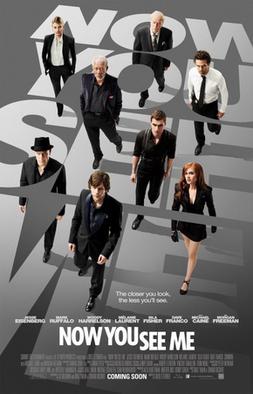
Now You See Me

Four magicians – illusionist J. Daniel Atlas (Jesse Eisenberg), his ex-girlfriend escape artist Henley Reeves (Isla Fischer), mentalist Merritt McKinney (Woody Harrelson), and sleight-of-hand expert Jack Wilder (Daniel Franco) are hired by an unknown party to pull off a complex scheme. Calling themselves the Four Horsemen, they create a highly popular act, which just so happens to coincide with a series of seemingly impossible high-profile robberies. This attracts the attention of magic debunker Thaddeus Bradley (Morgan Freeman), FBI agent Dylan Rhodes (Mark Ruffalo), and Interpol agent Alma Dray (Melanie Laurent). As the Horsemen’s act becomes more and more audacious and the investigators more and more determined to take them down, questions arise regarding what they are really after.

Caper films are nothing new, but Now You See Me comes across as a refreshingly original creation: an action-comedy-mystery….with MAGIC! Admittedly, a concoction that convoluted sounds like a recipe for failure. And yet because it balances those elements and changes gears quite fluidly, Now You See Me is more often than not a success.

Just as the Horsemen’s act is a team effort, so too are this film’s triumphs. Boaz Yakin’s script is fresh and funny. It drops hints and lays the seeds for numerous twists and turns without ever giving too much away. The lines are engagingly delivered by a seasoned cast. There are no slackers here, but Freeman’s jaded skeptic and Harrelson’s shameless horndog characters stand out. Louis Leterrier, primarily an action director, keeps the film moving. At no point does the film’s momentum grind to a halt.

Where Now You See Me suffers is in its conclusion. The contrived wrap-up resolves some lingering plot questions, but its reveal casts much of the film in a preposterous light. Too many by-chance happenings are passed off as the machinations of a master planner, and the blatant sequel hook is an insult to audiences.

To borrow from the magicians’ lingua franca, Now You See Me offers an intriguing setup and a fun performance but botches the prestige.


7.5/10

Monday, April 29, 2013

End of Watch


Brian Taylor (Jake Gyllenhaal) and Miguel Zavala (Michael Pena) are close friends and LAPD partners. Together, they patrol dangerous neighborhoods in South Central. Though they are hard-charging in their pursuit of criminals, Zavala is a dedicated family man and Taylor, a Marine veteran, lightheartedly videotapes their antics for a college film class. But when they cross paths with an up and coming Latino gang, their entire world will change.

If a movie made within the past fifteen years concerns cops or pseudo cops in Los Angeles, there is a good chance that David Ayer (and/or James Ellroy) is attached to the project. It is not surprising to learn that Ayer wrote and directed End of Watch. What is surprising, however, is the extent to which he challenges and deconstructs much of his previous work.

Typical Ayer fare gives us some combination of the following: very dirty cops, shoot-outs, a white-Latino partnership, a disturbed veteran, relationship drama, gang bangers, betrayal, and a downer ending. Many of these elements are here albeit reconfigured in very different ways. In lieu of the typical morally ambiguous anti-heroes, Taylor and Zavala are presented as wise-cracking good guys who, while rather aggressive, are also believably professional (i.e. they don’t shake down dealers or stage shootings and cover them up). They are also committed to their respective women, work closely with fellow officers, and generally behave like people instead of genre stereotypes.

Much of what allows Ayer the liberty to break from his prior work is the pseudo-documentary style in which the film is shot. Several scenes are presented from the perspective of Taylor’s camera, which gives the proceedings a naturalistic feel. The recorded musings, jokes, and anecdotes between service calls – Gyllenhaal and Pena have a mostly convincing rapport – provides a point of contrast to the horrors of the job. There is no overbearing score or overly cinematic mis en scene to contend with, but you never do forget that you are watching a fictional movie.

Unfortunately, the idiosyncratic style takes its toll on the film’s mood and pacing. While the former effect is probably deliberate (in that life can turn brutal in a heartbeat), the latter is often cloying. As viewers, when we see the clogs of the plot turning, we want them to keep turning. Too often, End of Watch pauses mid-turn, digresses, and arbitrarily skips ahead in time. The title also makes one aspect of the ending a foregone conclusion.

Ayer and the two leads put in commendable work here, and the distinctive style easily separates End of Watch from other police/action fare. But in the end, the execution falls short of the audacity of the approach.

7.75/10

Sunday, February 17, 2013

Thief


Frank (James Caan) is a veteran jewel thief who fronts as a car dealer. After his fence unexpectedly dies, he is recruited by mob boss Leo (Robert Prosky) to perform a difficult, high-value heist. Though Frank is hesitant, he sees the take as a way to retire with his girlfriend Jesse (Tuesday Weld) in peace. However, it isn’t long before he’s attracted unwanted attention from corrupt police officers and his plans are put in jeopardy.

This 1981 adaptation of jewel thief Frank Hohimer’s Confessions of a Cat Burglar served as Michael Mann’s directorial debut, and while he would go on to bigger and better things, Thief serves as the genesis for Mann’s trademark style. Like much of his later work (Heat in particular), Thief is steeped in gritty realism and visually striking. Hohimer and other real-life thieves served as technical advisors, and Dennis Farina (then still a Chicago police detective) plays a small supporting role. The result is that everything from Frank’s cagey demeanor to the tools he uses seems authentic.

Mann also debuts some signature touches (an important, character-establishing conversation in a coffee shop, police tracking a vehicle on a highway at night, etc.) that will be familiar to fans of his work. Even the synth-heavy soundtrack (courtesy of Tangerine Dream) serves as a prelude of sorts to Jan Hammer’s successful Miami Vice theme. From a production standpoint, you would have a hard time telling this is a debut film: everything is masterfully handled.

But while Mann’s style is still easy to appreciate 30+ years later, other aspects of the film fall flat. The plot is nothing if not predictable, and there are no likeable characters here. We are supposed to take Frank (who longs for retirement and family) as an antihero, but even in this morally ambiguous capacity, his volatility, bigotry, and selfishness make him hard to get behind.

The acting is likewise uneven. Caan fills Frank’s shoes with gusto and delivers a credible performance in the lead while Prosky brings both literal and figurative weight to the villainous Leo. The third-best performance may very well belong to Willie Nelson, who appears briefly as Frank’s ill, imprisoned compatriot. On the other hand, James Belushi is ineffectual and miscast as Frank’s sidekick, Barry. Weld, meanwhile, proves herself to be her generation’s Cameron Diaz, stumbling through an empty performance as the clueless Jessie. The rest of the supporting characters – be they cop or criminal – are clichéd and one-dimensional.

At its core, Thief is an 80s B movie elevated by the technical prowess of its makers. This makes it worth a look as both an artifact and a way to pass the time, but it lacks the complete package feel of Mann’s later works.

7/10

Friday, January 18, 2013

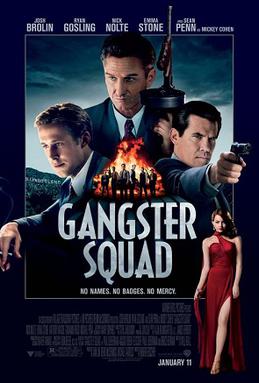
Gangster Squad


In postwar Los Angeles, New York-born Jewish gangster Mickey Cohen (Sean Penn) looks to solidify his grip over the city’s underworld. His ruthless methods lead police chief Bill Parker (Nick Nolte) to retaliate with some ruthlessness of his own. Parker tabs World War II vet Sgt. John O’Mara (Josh Brolin) to recruit an off-the-books squad to take Cohen down. Among the recruits are knife expert Coleman Harris (Anthony Mackie), gunslinger Max Kennard (Robert Patrick) and his protégé Navidad (Michael Pena), and surveillance man Con Keeler (Giovanni Ribisi). O’Mara’s friend and fellow veteran Jerry Wooters (Ryan Gosling) joins the mix later, but he brings a complication: he’s involved with Cohen’s moll Grace Farraday (Emma Stone).

I wanted to like this movie. I really did. James Ellroy’s L.A. Confidential is one of my favorite books and movies and L.A. Noire is one of my favorite video games. Combine that creatively fertile Los Angeles gangster milieu with an A-list cast, and Gangster Squad should have been a sure thing. Instead, the lackluster results are almost as much of a crime as anything you see on the screen.

Comedy director Ruben Fleischer makes for an easy scapegoat, but from a technical standpoint, he doesn’t disappoint. His cinematic L.A. is both ritzy and sordid, and it’s loaded with convincing period detail. While the film is quite violent, Fleischer avoids Tarantinoesque overkill and gives us some fairly suspenseful shootouts and car chases.

No, the real culprit here is Will Beal’s screenplay. Like The Untouchables, this film is ahistorical and overly simplified, but it lacks the former’s class. Most of the characters here are one-dimensional and thinly developed, the opening and closing narration is laughably bad, and the ending is downright inane (if also predictable). Such formulaic fluff might be acceptable for a network TV show, but it’s utterly disappointing to see in a big-budget movie.

Given the constraints, the cast at least tries. Penn in particular imbues Cohen with seemingly limitless ambition, avarice, and savagery. Kudos also go to Gosling, who is able to change from frivolous playboy to deadly avenger in the blink of an eye. Brolin comes across as wooden in the lead role though, and Stone’s talents are egregiously wasted.

On its own merits, Gangster Squad is watchable and occasionally even entertaining. But it’s a mere shadow of what it could have been.

7/10