Showing posts with label Documentary Films. Show all posts

Thursday, October 10, 2013

Metallica: Through the Never


While Metallica plays to a sold-out crowd, hapless young roadie Trip (Dane DeHaan) is sent across town to retrieve a mystery item from a disabled truck driver. Along the way, he undergoes a nightmarish journey and must escape the clutches of a mob led by a sinister masked Horseman.

Directed by Nimrod Antal, Through the Never is a tale of two movies. As a concert film, it works wonderfully in showcasing that the 50ish rockers still have it. The band plays its A-material (“Master of Puppets,” “One,” “Creeping Death,” etc.) with aplomb and looks and sounds good doing it. You don’t even need to be a Metallica fan (though it certainly helps) to appreciate it, either: the band plays with enough infectious energy to bring out the headbanger in all of us. Were this the entirety of the proceedings, Through the Never would be a solid hit.

As a concept film, however, it is a dismal failure. First and foremost, its concept is poorly defined. The mob battles the cops, suggesting a vaguely anarchist agenda, but don’t go looking for a coherent philosophical vision here. Nothing in Trip’s journey makes a lick of sense, and that appears to be very much by design. In addition, while there are few dull moments, the utter stupidity and lack of purpose make all the flying fists and fire difficult to enjoy even on a visceral level. Every cool-looking visual serves as a reminder of how little substance there is behind the style.

Alas, because of the constant alternation between the two threads, one must take the bad with the good. That’s a real shame because if the band had either excised Trip’s odyssey entirely or actually bothered to flesh it out, we would be looking at The Wall for the Millennial Generation. Instead, we are left with a frustratingly pointless mess with an above-average soundtrack (which, perplexingly, does NOT include the title song).


6.25/10 

Sunday, February 24, 2013

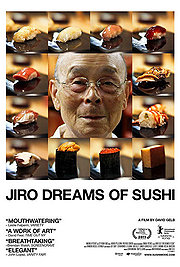
Jiro Dreams of Sushi


Eighty-five-year-old Jiro Ono is the world’s foremost sushi chef. Despite his age and years of experience, Jiro remains steadfastly dedicated to his craft. This ethic has rubbed off on his apprentices and children. Younger son Takashi has successfully opened his own restaurant while older son Yoshikazu waits patiently to take up his father’s mantle.

Directed by David Gelb, this 2011 documentary is a study in obsession. There is no better word to describe its subject: a man who started working as a child and vows to continue as long as he is physically able to. By his own admission, this has made Jiro a stern master and an absent father. It has allowed his dream – sushi perfection – to consume not only his life but, tragically, that of his children as well.

Despite this, the film never brands Jiro as a villain. He is shown to be an excellent teacher who inspires success in others (one apprentice could barely suppress his joy at winning Jiro’s praise). And for all of his apparent traditionalism, he also has a nonconformist streak. At one point, he finds himself questioning what advice he could give to future generations when his own path to success was long on years and short on education.

Knowing that there is more than meets the eye to Jiro helps explain the odd phenomenon that is his restaurant. A small establishment tucked off a Tokyo street, it seats only ten and offers absolutely no frills (not even appetizers). Despite this, it offers the exclusivity one would expect from a Michelin-rated three-star eatery: reservations must be made at least a month in advance, and meals start at an exorbitant 30,000 yen (about $260). This makes the proprietors’ frequent claims that “It’s not about the money” a little difficult to take.

With such a captivating subject at its core, Jiro Dreams of Sushi didn’t need a lot of cinematic embellishment, and Gelb wisely avoided an elaborate production. A Philip Glass soundtrack and English subtitles are the only reminders that you are even watching a professionally made film. The focus here is on the documented, not the documenter.

For those with no knowledge of or affinity for Japanese cuisine, Jiro Dreams of Sushi may seem inaccessible, despite the magnetism of its star. But anyone who has ever had a good piece of toro or unagi will appreciate (and perhaps pity) Jiro’s relentless quest for perfection.

8/10

Saturday, June 23, 2012

F for Fake


Directed, written, and narrated by Orson Welles, this 1974 pseudo-documentary studies the nature of authenticity by looking at people known for deception. Subjects include renowned art forger Elmyer de Hory, his biographer (and the author of a fraudulent biography of Howard Hughes) Clifford Irving, Welles’ companion Oja Kodar, and, ultimately, Welles himself.

The last completed Welles film, F for Fake is less a documentary than it is a visual essay on authenticity, credibility, authorship, and artistic values. At its best, it is clever, amusing, and incisive. At its worst, it is self-indulgent, pretentious, and incoherent. And if it seems like it should be two films, that’s because it really is. The project began with a straightforward documentary of de Hory by Francois Reichenbach, which Welles then expanded and put his creative stamp on. Whether this would have fared better in its original format depends on your preferences, but it certainly would have been less interesting.

What stands out most here is the film’s style. Welles and collaborator Gary Graver did a masterful job of editing, weaving the interview segments, historical images, and a jazzy Michel Legrand score into a kinetic, fluid whirr. Though the film preceded the MTV generation, it seems right at home with more contemporary efforts.

In terms of content, the film boasts a quirky cast of characters. De Hory comes across as sagacious and likeable as he and Welles exchange some well-deserved shots at the art establishment (The former at one point boasts that he never offered a forged painting to a museum that didn’t buy it). Irving, who writes off de Hory as delusional, seems as smarmy as he does skeptical. Interestingly, Welles constantly reminds us of his own inauthenticity: he opens the film by performing magic tricks, and he harkens back to his War of the Worlds days by recreating his faux news broadcast of an alien invasion.

The film decisively jumps off the rails at the one hour mark, after which Welles relinquishes any claim to the events being true. Kodar features heavily in these final segments, and she’s often shown in a needlessly voyeuristic light (one piece has Pablo Picasso lusting after her from afar). This last third begins amusingly, but it eventually becomes overwhelmingly bizarre and indifferent to the concerns of the audience. It was as if Welles grew bored with the film he was making and decided to shoot some esoteric exchanges with his girlfriend instead.

Thankfully, for as jarring as these end parts are, they do not sink the film as a whole. If you are willing to forgo a traditional narrative, F for Fake will reward you with its quirks, perceptiveness, and technical prowess, and that is the truth.

8/10

Saturday, March 5, 2011

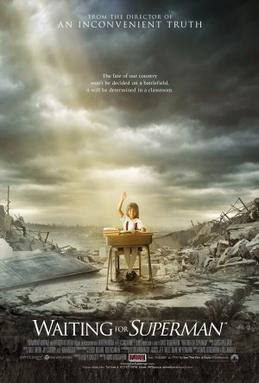
Waiting For "Superman"

This 2010 documentary from Davis Guggenheim examines the failures of the American public education system. The lives of several students and their families are explored, and prominent figures in education are interviewed.


The state of our schools is not something that can be fully explored in a two-hour movie, but Waiting For “Superman” serves as an excellent starting point. It pulls no punches, rightly assigning blame to change-resistant, accountability-shy teacher unions and their political surrogates who believe the solution to everything is “more money!” For that, it was savaged. Interestingly enough, Guggenheim is not a free marketer, but a political progressive. He is perhaps best known for the paean to climate change advocacy that was An Inconvenient Truth.


Of course, Waiting For “Superman” still could have been a failure even if it hit all the right philosophical notes. Either a dry-as-dust presentation or a mega-dose of bombast would have alienated the viewer. Thankfully, the even-voiced Guggenheim picked his spots carefully. Standouts include the charismatic Geoffrey Canada, founder of the Harlem Children’s Zone, and Michelle Rhee, the no-nonsense former Washington D.C. schools chief whose courageous push for merit pay for teachers sparked a firestorm of controversy. There is also a look at New York City’s infamous “rubber rooms” (where bad teachers are sent in lieu of being fired) and an emotional closing montage of lotteries that determine placement in successful charter schools. The pacing is inconsistent at times, but the slow moments are never long or numerous enough to make you want to give up.


Because of the weight given to the charters, some have criticized the film as offering them up as an idealized solution. It’s a fair point, but, in the scheme of things, also a minor one. Waiting For “Superman” does not – and should not – attempt to provide all the answers when it comes to education, but it at least asks the right questions. That alone makes it worth watching.


8/10