Showing posts with label Drama Films. Show all posts

Thursday, May 29, 2025

The Brutalist


Laszlo Toth (Adrien Brody), a Hungarian-Jewish architect and Holocaust survivor, immigrates to the United States, hoping to one day reunite with his wife Erzsebet (Felicity Jones). Laszlo is taken in by his cousin Attila (Alessandro Nivola), a Philadelphia furniture store owner who has assimilated and married a Catholic woman, Audrey (Emily Laird). Through Attila, Laszlo meets the wealthy industrialist Harrison Van Buren (Guy Pearce), who becomes his patron and helps Erzsebet and their niece Zsofia (Raffey Cassidy) emigrate. Despite this turn in fortune, Laszlo’s uncompromising nature, the toll of the Holocaust’s suffering, and the jealousy of Van Buren’s son Harry (Joe Alwyn) threaten to be his undoing.

It would seem ironic that a movie about an architectural movement that values minimalism clocks in at three and a half hours, but The Brutalist is every bit as thoughtfully crafted – and divisive – as its inspiration. Directed by Brady Corbett (who co-wrote the script alongside his partner Mona Fastvold), The Brutalist avoids being dragged down by its length and the familiarity of its premise thanks to strong performances and impeccable design.

Taking a sledgehammer to the American Dream wouldn’t have been a fresh take thirty years ago, and it certainly isn’t one now, but the way that Corbett does so here is still resonant (as is the film’s exploration of anti-Semitism). Through Toth and Van Buren’s relationship, he casts a withering eye on America’s treatment of immigrants: happy to accept them as long as they can claim credit for supporting their successes and obsessed with the idea that they don’t forget their place in the pecking order. And while Toth has shades of The Fountainhead's Howard Roark, Corbett does not idealize him, showing him as prone to angry outbursts and self-abuse.

Brody once again scored an Oscar for portraying a tormented Holocaust survivor, and it isn’t hard to see why. He conveys not only pain but outrage and devotion, all with conviction. Jones’s role is no less challenging: an Oxford-educated journalist working below her talents as her body fails her and her husband becomes a stranger before her eyes. She’s quite good in it, and it’s a shame that she isn’t on screen longer. While high-handed antagonists are definitely in Pearce’s wheelhouse, he gives the elder Van Buren enough complexities and contradictions to make him interesting despite his veiled monstrousness. The same cannot be said for Alwyn as his son, a one-note entitled creep. And while Nivola isn’t really bad as Attila, his inconsistent accent is distracting. We’re supposed to imagine a Philadelphian who’s trying too hard to cover up his Ashkenazi roots, but instead we get what amounts to a Boston guy who occasionally remembers he’s an immigrant.

The film’s look and sound at least do no wrong. The Brutalist is filmed in old-school VistaVision (think mid-1950s Paramount films) for a retro look. It oozes style thanks to cinematographer Lol Crawley (sharp-angled shots that allow the architecture to loom godlike over the cast) and production designer Judy Becker. Daniel Blumberg’s score mixes classical with industrial to mimic construction sounds and add tension.

Given how measured much of The Brutalist is, it isn’t surprising that some critics have taken its precision for hollowness, an impression amplified by the runtime. But this is not a case of aesthetics papering over emptiness. Just like the architecture it depicts, there is meaning in the seemingly cold and impersonal for those willing to see it.


Monday, July 17, 2023

Asteroid City


In the 1950s, a television host (Bryan Cranston) introduces an adaptation of the play Asteroid City by esteemed playwright Conrad Earp (Edward Norton). Set at a military science installation in the desert, the play is centered on a Junior Stargazer convention to honor the inventive wizardry of a group of teen geniuses. They are joined by their parents - the emotionally numb war photographer and recent widower Augie Steenbeck (Jason Schwartzman), the famous yet guarded actress Midge Campbell (Scarlett Johansson), and others – as well as June Douglas’s (Maya Hawke) elementary school class, singing cowboy Montana (Rupert Friend) and his band, the astronomer Dr. Hickenlooper (Tilda Swinton), Augie’s disgruntled father-in-law Stanley (Tom Hanks), a motel manager (Steve Carell), and General Gibson (Jeffrey Wright), who is overseeing the convention. Another arrival (from the skies) upends the status quo for everyone. Meanwhile, amid scenes from the play, the playwright and lead actor foster a relationship while the director (Adrien Brody) loses one.


Wes Anderson’s latest film bears many of his trademarks: precocious yet alienated kids, nostalgia, a huge ensemble cast, an Alexandre Desplat score, and a distinctive visual style (the play scenes are in bright, highly saturated color while the frame story/interludes are in sharp black and white). To this, he adds hearty doses of retrofuturism, pandemic quarantine metaphors, and metatextual commentary on the process of creation. It is, like most of Anderson’s oeuvre, divisive (one person’s artistry is another’s puzzling pretension), and, truth be told, less than the sum of its parts, but for anyone with any appreciation for Anderson’s usual tricks, there is still a lot to like here.


For starters, the film handles its insanely talented cast well. Even the smaller roles are memorable and distinctive (a barely recognizable Carell fills in for a missing Bill Murray). These include all of the above plus Matt Dillon as a mechanic of questionable competence and Margot Robbie (barely recognizable as well) as an actress whose scene was cut. In some cases, the casting gleefully subverts expectations: Swinton, who so capably portrays an ice queen, is warm and encouraging as she bonds with the stargazers while the oft-genial Hanks gives Harrison Ford a run in the grumpiness department. The constant deadpanning is a source of humor (along with recurring visual puns like a never-ending police chase and a Looney Tunes-appropriate roadrunner), but though many characters are exaggerated in one way or another, those with the greatest presence also have the greatest complexity. Schwartzman plays Augie as enigmatically detached yet Augie’s actor Jones Hall in his usual anxious manner, trying desperately to find an “in” into the character. Johansson’s Midge, the subject of exploitation as well as adulation, is deeply unhappy despite her fame.


While the quirky characters and the striking aesthetics are enough to hold our attention, Asteroid City is narratively underbaked. The circumstances that bore it (COVID quarantine and its resulting detachment) left an imprint on the production, but the film never really rises to full-on satire. While the interlude scenes provide context for the audience, they also rob the play-within-the-movie of scenes that may potentially help it gel. Perhaps as an overcorrection, the cast awkwardly chants a mantra at the end. “You can’t wake up if you don’t fall asleep” isn’t an unworthy message though the delivery leaves something to be desired.


Asteroid City will not win over any Wes Anderson converts and may even test the patience of his fans, but it is worth seeing for the cast alone. It may not hold up to a lot of scrutiny, but then again, neither did the Atomic Age sci-fi that it artfully evokes.

Friday, March 5, 2021

Judas and the Black Messiah


In the late 1960s, petty criminal Bill O’Neal (Lakeith Stanfield), arrested and facing prison time, is recruited by FBI agent Roy Mitchell (Jesse Plemons) to infiltrate the Illinois chapter of the Black Panthers and get close to its leader, Fred Hampton (Daniel Kaluuya), whom the bureau has designated a threat. The closer that O’Neal gets to Hampton and his inner circle, the more money – and pressure – he receives from Mitchell to keep gathering intelligence…and worse.


Historical dramas are, sadly, too often staid and predictable affairs. Even when the performances do the subjects justice, the storytelling often follows a familiar arc. Kudos then to writer/director Shaka King and his collaborators Kenny and Keith Lucas for delivering an inspired-by-fact film that is powerful and full of tension.


Though the title suggests a simplistic morality, Judas and the Black Messiah is full of complex, multilayered performances. Kaluuya is charismatic and commanding as the young revolutionary Hampton, doomed to be murdered by police during a raid, a man given to both inspirational speeches and cult-like indoctrination alike. As O’Neal, Stanfield is quick-witted and increasingly (and intensely) conflicted, a sympathetic take on a treacherous and selfish figure. Plemons, who is well-versed in playing characters a great deal more dangerous or competent than they initially appear, gets a change of pace here. The manipulative Mitchell has enough of a conscience to be disturbed by his superiors’ nefarious COINTELPRO tactics yet lacks the will and introspection needed to affect change. That said, while Martin Sheen under heavy makeup brings name recognition and the requisite note of menace to J. Edgar Hoover, he feels miscast in a brief role that is more caricature than character.


Were Spike Lee in the director’s chair, Judas and the Black Messiah may have featured a number of awkward cuts to contemporary racial justice protests. Instead, King wisely trusts his audience to implicitly make these connections and keeps his film largely grounded in time and place, marking it as a period piece with resonance rather than a grand treatise on race and injustice some had hoped for. If nothing else, it is both more affecting and more interesting than many movies set during the same turbulent era, and it shows us that just because the outcomes are preordained, our response to and understanding of them needn’t be.


Wednesday, February 3, 2021

The Little Things


Joe Deacon (Denzel Washington) is a Kern County sheriff’s deputy. Previously a Los Angeles homicide investigator, his commitment to his last case led to a heart attack and a divorce. Dispatched back to LA to collect evidence, Deacon joins Jimmy Baxter (Rami Malek), a LASD detective who is investigating a series of murders reminiscent of one of Deacon’s old cases. With the FBI poised to take over the investigation, Deacon and Baxter make one final push to solve it. Will Deacon’s mentorship give Baxter the boost he needs or lead him down the same self-destructive path?


Writer/director John Lee Hancock first conceived of The Little Things decades ago, and it shows. Not only does it have the feel of a 1990s crime thriller, but it also echoes several films in the genre. The opening cat-and-mouse car chase down a darkened California highway calls to mind a particular scene in Zodiac while pieces of Se7en, The Pledge, and Insomnia also seem embedded in this film’s DNA.


Given the cast involved, one can be forgiven for expecting the performers to elevate the material. Sadly, for the most part, they don’t. Washington, the lone exception, is excellent, as usual. When we first see Deacon, he seems affable enough and at ease with his new role, but the more time the film spends with him, the more apparent that he is still an obsessively driven mess. As Baxter, Malek is subdued to the point of blandness for most of the film before taking a turn toward the end. The third Oscar winner of the bunch, Jared Leto, shows up as prime suspect Albert Sparma, a long-haired weirdo who delights in trolling the investigators. It’s a distractingly showy performance, and the character comes across as an obvious red herring.


Derivative as it may be, The Little Things is mostly competently, if unremarkably, made. It’s atmospheric, boosted by a tense Thomas Newman score. The last third sees Hancock try to move beyond genre cliches to probe the psychological toll the investigations have exacted on the investigators, but the film does so in a rather convoluted way.


All told, The Little Things offers a few bright spots for genre fans, but it is also far more forgettable than its assembled talents suggest it should be.


Wednesday, December 23, 2020

Sound of Metal


When metal drummer Ruben (Riz Ahmed) suffers sudden hearing loss, it threatens his livelihood and upends his life, placing the former heroin addict at risk for a relapse. His girlfriend and bandmate Lou (Olivia Cooke) convinces the reluctant Ruben to stop performing and stay at a rehab facility for the deaf run by Joe (Paul Raci), a deaf Vietnam vet and recovering alcoholic. Ruben bonds with others in the deaf community while saving up for cochlear implants to restore his hearing, which puts him at odds with Joe, who rejects the idea that deafness is a disability.


Writer Darius Marder’s directorial debut has the ring of truth to it thanks to inspired sound design and a strong lead performance. The film fluctuates between louder and quieter and between clearer and more garbled relative to Ruben’s hearing, simulating deafness for a hearing audience. This, coupled with the use of ASL (Raci, the son of deaf parents, is a certified sign language interpreter) and deaf actors in supporting roles, paints a realistic picture of living with deafness in contrast to the patronizing “inspirationally disadvantaged” clichés. It’s a depiction furthered by Ahmed’s transformative performance. Lanky, bleached blond, and tattoo-covered, he imbues Ruben with both trepidation and determination, the fear of losing everything as well as the will to prevent it from happening.


While Sound of Metal’s dialogue is a bit stagey at times (and Joe’s spiel is as preachy to the audience as it is to Ruben), the film’s biggest liability by far is its sluggish pace. Sadly, this does not come as a surprise given the creators involved. Marder is again collaborating with Derek Cianfrance, for whom he wrote The Place Beyond the Pines, which managed to make a heist film boring. Yes, this is a character study, and yes “savor the quiet moments” is very much the film’s point, but the lack of momentum, coupled with underdeveloped secondary characters (Cooke does good work in limited screentime, but Lou's family drama feels tacked-on), are very nearly the film’s undoing.


All told, Sound of Metal is neither an easy nor a particularly enjoyable film to watch, but its intentions as well as Ahmed’s top-notch work make it worthwhile.


Thursday, May 7, 2020

The Lighthouse


In the late 1800s, Ephraim Winslow (Robert Pattinson) takes a contract job as an assistant lighthouse keeper on a remote island off the New England coast. The head lighthouse keeper, Thomas Wake (Willem Dafoe), is a demanding, unhygienic, boastful drunk. Winslow is also tormented by a one-eyed gull who seems to mock him at every turn. After learning about each other’s pasts, Winslow and Wake begin to get along better. However, the menace of a storm threatens to destroy their rations, their truce, and, ultimately, their sanity.

Directed by Robert Eggers (The Witch) and written by his brother Max, The Lighthouse is an exacting film that commands respect though not necessarily admiration. Ostensibly inspired by Edgar Allan Poe’s last story (“The Light House”), the film also takes cues from Melville and Coleridge, Greek mythology, the historic Smalls Lighthouse Tragedy, and, at least tonally, Lovecraft. It’s awash in symbolism that is refracted through Winslow’s dreams and hallucinations, some of which are revelatory (i.e. a vision of Wake’s one-eyed previous assistant - reincarnated in the gull, perhaps?) and some of which are just unsettling (giant octopus tentacles and mermaid sex). For every meaningful detail imparted, however strange or disturbing, The Lighthouse seems content to also offer us random shrieks and shouts and nonsense.

Questionable editing aside, The Lighthouse is aesthetically striking, and its two leads fully embrace their challenging roles. Eggers shot in black and white on 35-mm film to give the movie a vintage look, and Mark Korven’s score makes good use of appropriately ominous droning. As Wake, Dafoe sounds like the Sea Captain from The Simpsons with a puffed-up lexicon. He’s a grotesque and pathetic figure, equal parts controlling (he refuses to let Winslow anywhere near the lantern room) and desperate for approval. Speaking of desperation, a lean, Maine-accented Pattinson gives Winslow a past-haunted, repressed-violent quality that is evident even before his sanity starts to fray. It isn’t to Jack Nicholson in The Shining levels of crazy-gone-crazier, but it does lend tension to the abuse and misfortune that he endures in a subservient role in the film’s early going.

Thematically and symbolically rich and skillfully crafted, The Lighthouse is nearly undone by its excesses, but it’s still worth watching even if the experience makes you never want to watch it again.

Friday, April 17, 2020

Parasite


The Kims are a poor family struggling to make ends meet. Min (Park Seo-joon), a college student and friend of Ki-woo Kim (Choi Woo-Shik), recruits the latter to take over for him as an English tutor for Da-hye Park (Jung Ji-so), a high school student from an upper-class family. After getting his sister, Ki-jung (Park So-dam), to forge university credentials for him, Ki-woo is hired by the Da-hye’s gullible mother, Yeon-gyo (Cho Yeo-jeong). Ki-woo, now answering to “Kevin,” begins a secret romance with Da-hye and talks Yeon-gyo into hiring his American-educated cousin “Jessica” (actually, Ki-jung) as an art therapist for her young son, Da-song (Jung Hyeon-jun). Before long, the Kims have inserted themselves into the Park household, using underhanded means to get rid of existing servants who stood in their way. However, their scheming threatens to come back to bite them.

As 2013’s underrated Snowpiercer demonstrated, director Bong Joon-ho has a knack for visually striking cross-genre filmmaking laced with social commentary. While Parasite is a very different film, it carries on in that same tradition. Unfortunately, its critical acclaim and subsequent backlash have complicated a discussion of the film’s merits, which is almost as much of a robbery as what’s depicted on-screen.

Parasite begins as a dark comedy before morphing halfway through into a tense thriller and, ultimately, a tragedy. These tonal shifts can be jarring, but they make for an experience that is more than the sum of its parts. It also helps that the cast does a great job of shifting gears. As Mr. Kim, Song Kang-ho spends the first half of the movie as a shrewd but utterly shameless (albeit amusing) bum only to later settle into nihilism and regret. He’s matched by Jang Hye-jin as Mrs. Kim, an acid-tongued woman posing as a kindly housekeeper, and by Lee Jeong-eun as her predecessor in that role, a seemingly dutiful matron harboring a huge secret.

Though this film doesn’t match Snowpiercer as a visual spectacle, it still benefits from tight editing and aesthetics that reinforce the class divide. The Kims’ semi-basement apartment is small and cramped while the Parks’ house is large, bright, and airy. So too does a picturesque sunny day contrast with vicious rain the evening before as one family’s cause of celebration is another’s reminder of loss.

Given this unsubtle treatment of theme, it would be tempting to read Parasite as a work of eat-the-rich resentment in the vein of Joker, but to do so would be to ignore the complexities at play here. The Kims’ situation renders them sympathetic, but they are also liars and predatory schemers who screw over even other working-class folks. On the other hand, with the exception of Mr. Park (a condescending snob), the Parks are nice people, but, as Mrs. Kim notes, this is because they can “afford to be.” Ultimately, it is the film’s refusal to stereotype its characters that elevates it from predictable propaganda into more engaging fare.

Saturday, November 30, 2019

The Irishman


From a nursing home, an elderly Frank Sheeran (Robert DeNiro) recounts his involvement in the American underworld. A World War II veteran and truck driver, Sheeran begins selling stolen wares to the Philadelphia mob before graduating to arson and finally “painting houses” or murder-for-hire. As his star rises, he abandons his first marriage, becomes more active in his local union, and befriends two very powerful figures: Scranton mafia boss Russell Bufalino (Joe Pesci) and Teamsters president Jimmy Hoffa (Al Pacino). Though allied at first, Hoffa and the mob have a falling out, which puts Sheeran uncomfortably in the middle. Years later, predeceased or abandoned by everyone once close to him, he divulges the missing labor leader’s fate.

The first Scorsese-DeNiro-Pesci film in nearly a quarter-century (and the first Scorsese-Pacino pairing ever), The Irishman should have been the kind of film that studios salivate over, but instead, its production was nearly as long and tortured as the story it depicts. First, there are plenty who are skeptical of Sheeran’s account, which came to light when his lawyer, Charles Brandt published it as the book I Heard You Paint Houses in 2004, the year after Sheeran died. Next, it took a considerable amount of cajoling to bring Pesci out of retirement. And then, no studio wanted to foot the bill for the special effects needed to digitally de-age the leading trio of septuagenarian actors. Thus, what would have been a leading Oscar contender in bygone days became a delayed Netflix release.

This ignominy aside, however, The Irishman is a thing of beauty to behold aesthetically, dramatically, and narratively. Scorsese’s eye for period detail remains very much intact as he and his collaborators recreate the look and feel of the Kennedy and Nixon eras. The soundtrack is thoughtfully curated as well, but in place of Goodfellas’ Eric Clapton-backed murder montage or Casino’s operatics, The Irishman’s pivotal moment – the drive to pick up an unsuspecting Hoffa on the day of his final meeting – is marked by silence.

The choice to go quiet instead of loud is a mark of maturity, and it’s one that extends to the film’s themes. Previous gangster fare has a tendency to glamorize its subjects no matter how vicious it ultimately reveals them to be, and Scorsese’s films have been no exception. Henry Hill may have fallen from grace by the end of Goodfellas, but that he was able to thumb his nose at being a solid citizen says something about the lofty perch he once occupied. Sheeran, however, is denied even this fleeting sense of nostalgic grandeur. By the end of The Irishman, he is in failing health and truly alone. One can take issue with how little screen time women have in the film – Anna Paquin, as Sheeran’s disapproving daughter says maybe a dozen lines – but they nevertheless serve as a powerful rebuke to the idea that Sheeran’s way of life was for some family-affirming greater good.

Given the cold nuance of the film’s approach, a cast best known for showy performances (to put it lightly, in Pacino’s case during the past two decades) would seem a strange fit, but Scorsese evidently commands enough respect to get the most out of his performers, and in turn, they remind audiences of what they were capable of before they reached the point of self-caricature. DeNiro, who is of average height, captures the much-taller Sheeran’s shambling movements, his soldier’s stoicism, and the hints of anguish that peek through the veneer all quite believably. As the charismatic yet belligerent Hoffa, Pacino gets to do his fair share of yelling, but the performance is far from one-note. He captures the man’s vanity and bigotry as well as his amiability toward children and belief in the righteousness of his cause. Perhaps the biggest surprise here is Pesci, best known for playing corrosive, diminutive psychopaths who immeasurably complicate the lead gangsters’ lives. Instead, he plays Bufalino as shrewd and calculating, a man whose quietly whispered request could have ten times the impact of one of Tommy Devito or Nicky Santoro’s worst outbursts. Ironically, the specter of Pesci’s past roles shows up here in the form of Anthony “Tony Pro” Provezano, a short-but-volatile mobster whose prison contretemps with Hoffa fuels much of the second-half conflict. Tony Pro is played without an impeccable accent by the Englishman Stephen Graham in a turn that calls to mind his Boardwalk Empire work (as a young Al Capone) minus any hint of likeability.

For all these strengths, however, The Irishman does have several noticeable faults. For starters, it is very long, even by the standards of gangster epics. The three-and-a-half-hour runtime and leisurely pacing demand patience, and even the committed will find themselves wondering if Thelma Schoonmaker (Scorsese’s longtime editor) couldn’t have trimmed fifteen minutes or so. The much-discussed de-aging technology is also a miss albeit not a catastrophic one. DeNiro never looks any younger than his mid-40s even when Sheeran is supposed to be, and it is difficult to buy Pacino seeming even that young.

A gripping exploration of the mythology of midcentury American power and the corruption that underpinned it told through the eyes of a bloody-handed fixer, The Irishman is a slow but masterfully executed assault on the very idea of innocence. If this is the last time that Scorsese gets to work with any of these leads, then the film, like a rival cab company that Sheeran sees to, is going out with a bang.

Monday, April 30, 2018

Detroit

In 1967 amid Detroit’s 12th Street Riots, police officers led by Phil Krauss (Will Poulter) descend upon the Algiers Motel in response to shots supposedly fired their way. In their attempt to identify the shooter, they subject the motel’s occupants – a returning Vietnam War veteran (Anthony Mackie), members of an R&B band (Algee Smith and Jacob Lattimore), and two white girls (Hannah Murray and Kaitlyn Dever) – to increasingly abusive and terrifying interrogations. Melvin Dismukes (John Boyega), a security guard, is uncomfortably caught in the middle.

Directed by Kathryn Bigelow and written by Mark Boal (the team behind Zero Dark Thirty), Detroit is a polarizing film both in terms of its treatment of history and its creators’ stylistic and narrative choices. What it does well it does exceedingly well, but that strength comes at the expense of nearly all else.

As should come as no surprise for fans of Bigelow’s work (see The Hurt Locker), Detroit is an extremely tense film. The film’s long, brutal interrogation sequence is unflinching, unglamorous, and uninterrupted by either music (arguably a waste of James Newton Howard’s talents) or Hollywoodized false hope. It grabs audiences and makes them feel as uncomfortable as the beleaguered motel patrons, a relevant and resonant move given contemporary worries about police tactics.

Unfortunately, this comes at the expense of diminishing both character development and the film’s conclusion. Poulter stands out as a rabid, paranoid, violent cop who is nevertheless assured that he is in the right, but other actors aren’t given enough to work with – it’s hard to build layers of character when most of your screen time calls for you to either casually drink or look scared. Moreover, because the motel scenes take up so much of the film’s nearly two and a half hour run time, the aftermath, which is supposed to make us feel the repercussions of the damage done, instead comes across as almost an afterthought. It simply pales compared to the dramatic crescendo that preceded it.

All of this makes Detroit an ambitious, admirable, yet frustratingly flawed and not particularly likeable film. It’s worth watching for its intensity, but one wishes it had broadened its focus.


7.5/10

Monday, January 1, 2018

Silence

In the 17th century, young Portuguese Jesuit priests Rodrigues (Andrew Garfield) and Garupe (Adam Driver) travel to Japan in search of their fellow priest and mentor Cristovao Ferreira (Liam Neeson), who is rumored to have apostatized. Guided by disgraced fisherman Kichichiro (Yosuke Kobuzaka), the priests come across a Christian community that is being persecuted by the Tokugawa shogunate and its inquisitor, Inoue (Issey Ogata). Though Rodrigues arrives hopeful and determined, watching the converts’ suffering repeatedly tests his faith.

Martin Scorsese’s adaptation of Shusaku Endo’s novel is not a film with mass appeal: it’s long (2 hours and 40 minutes), talky, and full of torture. In lesser hands, that would make it unbearable. But Silence is a passion project for Scorsese, and the effort shows. It’s still a somewhat divisive film albeit a rewarding one for those who have the patience and the stomach for it.

Working in Silence’s favor are lush visuals, well-written characters, and a complex treatment of theme. The film makes the most of its setting, juxtaposing the natural beauty of Japan with the harsh realities of feudal village life. Jay Cocks’s script allows for a good deal of character ambiguity, and the cast is largely successful in playing that out. Kichichiro repeatedly renounces his Christian faith when threatened yet seeks Rodrigues’s forgiveness every time. Through Kobuzaka’s anguish, we see him as a sympathetic figure rather than a treacherous weasel. As Rodrigues, Garfield is sort of an anti-Thomas More. His attempts to remain resolute invite horrible consequences, and the film toys with the idea that he is motivated by a desire for the glory of martyrdom rather than mere benevolence. Ogata plays Inoue as genial rather than sadistic even though the punishments that he inflicts become crueler and crueler. The film works to raise questions about the cost of belief, but it wisely avoids providing obvious and ham-handed answers.

As with many longer films, Silence drags at times, and the score is too understated to impart much tension. A bigger distraction, however, is the film’s treatment of language. English stands in for Portuguese here, a pragmatic choice that nevertheless invites several problems. At one point, a character remarks about the confusion between “son” and “sun,” something that would not exist in Portuguese. Garfield and Driver begin with unconvincing Portuguese accents that are not consistent throughout the film while Neeson doesn’t even bother. Meanwhile, Ogata’s English evokes racist stereotypes and would not sound out of place in a World War II-era propaganda reel. Given how much attention was paid to other elements of the film’s production, it is puzzling to see communication get short shrift.

Despite his deep personal commitment to it (the film was in development for years as the director took other projects solely to secure financing), Silence is not among Scorsese’s best works. It is, however, still thought-provoking and well-crafted in its own right.


8/10

Thursday, June 22, 2017

Greed Narratives: The Wizard of Lies and The Founder

For as much as America celebrates innovation, entrepreneurship, and business success, it also revels in exposing the (real or exaggerated) dark side of that success. The greed narrative is one that shows that the desire to do better, reach higher, or earn more comes at a great cost, be it laws broken, lives ruined, personal integrity destroyed, and/or relationships torn asunder. It should be a tired trope at this point, but it is kept relevant (if not exactly fresh) by a seemingly endless parade of real-life inspirations.

Wall Street fraudster Bernie Madoff and McDonald’s founder Ray Kroc are two such inspirational figures whose lives were recently given the greed narrative treatment. Both 2017’s The Wizard of Lies and 2016’s The Founder aim to shine some light on the price paid for financial success. But just as these two cases are separated by time, circumstance, and several orders of magnitude (Madoff’s empire crashed and burned while McDonald’s continues to thrive), so too do their respective films diverge.


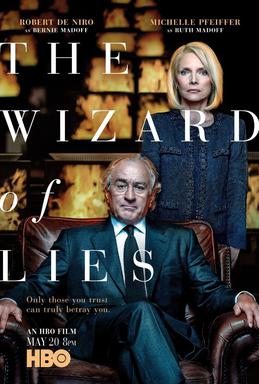
Based on the book of the same name by financial reporter Diana Henriques, The Wizard of Lies is a small-screen (HBO) production that boasts a big-screen pedigree. Robert DeNiro stars as Madoff, Michelle Pfeiffer plays wife Ruth, Alessandro Nivola and Nathan Darrow are sons Mark and Andrew while Barry Levinson directs (His son Sam is the screenwriter). DeNiro, who has been toiling in forgettable comedies and B-films lately, reminds audiences what he is capable of when given a weightier role. He portrays Madoff, who infamously bilked investment clients in a long-running $65 billion Ponzi scheme, as confident, calm, and compartmentalized to the extreme though also self-aware and ultimately broken. Pfieffer is more than solid in support – Ruth comes across as a tragic figure – and Mark and Andrew emerge as reluctantly complicit foils to their scheming father.

Intimate in its characterization and slickly shot, The Wizard of Lies suffers from misplaced narrative focus. So much emphasis is given to the implosion of the Madoff family that the film largely glosses over the greater impact of Bernie’s misdeeds. The Big Short showed that it was definitely possible to expose the workings of Wall Street chicanery without losing the audience. The disappointing reluctance to do so here renders The Wizard of Lies a stylish, at times affecting, but ultimately hollow film.


Whereas The Wizard of Lies documents a fall, The Founder focuses largely on an ascent. In 1954, Ray Kroc (Michael Keaton) is a struggling milkshake mixer salesman from the Midwest who finds that a client in California has high demand for his company’s machines. After meeting the McDonald brothers Mac (John Carroll Lynch) and Dick (Nick Offerman), he is greatly impressed by their restaurant’s speedy, efficient operation and convinces them to franchise it. Though Ray successfully markets the concept to franchisees, he finds himself unable to get ahead financially. His plans to cut costs by using powdered milkshakes and to buy and lease the land the restaurants sit on put him at odds with the brothers but hold the potential for runaway success.

Directed by John Lee Hancock (The Blind Side) and scripted by Robert Siegel (The Wrestler), The Founder starts as a paint-by-the-numbers, hard-work-makes-good origin story before going noticeably darker. Though it thankfully avoids hagiography, it also steers clear of Social Network-style immolation of its subject. Keaton gives a convincing performance, portraying Kroc not as a moustache-twirling schemer but as a beleaguered dreamer whose ambition clearly got the better of his ethics. And though the film contains several notable omissions (don’t look for Ronald here), it still works to document the moves that transformed McDonald’s into a juggernaut. However, it suffers from precisely the opposite problem of The Wizard of Lies. It is at such an emotional remove from its subjects’ personal lives (Laura Dern’s role as Kroc’s first wife is a thankless, one-note role and the McDonald brothers are only shown vis-à-vis their relationship to Kroc) that it makes it difficult for the audience to invest in these characters.

Greed narratives are unlikely to fall out of favor any time soon. The best of them offer unorthodox storytelling and complex characterization; the worst of them treat their subjects as props in a predictable morality play. Both The Wizard of Lies and The Founder fall somewhere in the middle, boosted by strong lead performances but hampered by sins of omission.

The Wizard of Lies: 7.25/10
The Founder: 7.25/10

Sunday, May 14, 2017

Moonlight

Barry Jenkins’s adaptation of Tarrell Alvin McCraney’s play traces the life of Chiron from childhood to adulthood. As a child in Liberty City, Miami, Chiron (Alex Hibbert), nicknamed “Little,” is mentored and provided for by drug dealer Juan (Mahershala Ali) and Juan’s girlfriend Teresa (Janelle Monae) when his drug-addicted mother Paula (Naomie Harris) isn’t up to the task. As a teenager, Chiron (Ashton Sanders) is shaken down by Paula for the money that Teresa provides him and frequently bullied by Terrel (Patrick Decille) all while developing feelings for his best friend Kevin (Jharrel Jerome). As an adult, Chiron (Trevante Rhodes), now nicknamed Black, is a drug dealer living in Atlanta who has a strained relationship with a now-recovering Paula and faces an awkward reunion with Kevin (Andre Holland), now a chef with a young son.

Too often, “message movies” turn into bloated spectacles that are too enamored of the righteousness of their thematic concerns to bother telling an engaging story. Moonlight, however, is a welcome departure from that trend: it gets its ideas across effectively through well-developed characters without being self-aggrandizing or contemptuous of its audience. Jenkins’s direction lends the film a naturalistic feel, and his lean, uncluttered script makes what little is said resonate more. From Little confronting Juan about Paula’s drug use to Terrel instigating a cruel hazing ritual with tragic results, there are plenty of poignant, raw, and powerful moments, yet thanks to the measured performances of the talented cast, Moonlight almost never feels like melodrama. Like a bleaker counterpart to Richard Linklater’s Boyhood, Moonlight is a harrowing snapshot of life away from both the middle-class suburbs and the familiar-to-the-point-of-cliché hoods of Los Angeles.

If there is a critique to be made here, it is that Moonlight is almost too economical for its own good. The time skips between stages of Chiron’s life make sense narratively, but they also leave the intervening years (and the potential therein) unexplored. That Ali won a supporting actor Oscar despite Juan’s presence in only the first act says a lot about how much more mileage Jenkins could have gotten out of these characters.

Moving without being maudlin and fluid to a fault, Moonlight may lack the grandeur of previous Best Picture Oscar winners, but it is every bit a worthwhile selection.


8.75/10

Friday, March 10, 2017

Offbeat Loneliness Cinema: The Lobster and Swiss Army Man

It is an unfortunate truism that the bigger and farther-reaching a problem is, the more easily it lends itself to a film. War movies and natural disaster movies have been done countless times, yet as Hacksaw Ridge most recently demonstrated, that well has yet to run dry. But take a problem more personal, more intimate, and smaller in scope, and as a filmmaker, you will have your work cut out for you. If you are lucky, your tale will be moving and relatable. If you are not careful, however, you risk littering the screen with solipsistic whining. Loneliness falls into this latter category of problems, but that didn’t stop two films of recent vintage – 2015’s The Lobster and 2016’s Swiss Army Man – from exploring it anyway.


The Lobster takes its name from its protagonist, a shortsighted architect named David (Colin Farrell) whose wife recently left him. David is taken to a hotel and given 45 days to find a partner, or he will be turned into an animal of his choosing. During his stay, he is fed pro-relationship propaganda, befriends a limper (Ben Whishaw) and a lisper (John C. Reilly), and tries to court a heartless woman before realizing his perfect match (Rachel Weisz) may exist among a fiercely independent colony of loners out in the woods.

Though its premise may be a tough sell, Yorgos Lanthimos’s film gets by on its absurdist sensibility. There is an exaggerated, European-accented formality that permeates the film. Everything from dialogue to acts of violence come across as stilted and uncomfortable, which speaks volumes about the rules-obsessed world that David occupies. The hotel, for instance, doesn’t allow masturbation, bisexuality, or half-sizes in clothing whereas the loner colony punishes romance and makes members dig their own graves. If Brazil is 1984 by way of Monty Python, then The Lobster is Brazil by the way of Samuel Beckett. Though certainly off-putting at times, it’s an effectively deep black comedy aided by a lonely, desperate, frumpy Farrell, obliterating the typecasting of his youth.


Daniel Kwan and Daniel Scheinert’s Swiss Army Man explores a similar theme – what it means to be alone in contemporary society – in a very different way. Here, Hank Thompson (Paul Dano) is a marooned man on the verge of hanging himself when a corpse (Daniel Radcliffe) washes ashore. Dubbing the corpse Manny, Hank uses its flatulence to propel it across the water like a jetski. As Manny gradually begins to come back to life, Hank befriends him and tries to teach him the ways of the world. They are eventually motivated to try to return to civilization by their shared love for a woman named Sarah (Mary Elizabeth Winstead).

If The Lobster derives humor from its stiltedly awkward restraint, Swiss Army Man attempts to do likewise from its complete lack of it. Flatulence, erections, and other things a twelve-year-old boy might find amusing all factor prominently here, making the film seem the bastard offspring of Cast Away and Dumb and Dumber. The abundance of crass stupidity makes the movie’s moments of genuine introspection, intended as heartfelt, hard to take. The fault lays not with the actors – Dano is an enthusiastic but bumbling Hank and Radcliffe’s bizarre, occasionally wooden performance suits his “dead” character well – but rather with a script that asks us to understand and sympathize with characters it has inadequately developed. While Swiss Army Man deserves some plaudits for the boldness of its approach, it should also serve as a reminder that not all gambles are worth taking.

The Lobster: 7.75/10

Swiss Army Man: 6.25/10

Sunday, August 28, 2016

Remember

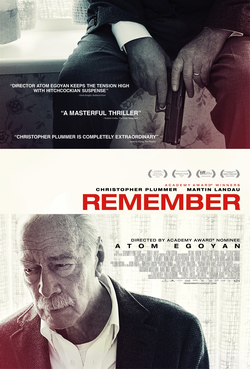
Zev Guttman (Christopher Plummer) is a nursing home patient suffering from dementia. Following the death of his wife, fellow patient and Holocaust survivor Max Rosenbaum (Martin Landau) tasks Zev with avenging their families by tracking down and killing the SS officer responsible before he dies anonymously from old age. The sadistic officer, Otto Walisch, has been living under the name Rudy Kurlander, and Max has located four men with that name. With Max’s detailed instructions in hand, Zev procures a gun and begins a hunt that will take him across the U.S. and Canada in pursuit of long-awaited vengeance.

Scripted by newcomer Benjamin August and directed by veteran Atom Egoyan, Remember plays like a mashup of Memento and The Debt. If that sounds gimmicky, it should come as no surprise that the film definitely is, but it is also affecting and poignant.

Much of the film’s power is derived from Plummer’s masterful performance in a demanding role. In lesser hands, Zev would come across as a doddering caricature, but Plummer plays him as a man fiercely intent on preserving both his dignity and his resolve even if he isn’t always successful. The rest of the cast gives him plenty of help. Landau has the whole strong of mind/frail of body thing down pat, imbuing Max with cunning while he coughs and wheezes. Character actors Bruno Ganz and Jurgen Prochnow, under heavy makeup, are memorable in their brief roles as potential Rudy Kurlanders. The film also features a Dean Norris appearance as a bombastic lawman, something of a cliché at this point, but it works to fuel a pivotal scene.

Behind the camera, Egoyan furthers the film’s ambitions by never lowering the stakes. He expertly builds in tension and keeps the audience invested in Zev’s journey. The film’s twist ending is likely to infuriate some viewers, but even viewed in the worst light, it never reaches M. Night Shyamalan territory.

Besides, Remember’s biggest liability is evident well before that point. Despite the film’s attempts to gloss over it, the plot demands the viewer accept quite a bit of illogic. How else would one describe a visibly disoriented 90-year-old who makes little effort to adequately conceal a handgun progressing as far as Zev does? Or does one take this as the Canadian Egoyan’s deliberate jab at American gun culture?

Inanity aside, Remember is a potent little film that both presents and questions the idea that some things can never be forgiven. It also works to reminder viewers that, regardless of where they stand on that question, being north of 80 doesn’t mean that you can’t turn in a great performance.

7.5/10