Showing posts with label Superhero Films. Show all posts

Tuesday, July 29, 2025

The Fantastic Four: First Steps


In the early 1960s, astronauts Reed Richards (Pedro Pascal), Sue Storm (Vanessa Kirby), Johnny Storm (Joseph Quinn), and Ben Grimm (Ebon Moss-Bachrach) are bombarded by cosmic rays during an interstellar flight, granting them superhuman powers. As the Fantastic Four, they operate as beloved heroes and protectors, promoting science and diplomacy in addition to thwarting criminals. However, a pair of arrivals soon threatens their idyllic status quo: Sue and Reed prepare to welcome their first child unsure of how their powers might affect him, and the Silver Surfer (Julia Garner), herald to the godlike planet-devouring Galactus (voiced by Ralph Ineson), tells them that Earth has been targeted for destruction.

Its Space Age origins may mark the Fantastic Four as outdated, but at the time of the team’s creation, public-facing superheroes that were also a flawed, dysfunctional family were something of a radical idea. Adaptations – and there have been plenty over the years – tend to either acknowledge the 60s-spawned cheesiness with a wink or a nod or subvert it by cranking up the dysfunction. Neither approach has been particularly successful. If nothing else, First Steps deserves credit for trying something different.

That something is full-bore, unironic retrofuturism. The team wears bright blue costumes and battles foes such as Mole Man (Paul Walter Hauser), the film’s production design nails a period-appropriate look and feel, and Michael Giacchino’s upbeat score is a good fit for the film’s tone. Speaking of design, whereas CGI quality in Marvel films has been hit-or-miss as of late, the team behind the First Steps manages to render characters that might look goofy in lesser hands – such as The Thing and Galactus – convincingly.

The film is also well-cast with all the leads displaying strong chemistry. Pascal is once again protecting a child, but don’t go looking for the hard edges of Joel Miller or Din Djarin: Reed is instead waging an inner war on the worst-case scenarios he can’t help but imagine. Moss-Bachrach (whom no one will confuse with looking or sounding like Jack Kirby but who is, at least and at long last, finally, a Jewish New Yorker playing Ben Grimm) does manage to occasionally evoke The Bear’s Richie, however, albeit the mellower post-“Forks” version. Kirby pushes Sue past one-note “protective mother” cliches, and Ineson’s voice – imposingly deep and threatening yet tinged with weariness (Galactus is clearly over having to feed on planets to survive) – suits the character well.

And yet for as well-performed as they are, the characters do not feel completely written. Reed, Marvel’s poster boy for “insufferable genius,” keeps the genius but does little more to offend than missing a few social cues. Ben lacks both his source material’s coarseness and hang-ups regarding his transformation while Johnny is a far cry from a hotheaded playboy. He and Ben may lightly needle each other but not in a way that suggests any real dysfunction. This idealization extends to the harmonious, unified world which the characters inhabit, a bland pleasantness that saps the film of tension and complexity. Matt Shakman, best known for his television work, is competent enough in the director’s chair, but the screenplay, credited to four writers, is downright weak.

Debuting shortly after the similarly retro-inspired and optimism-fueled Superman, The Fantastic Four: First Steps is a less cluttered affair. It’s a nostalgic sop of sorts to those who miss Star Trek: The Original Series’ sense of possibility through exploration and innovation, but amid Marvel’s increasingly byzantine mythology and countless clumsy attempts at either grit or relevance, is that simplicity such a bad thing?


Monday, July 21, 2025

Superman


A few years into his superhero career, Superman (David Corenswet) intervenes to stop the nation of Boravia from invading its neighbor Jarhanpur. In doing so, he falls into a trap set by Boravia’s financial backer, tech billionaire Lex Luthor (Nicholas Hoult). Luthor uses his metahuman pawn Ultraman to attack the hero physically while launching a media campaign to turn public opinion against him. At the same time, Superman’s relationship (as his civilian alter ego Clark Kent) with fellow reporter Lois Lane (Rachel Brosnahan) is fraying, and he is forced to question his purpose.

For as often as he’s been adapted, Superman is a deceptively difficult character to do well. Faithful takes risk being stale and insipid while conspicuous attempts to try something different risk alienating the audience. But if there is anyone equipped to handle this balancing act, it is writer-director James Gunn, who brings both knowledge of and appreciation for the source material as well as a well-honed sense of how to make a movie fun. His version of Superman isn’t without its divisive aspects, but it’s also fresh and entertaining.

A good deal of how well this movie works can be chalked up to its impeccable casting. Corenswet (an actor of Jewish descent finally playing an allegorical Moses) bears more than a passing resemblance to the beloved Christopher Reeve. His version of Clark/Kal-El is still idealistic and powerful but also relatably human. Brosnahan’s quick-witted, resourceful Lois shows the character at her journalistic best, and the Daily Planet as a whole comes across as more relevant here than in some adaptations. Wendell Pierce as Perry White and Skyler Gisondo as Jimmy Olson honor the classic versions of the characters. Something of a novelty for a Superman film, Clark’s super-allies are also given a chance to shine. Spinoff bait as they may be, Edi Gathegi and Nathan Fillion are in good form as Mr. Terrific Michael Holt (a bored tech genius) and Green Lantern Guy Gardener (an abrasive space cop with a terrible haircut). Previous Gunn films were known for balancing humor and earnestness with an incredibly vile antagonist, and that trend continues here. Hoult’s version of Luthor lacks the camp of Gene Hackman or the upbeat quirkiness of Jesse Eisenberg. He’s instead a toxic brew of selfishness, intellect, smug superiority, and petty jealousy, and Hoult nails it.

For as well-cast and performed as these characters are, the sheer number of them in a two-hour movie can feel overwhelming, especially to viewers unfamiliar with the source material. The Fortress of Solitude robots and Metamorpho might get nods of approval from comic books fans, but they may also leave casual viewers wondering if they missed something.

Beyond that and a few tired set pieces – a city-leveling fight against a giant monster feels like a cliché at this point – there is little room for complaint. Superman is bright and colorful, Gunn’s direction is energetic, and the Boravia-Jarhanpur conflict echoes enough of Russia-Ukraine (and Luthor of a Silicon Valley type) to strike a relevant chord without being obnoxiously polemical.

If you’re completely over superhero films or never enjoyed them to begin with, Superman isn’t likely to make you change your mind. But if you’re looking for something to rekindle any affinity (for the genre, the character, or even for some degree of hopefulness), it just might.


Tuesday, May 20, 2025

Thunderbolts*

As CIA director Valentina Allegra de Fontaine (Julia Louis-Dreyfus) faces Congressional scrutiny for sanctioning black ops and illegal research, she contrives to pit her operatives against one another in hopes that they will wipe each other out. The motley group includes Yelena Belova (Florence Pugh), a depressed former Black Widow; John Walker (Wyatt Russell), a disgraced former Captain America; Ava Starr (Hannah John-Kamen), a thief who can briefly become intangible; Antonia Dreykov (Olga Kurylenko), the mercenary known as Taskmaster; and Bob (Lewis Pullman), a seemingly normal man suffering from amnesia. Instead of slaughtering each other, the group, dubbed the Thunderbolts after Yelena’s childhood soccer team, works together to escape Valentina’s clutches. In doing so, they attract the attention of Yelena’s adoptive father Alexei (David Harbour), the erstwhile Soviet hero Red Guardian; as well as that of Buck Barnes (Sebastian Stan), a former super soldier-turned-congressman hoping to use the Thunderbolts’ testimony to bring Valentina down.


The Thunderbolts can best be read as Marvel’s answer to DC’s Suicide Squad (particularly James Gunn’s take): a crew of government-approved (until they become a liability), morally ambiguous, empowered losers. As with the latter, the Thunderbolts’ status as lesser-known characters frees them from the burden of audience expectations and allows the film to simply be fun, which it is when it isn’t also serving as an allegory for mental illness.


Just as the Thunderbolts are unlikely heroes, Jake Schreier is a head-scratching choice for the director’s chair. His previous work includes a John Green adaptation and the quirky (but decidedly not action-heavy) Robot & Frank. Joanna Calo (Bojack Horseman and The Bear), who provided script rewrites during production, likewise brings an unexpected pedigree. Original screenwriter Eric Pearson, on the other hand, is a seasoned Marvel vet, and perhaps for that reason, Thunderbolts* never feels too far afield from other MCU offerings.


The old adage about not watching action movies for the plot applies here as the story is a threadbare excuse to throw these characters together. And yet it wouldn’t be accurate or fair to say that the movie lacks depth. While trauma often informs superhero backstories, it’s often given no more than a passing allusion between fisticuffs and wisecracks. Here, however, it is front and center. This actually puts Thunderbolts* in an unwinnable situation. The movie gives its characters enough dimensionality to make us want to know them better without giving enough time to develop them further. At just over two hours, Thunderbolts* is well-paced. Add another half-hour though, and it might feel like a slog.


Despite these limitations, the cast does admirable work. Plaudits especially go to Pugh, whose previously dismissive attitude is tinged with heavy doses of purposelessness and grief, and to Pullman. SPOILERS AHEAD. The latter plays what are effectively three different characters sharing one body: Bob, who suffers from mental instability and addiction, the Sentry, a godlike hero who resists being trotted out as a public relations win, and the Void, a malevolent shadow who can make people relive the worst moment of their lives again and again. That Pullman nails all three aspects is a testament to his range. The supporting cast is equally game. As Valentina, Dreyfus embodies power-hungry realpolitik, but unlike her DC equivalent Amanda Waller (all icy intimidation), she’s almost chipper in her disregard of others. Imagine Elaine Benes abusing her authority in J. Peterman’s absence, only with much higher stakes. Stan plays Bucky as perhaps the most level-headed member of the Thunderbolts, which, given his past (artificially enhanced, formerly brainwashed assassin with a bionic arm), says a lot about the team’s dysfunction.


Thunderbolts* is unlikely to win back anyone who has sworn off Marvel movies for good. Inasmuch as it ends in a way that sets the stage for the next MCU entry, it can feel like a link in a chain. But the movie’s themes, performances, and finely calibrated mixture of humor, excitement, and pathos all still make Thunderbolts* worth your time.


Tuesday, February 18, 2025

Captain America: Brave New World


After being elected President of the United States, former general Thaddeus “Thunderbolt” Ross (Harrison Ford, replacing the late William Hurt) pushes for an international treaty that would prevent an arms race and allow for shared extraction of adamantium, an advanced extraterrestrial metal. He also seeks the help of Captain America, Sam Wilson (Anthony Mackie) to re-form the Avengers, a superhero group Ross once opposed. Wilson is skeptical, but when a series of coordinated attacks jeopardize Ross’s plans and threaten to trigger a war, Cap and his protégé Joaquin “Falcon” Torres (Danny Ramirez) vow to get to the bottom of it before someone they care about takes the fall.


The standard knock on Marvel movies these days is that they’ve become too insular, too creatively sterile, and too dependent on quippy dialogue and slick CGI to do more than briefly (or, in the case of runtime bloat, not-so-briefly) entertain. Truth be told, Brave New World, the fourth Captain America film (though the first to star Mackie in the role), won’t do much to challenge those perceptions. And yet to call it “bad” wouldn’t really be fair. Even after reshoots and delays, no one should confuse this with a Zack Snyder film butchered by meddling executives or a Fant4stic doomed by directorial incompetence. The worst that can be said about Brave New World is that it is neither brave nor new, playing as a muted version of what Marvel previously did much better in projects like Captain America: The Winter Soldier and even The Falcon and the Winter Soldier.


The one unblemished bright spot is the addition of Ford, a controversial choice given that other Marvel characters (cough T’Challa cough) were not recast when the actor died. Hurt’s version went from Ahabesque Hulk hunter to obstructive politician, never the worst person the heroes had to face but a consistently unpleasant jerk nevertheless. Ford’s version keeps the character’s rough edges (stubbornness, selfishness, and pride) but adds a layer of melancholic regret. He’s believable as a man who knows he’s caused a lot of damage (alienating his daughter in the process) and is trying to do better.


Everyone else is solid even though they aren’t given enough to work with. Mackie is a good fit for the title role, yet he doesn’t have the room to spread his acting wings that The Falcon and the Winter Soldier afforded him. He sometimes seems sidelined in what is nominally his movie. Giancarlo Esposito has made menacing villains his stock and trade as of late, and he appears briefly as terrorist leader Sidewinder here. He supplies a physical threat, but the character isn’t particularly memorable. More distinction was granted to Tim Blake Nelson’s mad scientist Samuel Sterns, last seen getting infected by gamma-radiated blood way back in 2008’s The Incredible Hulk. Nelson’s creepy calm tilts the character away from garden-variety megalomania, but Sterns comes across petty, and the character design does him no favors. Shira Haas as national security advisor Ruth Bat-Seraph had the potential to bring something interesting to the mix, but instead of the comics’ Israeli superheroine, she’s depicted as an ex-Black Widow: still formidable but a type of character we’ve seen several times before.


“We’ve seen this before” applies to the feel of several of the film’s action set pieces as well, be they aerial battles or Captain America going hand-to-hand against a tough mercenary. That said, the pacing is brisk without being rushed. What Julius Onah’s direction lacks in distinction it makes up for in competence. The visual effects, derided by some critics, aren’t really poor.


Malcolm Spellman, who created The Falcon and the Winter Soldier, was one of Brave New World’s co-writers though you wouldn’t really know it. Whereas the show was guilty of occasional grandstanding, it wasn’t afraid to engage complex issues. This movie gives a nod to the power of representation before breezily zipping along to the next plot point. It’s enough for some – and too much for racist idiots — but it will leave others wondering what a bolder version of this movie might have been.


Sunday, July 28, 2024

Deadpool & Wolverine


Wade Wilson (Ryan Reynolds), the soldier-turned-mercenary known as Deadpool, applies to become an Avenger but is rejected and also splits with his girlfriend Vanessa (Morena Baccarin). He settles into a quotidian life before he is apprehended by the Time Variance Authority. TVA operative Mr. Paradox (Matthew Macfadyen) informs him that his timeline is deteriorating due to the death of James Logan “Wolverine” Howlett (Hugh Jackman), who was pivotal to the timeline’s existence. Paradox offers Wade an opportunity to join a different timeline, but Wade instead decides to hop across timelines in order to find a still-living Wolverine who can save his own.


Crude humor, violent slapstick, and fourth-wall-breaking self-awareness are Deadpool’s shtick, and that will always be divisive. Even those who find the character and sensibility off-putting, however, should at least be able to appreciate Reynolds’ wholehearted embrace of the role. Here, he’s paired with another performer whose dedication matches if not outpaces his own. Now in his mid-50s, Jackman has played Wolverine for nearly a quarter-century, subjecting himself to a ridiculous diet-and-workout regimen each time. It’s to his credit that this portrayal is markedly different, and not just because he finally dons a comics-accurate costume. In making Jackman a leading man, prior films also romanticized the character, accentuating his haunted, Byronic qualities. Here, he’s still haunted, but he’s also violent, surly, profane, and frequently drunk. His abrasiveness is both truer to the source material and openly contemptuous of past attempts to make the character more marketable and kid-friendly.

This reverence masquerading as irreverence can be found throughout Deadpool & Wolverine. There is biting-the-hand humor aplenty, but there is also a genuine affection for characters whose days have passed or who were never given their cinematic due to begin with. Within the film, the Void – a place outside of time first introduced in the Loki series – serves as a dumping ground for the discarded and a way for Marvel to pay homage to the characters it licensed (to Fox and other studios) before regaining creative rights. A list of Void inhabitants would spoil several (mostly welcome) surprises, but for viewers of a certain age, nostalgia is inevitable.


The Void is also home to Cassandra Nova (Emma Corrin), who serves as the film’s primary antagonist. For all intents and purposes Charles Xavier’s evil twin, she has all of his telepathic power and none of his empathy or morality. Corrin gives a fascinating performance here, often playing Cassandra as something like a curious child even as she inflicts horrible punishments on those who defy her. Unfortunately, her screen time is relatively brief, and the role as a whole feels underbaked. The same can arguably be said for several other supporting roles though Leslie Uggams as Wade’s blind, cantankerous, coke fiend of a roommate continues to steal every scene she’s in.


Story is always secondary to action and comedy in a movie like this, but even by those standards, Deadpool & Wolverine is narratively very thin. Fortunately, there’s enough excitement to make up for it, thanks to Shawn Levy’s surehanded direction. The expected throwdown between the title characters does not disappoint, and the franchise continues its proud tradition of treating drawn-out brawls as quirky music videos. Add to that a number of amusing Easter eggs (a shoe store, Liefeld’s Just Feet, mocks the inability of Deadpool’s comic book creator to draw them), and you’re in for a fun – if shallow – ride.


Monday, November 20, 2023

The Marvels


As the Kree home world Hala lays dying, Dar-Benn (Zawe Ashton) seeks quantum bands that will allow her to create jump points that tear open the fabric of space and harness the power of the sun. She finds one, but the other is held on Earth by Kamala Khan (Iman Vellani), aka Ms. Marvel. Spymaster Nick Fury (Samuel L. Jackson) operates the space-based defense agency S.A.B.E.R. and sends Monica Rambeau (Teyonah Paris) to investigate a jump point while Carol “Captain Marvel” Danvers (Brie Larson), Kamala’s idol and Monica’s estranged surrogate aunt, tracks Dar-Benn. When Monica approaches the jump point, she, Carol, and Kamala experience a quantum entanglement that causes them to switch places when they use their light-based powers. Amid this complication, Dar-Benn’s relentless pursuit of the other band, and Kamala’s worrying parents, the three marvels will have to find a way to work together.


Sometime during the past few years, “Marvel fatigue” metamorphosized from the sour grapes of elitists to a phenomenon much harder to deny. Delays, declining quality, runtime bloat, weird tonal shifts, and a general lack of vision have hampered MCU projects as of late. Add to that the lack of publicity stemming from recent Hollywood strikes, and The Marvels never really stood a chance. That makes it a victim of circumstance, undeserving of either anemic box office or critical scathing though even under more favorable conditions, it would still skew more adequate than impressive.


Director Nia DaCosta (who co-wrote the script), best known for indie debut Little Woods and the Candyman remake, seems an odd choice of director here, but it’s hard to fault her taut, fluid directorial work here. The titular leads play well off of one-another. In the Ms. Marvel streaming series, Vellani played Kamala with hyperactive enthusiasm, and while she starts in that mode here, she’s given more opportunities for depth and nuance here. Monica, dealing with the trauma of her mother’s death and Carol’s prolonged absence, is often thrust into being the responsible adult in the room, and Paris captures her frustration well. Larson, long unjustly derided as wooden, continues to be a more-than-capable Captain Marvel, and even when the material is below his ability, Samuel L. Jackson is never bad as Nick Fury.


On the other hand, Ashton, a newcomer, is utterly forgettable as Dar-Benn (following, sadly, in the way that previous films mangled the character’s predecessor, Ronan). At 105 minutes, The Marvels is mercifully tauter than recent MCU outings, but it also can’t help but feel somewhat disposable. The convoluted plot certainly won’t resonate. Flerkens (alien cats that can spawn a mouth full of tentacles) are back and feature prominently, but while they represent the “good” kind of crazy, the same cannot be said for an utterly contrived musical sequence that seems shoved in to give Larson a reason to sing.


For those who have felt themselves straining to maintain interest in recent Marvel projects, The Marvels’ lightness may be a refreshing change of pace. However, one can hope that it is but a stop on the elevator ride back up, not the new top floor.

Thursday, June 15, 2023

Spider-Man: Across the Spider-Verse


Gwen Stacy (Hailee Steinfeld) is struggling to keep her identity as Spider-Woman hidden from her police captain father George (Shea Whigham) when they encounter a villain displaced from another universe. Gwen is recruited by Miguel O’Hara/Spiderman 2099 (Oscar Isaac) and Jessica Drew/Spider-Woman, themselves from alternate universes, to help them track down such anomalies. Meanwhile, in yet another universe, Miles Morales (Shameik Moore) finds that his activities as Spider-Man have made him appear secretive and distant to his concerned parents. His problems are compounded when Dr. Jonathan Ohm/The Spot (Jason Schwartzman), a scientist whose body became infused with spot-like portals following a lab accident, blames Spider-Man for his disfigurement and vows to make him suffer.


The follow-up to 2018’s successful Into the Spiderverse, Across the Spiderverse is nothing if not ambitious. It’s the longest American animated feature, and it’s packed to the gills with alternate versions of Spider-Man from the British anarchist Spider-Punk (Daniel Kaluuya) to Spider-Man India (Karan Soni) to the classic Peter Parker (Jake Johnson, playing him as a middle-aged dad). Each universe explored has its own distinctive art style, and the film is a treasure trove of easter eggs and references to comic book lore. As such, Across the Spiderverse walks a thin line between being a labor of love for Spider-fans and a study in excess.


The central idea here is one of fatedness: would the Spider-heroes be the heroes they are if they were not shaped by tragedy? Miles seems determined to find out, but for Miguel, privy to deeper losses than the average Uncle Ben, it’s too dangerous a possibility to ponder. This is both mature turf for an animated comic book adaptation and a conceit on the verge of becoming hackneyed (The upcoming Flash movie is the latest of several properties to play around with the consequences of disrupting fate to prevent tragedy).


This weightiness and Isaac’s intense voice performance aside, Across the Spiderverse still manages to be solidly entertaining. The animation is varied and kinetic, taking us everywhere from a Lego dimension to a teeming Mumbattan of Spider-Man India’s realm. The early Spot sequences are pure slapstick as Ohm is a bungler who has no idea how his powers work, but a later escape sequence is full of tension-pumping adrenaline.


Across the Spiderverse is the middle film in a planned trilogy, and it ends on a shamelessly blatant cliffhanger, a frustrating lack off payoff for the 140-minute run-time. And yet, it offers hope that the next installment can be entertaining and visually daring just the same. 

Thursday, May 18, 2023

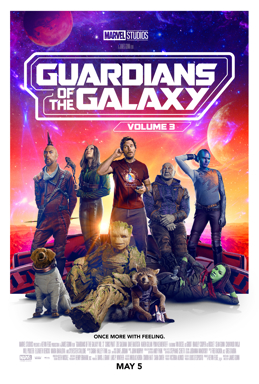
Guardians of the Galaxy Vol. 3


Seeking revenge of her humiliation at the Guardians of the Galaxy’s hands, Ayesha (Elizabeth Debicki), high priestess of the Sovereign, sends her artificially created son Adam (Will Poulter) after them. The Guardians are able to drive him away, but Rocket (voice of Bradley Cooper) is badly wounded in the process. Saving his life requires stealing a code from his creator, the High Evolutionary (Chukwudi Iwuji), who sees Rocket as property that he is intent on reclaiming as the evolved raccoon’s capacity for ingenuity is key to his plan to build a utopia for his “perfected” biological experiments.


The last Marvel movie from writer/director James Gunn before he left to take over DC Studios, Guardians Vol. 3 appears to follow other recent MCU missteps: it’s long (two and a half hours), and it attempts to inject a darker tone and weighty issues (animal cruelty, in this case) into a franchise known for humor. And yet thanks to Gunn’s creative vision and the ensemble cast’s efforts, the film largely works anyway.


The two lynchpins of previous Guardians films are humor and heart, and both can be found here. Vol. 3 is both irreverent – Chris Pratt’s Peter “Star-Lord” Quill shamelessly bluffs his way past a receptionist during an infiltration mission and has some rather creative insults for the High Evolutionary while Dave Bautista’s Drax the Destroyer remains obliviously insensitive as ever – and sentimental with the edge of the former preventing the latter from seeming too cloying or cheesy (except, perhaps, at the very end). Perhaps it is the franchise’s facility with juggling multiple tones that allows it to absorb the unabashed horror of exploring Rocket’s backstory: a normal raccoon painfully experimented upon and threatened with destruction for not meeting an impossibly high standard. Even though these moments of animal abuse don’t crater the entire film, they do seem exploitatively protracted.


Gunn’s excesses aside, he still produced a stylish film that feels shorter than its run time. The soundtrack is less awash in 70s pop than that of the preceding two films. Though that decade is still represented (via Heart, Bruce Springsteen, and Earth, Wind, and Fire), the eclectic mix also includes the likes of Radiohead, Faith No More, and the Beastie Boys.


Most of the Guardians cast has been playing their roles for several outings now, but a change in narrative focus helps keep their performances from feeling stale. Quill is, thankfully, no longer in the spotlight, Nebula (Karen Gillan) gains a personality beyond merely being mean, and Drax is finally allowed to be more than comic relief once again. Cooper and Sean Gunn (motion capture) help transform Rocket from a mere mechanically-inclined cynical hothead into a highly sympathetic figure. There are, of course, smaller returning characters that have minimal presence: Ayesha is somehow even more ineffectual here, and Sylvester Stallone’s space pirate Stakar has only two brief scenes.


The newcomers leave an impression as well, albeit one that is quite different from their source material. As Adam Warlock, Poulter is powerful but also naïve and childlike. Iwuji’s take on the High Evolutionary replicates the first Guardians movie’s defilement of Ronan the Accuser: strip out the comic book character’s redeeming qualities and crank up the hammy evil. The film version shares an obsession with achieving utopian perfection, but he’s also petty, sadistic, and cruel.


If this is the last Guardians film – and let’s hope, for sake of quality control, that it is – then Vol. 3 brings the franchise to a memorable end. It is a far more draining experience than the first or even the emotionally heavy second outing, but it never completely loses its sense of fun.

Saturday, March 4, 2023

Ant-Man and the Wasp: Quantumania


After helping to save the world, Scott Lang (Paul Rudd), the Avenger known as Ant-Man, has settled into life as an author/speaker and a father to his teenage daughter Cassie (Kathryn Newton). Inspired by her surrogate grandparents’ (Michael Douglas and Michelle Pfeiffer) adventures in the subatomic Quantum Realm, Cassie builds a device that can send a signal to it, which ends up trapping her and her family there instead. Once inside, they find themselves caught in a conflict between a motley group of rebels and Kang the Conqueror (Jonathan Majors), a despot exiled from the surface world who has a history with Janet van Dyne (Pfeiffer) that she has kept hidden, upsetting her daughter Hope (Evangeline Lilly).


Up to this point, the Ant-Man films have been both fun and funny yet fairly disposable. They’ve boasted a likable performance from Rudd, a few laughs and exciting stunts, and precious little in the way of character depth or dramatic heft. The third entry in the series is a longer and darker affair, but much like Pfeiffer’s character, it cannot escape its past. The result is a film schizophrenically torn between trying to remain fun and trying to up the stakes, and while still quite watchable, it doesn’t really succeed at either.


Quantumania is, in a way, a victim of Marvel’s success and its own strengths. The Quantum Realm is a strange and colorful place, full of bright lights and bizarre-looking beings (and Bill Murray as a sleazy ex-rebel leader), which would be impressive had we not been entreated to the mind-bending visuals of the Doctor Strange films or the weird aliens of the Guardians of the Galaxy films. Majors and Pfeiffer give strong performances. The former is cold and cerebral yet still physically formidable, a man whose dominion over time has left him isolated while the latter is hellbent on not repeating past mistakes. Unfortunately, this makes the other performances seem weaker in comparison. Rudd nails affable everyman perfectly, but his angrily protective father never quite lands, and while Corey Stoll’s version of classic comic book antagonist MODOK (a giant-headed cyborg with a vast array of weapons) hits the character’s grandiosity but otherwise feels like a waste. Even the film itself seems to realize how ill-equipped it is for its ambitions. As Majors dismissively tells Rudd, “I am Kang. You talk to ants.”


So why watch it? Maybe Majors’s Kang is a big enough draw. Maybe Pfeiffer, Douglas, and Murray appeal to your nostalgia. Maybe you’ve enjoyed the Rudd-Lilly chemistry up to this point. Maybe you want to see what a third actress stepping into the role of Cassie can do with more screen time. Maybe you’re willing to sit through this chapter of the on-screen Marvel saga to get to the next. Or maybe, given Quantumania’s disparate nature, the half of the film that appeals to you is enough to make you overlook the half that doesn’t.

Tuesday, November 29, 2022

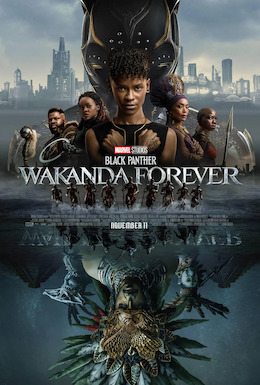
Black Panther: Wakanda Forever


Following the death of T’Challa (Chadwick Boseman), Wakanda’s king and protector, the nation falls into despair as his mother, Queen Ramonda (Angela Bassett), faces a world hungry for the country’s rare metal, vibranium. The pursuit of an alternate vibranium source leads Americans to the secretive underwater kingdom of Talokan, whose ruler Namor (Tenoch Huerta) urges Wakanda to ally against outside threats or else face devastation. However, Princess Shuri (Letitia Wright) instead decamps to the U.S. with General Okoye (Danai Guirira) on a mission to locate and rescue the teen genius (Dominique Thorne) behind the government’s vibranium detector before Namor’s forces can do her harm.


While writer/director Ryan Coogler’s Black Panther was a culturally resonant hit in 2018, lead actor Boseman’s 2020 death from colon cancer cast a long shadow over the second installment. The film tastefully honors his passing, but it also makes Wakanda Forever, at times, a very heavy affair. There is still plenty of visual spectacle to behold here along with several strong performances, but this cannot help but feel like a too-long (161 minutes) film that tries to do too much.


While Thorne’s Riri Williams seems rushed and shoehorned into her Iron Man successor role, the film’s character development is otherwise an asset with acting to match. Those (James Cameron the latest among them) who are quick to dismiss Marvel movies as emotionally stunted juvenilia should pay close attention to Bassett’s powerhouse performance here as a strong leader and grieving mother whose best intentions have catastrophic consequences. Namor, Marvel’s first antihero (dating back to the 1930s!), is usually depicted in the source material as ambiguously East Asian, so the switch to a Mesoamerican background (he’s synthesized with the Mayan god Kukulkan here) may be less about representation and more about separating him from his DC equivalent, Aquaman. At any rate, Huerta is both disarmingly genial and coldly and ruthlessly dedicated to protecting his people, a complexity that frees him from the generic megalomania that has plagued many a villain and that engenders sympathy. Wright, who shifts from smart-aleck sidekick/foil to a guilt-ridden leadership role, is outshined, but she does give her character more dimensionality, and the same can be said for Lupita Nyong’o as T’Challa’s friend and lover Nakia, an ex-spy living abroad. And for those who enjoyed his trollish performance the last time around, Winston Duke's M'Baku returns to do more scene-stealing as well.


Visually, Wakanda Forever combines the silly and the sublime. The warriors of Talokan appear blue when on land, which invites unfortunate Avatar comparisons. Whereas the first Black Panther suffered from decidedly dodgy CGI animals, the fauna don’t look as bad here; they are just used in ridiculous ways (whales as troop transports, anyone?). That said, Talokan’s first appearance is grippingly suspenseful, and the movie’s grand battles are gripping and majestic. There is, however, a sense that they could be shaved by a few minutes to speed the movie along as by the 150 minute-mark, Wakanda Forever feels as if it will go on….you get the idea.


Between Boseman’s death, COVID-related production delays, and the taint of Wright’s anti-vax activism, Coogler faced an extraordinarily difficult path in bringing Wakanda Forever to the screen. What he was able to achieve is commendable even if this film lacks some of its predecessor’s vibrance and cachet. 

Monday, October 17, 2022

Werewolf by Night


When Ulysses Bloodstone, leader of a group of monster hunters, dies, the other group members are enlisted to compete in a hunt to determine who will replace him and wield the powerful Bloodstone. The aspirants include Ulysses’s daughter Elsa (Laura Donnelly), who had forsaken her family’s legacy, as well as Jack Russell (Gael Garcia Bernal), who boasts an impressive track record and harbors more than a few secrets. As the hunt gets underway, it soon becomes clear that nothing is as it seems, including the monster the group is chasing.

Prolific composer Michael Giacchino’s directorial debut is billed as a Marvel Studios Special Presentation, occupying a middle ground between a feature-length film and an episode of a Marvel/Disney Plus streaming series. Tonally and aesthetically, however, it stands apart from either. Shot in black and white, it is a faithful homage to the monster movies of old. Far from being a mere nostalgia act, however, Werewolf by Night is a stylistic spectacle that highlights lesser-known Marvel characters.

The film’s 53-minute runtime is both a blessing and a curse. Werewolf by Night is tautly paced with nary a wasted moment, let alone a superfluous subplot or ham-handed declaration of theme (I’m looking at you, She-Hulk). However, because we follow them so briefly, we do not get to know most of the movie’s characters very well. The stakes will always be lower for red shirts led to slaughter than they will be for fan favorites biting the dust.

Despite these confines, however, Bernal and Donnelly do a decent job of fleshing their characters out. Bernal’s Russell is enigmatic, and though he is not the tortured soul of his comic book counterpart, he has more depth and morality than his initial appearance suggests. Donnelly exudes a cool competence verging on boredom at times, but this façade crumbles when she finds herself face-to-face with a monster she did not expect. As Elsa’s stepmother Verussa, Harriet Sansom Harris hams it up with aplomb, her demonstrativeness a throwback to the old monster flicks that inspired this one. “Ted” also makes quite an impression, but to say more would be to spoil one of the movie’s best-kept secrets.

Style, however, is where Werewolf by Night really shines. The use of black-and-white is striking, and it allows the bright red Bloodstone (the only bit of color throughout much of the run time) to take on a grandly sinister aura. It also helps mask the film’s brutality as Werewolf by Night is considerably gorier than typical Marvel fare. Practical effects rather than copious CGI further establish the movie’s old school bona fides. While Giacchino shows surprising flair from the director’s chair, he is still equally adept at his day job: the film’s score is a perfect fit for its mood.

If the worst that can be said for Werewolf by Night is that it is too short, then its creators must be doing something right. Don’t go looking for the reality-bending visuals of a Doctor Strange or the further development of Marvel’s increasingly complex interconnected mythology here. Do enjoy it on its own terms: a brief bit of distinctively rendered scary fun.

Wednesday, July 13, 2022

Thor: Love and Thunder


When his daughter Love (India Hemsworth) dies and his prayers go unanswered, Gorr (Christian Bale), a devout follower of the god Rapu (Jonathan Brugh) takes up the powerful-yet-cursed Necrosword and slays the callous, mocking deity, vowing that all gods must die. This puts the “God Butcher” on a collision with Thor Odinson (Chris Hemsworth), the Asgardian god of thunder, who has been fighting alongside the Guardians of the Galaxy but finds little pleasure or purpose outside of combat. Meanwhile, Thor’s former girlfriend, the renowned astrophysicist Jane Foster (Natalie Portman) is dying of cancer. Desperate for a cure, she wonders if Asgardian magic might hold the answer. The refugee settlement turned tourist attraction of New Asgard, Norway, run by the last surviving Valkyrie (Tessa Thompson) seems to have what everyone is looking for.


The fourth solo Thor film, Love and Thunder is helmed by Taika Waititi, who injected a badly needed dose of vitality into the franchise with 2017’s Ragnarok. Waititi also returns as the voice of amiable alien rock monster Korg, who serves as the film’s narrator, and the film is an odd mixture of Waititi’s trademark awkward humor, 1980s nostalgia, and inspiration from Jason Aaron’s divisive comic book run. The results are often entertaining, sometimes heartfelt, tonally catastrophic, and narratively frustrating.


Perhaps the biggest gripe that can be leveled against Love and Thunder is that its character work is largely threadbare. Thor’s “finding out who he is” arc was largely explored in Ragnarok, and this feels like a rehash. Jane has largely been absent from the MCU mythos for years, and so her sudden cancer diagnosis and equally sudden acquisition of Asgardian power feels less like character development and more like sudden change to move the story forward. The one exception to this is Gorr, whom a bald, ashen-skinned, shadow-ensconced Bale renders both creepy and sympathetic (perhaps too much so given the relative absence of benign deities).


However, Love and Thunder’s tonal ping-pong ultimately works against Bale’s effectiveness here. Films – and especially MCU films – can balance comedy and action, and prior Thor entries did this well (pronouncedly so in Ragnarok, but even the original Thor had its hilarious pet shop horse demand). Here, however, the effect is that of a romantic comedy spliced together with a much darker (aesthetically and tonally) action-drama, and the two strands undercut rather than complement each other.


None of this is the actors’ fault. Hemsworth might not be doing anything radically new with the character, but he still makes for an excellent Thor. Jane’s compacted arc aside, Portman’s return to a prominent role is welcome, and here she gets to display combat prowess to go with her and Hemsworth’s banter. There’s also a supremely hammy Russell Crowe as Zeus, sporting a selfish attitude (no surprise there) and a confusing (Grecco-Italian?) accent.


Moreover, for all of its storytelling faults, Love and Thunder is, at times, both funny and fun. Toothgnasher and Toothgrinder, pullers of the mythological Thor’s chariot, are rendered here as a pair of inappropriately screaming goats, Matt Damon and Luke Hemsworth return as members of a cheesy Asgardian acting troupe (joined by Melissa McCarthy playing Hela with all the subtlety of the Wicked Witch of the West), and the film as a whole is a long, strange ode to Guns n Roses (!). As an added perk, Hemsworth’s and Portman’s children pop up in small but important roles, and some of Thor’s all-but-forgotten comrades make a return as well.


Ultimately, Love and Thunder does little to advance the Marvel Cinematic Universe’s increasingly byzantine mythology, nor is it a stellar stand-alone film. It is, however, an amusing way to kill two hours.

Sunday, May 8, 2022

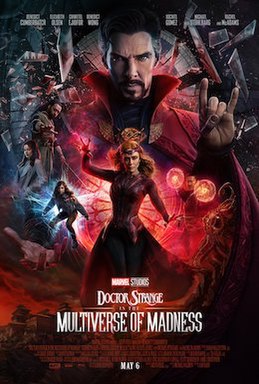
Doctor Strange in the Multiverse of Madness


Dimension-hopping teenager America Chavez (Xochitl Gomez) arrives in New York pursued by demonic creatures, drawing sorcerer Stephen Strange (Benedict Cumberbatch) away from his colleague/former girlfriend Christine Palmer’s (Rachel McAdams) wedding. Sensing witchcraft at play, Strange calls upon his friend Wanda Maximoff (Elizabeth Olsen), only to find that she has been corrupted by the Darkhold, a grimoire that convinces her that she can have the family she has been dreaming about…by taking America’s power (killing her in the process) and relocating to another dimension. To stop her, Strange, America, and Wong (Benedict Wong), will seek allies in whichever dimension they can find them.


With directors as distinctive and diverse as James Gunn, Taika Waititi, and Chloe Zhao helming entries, one would think that criticisms of the Marvel Cinematic Universe as cookie-cutter cinema would have waned by now. The addition of Sam Raimi (replacing previous Doctor Strange director Scott Derrickson) suggests a further corrective to that narrative. However, like Zhao’s Eternals, Raimi’s stab at an MCU film is an awkward fit that shows a talented director not quite hitting the mark.


On paper, Doctor Strange in the Multiverse of Madness should have been a dream project. After all, Raimi is beloved for the first two Spider-Man films, and he cut his teeth as a horror director well before then. A project that combines both seems like a no-brainer. Moreover, writer Michael Waldron experienced more recent Marvel success with last year's Loki series. Add a Danny Elfman score and lots of returning faces, and what could go wrong?


The answer, sadly, is a lot. Pointing out the MCU’s interconnectedness and reliance on prior familiarity is beating a dead horse, but despite drawing from that shared history, Doctor Strange in the Multiverse of Madness doesn’t seem to understand it. In WandaVision (which ended with the character using the Darkhold), Wanda committed heinous and destructive acts, but Olsen delivered a complex, anguished performance. Here, the character is more powerful yet feels cheapened and one-dimensional, a dark magic-empowered Terminator with T2 Sarah Connor’s motives. This character neglect extends to Strange as well. The character is once again chided as being an arrogant risk-taker, the one who always has to be holding the knife. For most of the movie, he justifies that reputation rather than challenging it, only breaking from it in the form of a cliched late-game pep talk. Neither Olsen nor Cumberbatch are mailing it in here and embody the characters as best as they are able; they just don’t have a ton to work with. The Illuminati – a well-intentioned but secretive and ethically dubious council featuring some of Marvel’s heavy hitters – shows up in one of the film’s visited dimensions, but don’t get too attached. Their brief appearances are part fan service, part Marvel bragging about the character film rights they have reacquired, part inflating the danger an out-of-control Wanda poses, and part Raimi utilizing his penchant for shockingly violent slapstick. Undoubtedly, some of these faults can be pinned on a script that seemed to change by the day during production, but even with a more solid plan from the get-go, Raimi’s type of conspicuously comic booky superhero film would have been a better fit for audiences fifteen years ago than audiences today.


While the film arguably wastes its characters, one can still see where the money went. Even as MCU films become more and more visually audacious, Raimi’s work here stands out. It captures some of the exhilaration of his Spider-Man films, but its also fluid, getting weird and wacky or darkly terrifying as the occasion demands. Elfman’s score is serviceable and perhaps a good complement to Raimi’s throwback approach, but it isn’t particularly memorable.


To borrow the film’s central conceit, in a dimension where the Marvel Cinematic Universe didn’t exist, Doctor Strange in the Multiverse of Madness would be a thoroughly entertaining if weird and wonky two hours. But in our reality, it doesn’t measure up to the expectations created by what came before, rendering it a frustrating – if also at times thrilling and daring – outing. At the very least, however, it leaves the door open for further adventures featuring these characters, hopefully by a creative team that will better utilize them.

Sunday, March 13, 2022

The Batman


On Halloween night, Gotham City mayor Don Mitchell Jr. (Rupert Penry-Jones) is brutally murdered by masked killer The Riddler (Paul Dano), who leaves behind a cryptic clue for vigilante crimefighter Batman (Robert Pattinson). Though Gotham police higher-ups have a deep distrust of the caped crusader, Lt. James Gordon (Jeffrey Wright) trusts him and welcomes his help. Batman decides to look for leads at the Iceberg Lounge, a nightclub run by Oz Cobblepot aka the Penguin (Colin Farrell) on behalf of mafia don Carmine Falcone (John Turturro). While infiltrating the lounge, Batman meets Selina Kyle (Zoe Kravitz), a thief who enlists him to help her find her missing friend. As the Riddler’s targets expand to include more and more corrupt Gotham officials, Bruce Wayne – Batman’s civilian alter ego – begins to see a connection to his murdered parents. His growing obsession disturbs his butler and confidant Alfred Pennyworth (Andy Serkis), but he will not stop until The Riddler is unmasked and the truth is revealed.


Matt Reeves’ long-delayed and long-anticipated take on a Batman film grew out of what was supposed to be a Ben Affleck project before morphing into something else entirely. The end result manages to provide a semi-fresh take on an oft-adapted character and a gripping murder mystery that only occasionally falls prey to its excesses.


The Batman is both tonally and aesthetically a very dark film. Even more so than most adaptations, Gotham here is depicted as a cesspool of bottomless corruption. Correspondingly, The Riddler’s murders of those responsible for it are that much more brutal than typical costumed villain hijinks. Much of the action takes place at night, and Michael Giacchino’s haunting theme only adds to the ambiance. Reeves’ film isn’t quite as dazzling as Christopher Nolans’ trilogy (a testament to how well those films hold up visually after more than a decade), but it’s still well-choreographed with style to spare. A chase scene involving the Batmobile (reimagined here as a massively modded muscle car) pursuing a gun-toting Penguin down a highway is a particular standout.


A capable cast largely supplies the substance to match. Pattinson is an excellent Batman, mastering the character’s menacing whisper, noirish voiceover, and unflappable dedication while also showing hints of vulnerability that befit a hero still coming into his own. The Bruce Wayne side of the character, on the other hand, feels hollow and underwritten. True, Batman is the “real” personality and Bruce the mask, but the civilian identity has always been a crucial part of the character whether it takes the guise of a frivolous playboy or an astute and responsible business mogul. Here, we’re given Bruce as a pallid ultra-recluse. And while Batman’s arc is learning to be more than just a symbol of fear and vengeance by providing hope, Bruce himself gets no such redemptive moment. So little attention is paid to this side of the character that Serkis as Alfred doesn’t make much of an impact either.


Fortunately, the other roles are meatier. Dano eschews the camp goofiness of Frank Gorshin and Jim Carrey and instead borrows from Cory Michael Smith of Gotham’s more demented Riddler with elements of the Zodiac Killer thrown in for good measure. It’s an effectively creepy performance though Dano’s high-pitched exhortations seem distractingly showy. A completely unrecognizable Farrell effectively plays Al Capone to Falcone’s Johnny Torrio, laying the groundwork for more screentime later. Kravitz’s Selina is a compassionate and sympathetic Catwoman who is nevertheless willing to get her hands dirty. It’s not as memorable a rendition as Michelle Pfeiffer provided, but it does the character justice. Given that this film plays up Batman’s role as a detective, it’s fitting that Wright’s version of Gordon functions as his de facto partner, not only the rare honest Gotham cop but a capable investigator in his own right.


The Batman draws heavily from The Long Halloween storyline, and even while condensing the plot and excising characters (don’t go looking for Harvey Dent), it still feels, at nearly three hours, a bit bloated. Pacing isn’t nearly as poor as the DCEU/Snyderverse films, but once the biggest mystery is solved, the film loses steam with only a few exciting set pieces and a memorable cameo to preserve audience interest.


More a moody noir thriller with flair than a superhero film, The Batman is a finely attuned synthesis of new and old. It’s overlong and far from essential, but it’s overall quite well-made. 

Tuesday, December 21, 2021

Spider-Man: No Way Home


After being framed for murder and outed as Spider-Man, Peter Parker (Tom Holland) sees his life turned upside down. While attorney Matt Murdock (Charlie Cox) is able to get him out of legal trouble, he, his Aunt May (Marissa Tomei), his girlfriend MJ (Zendaya), and his best friend Ned (Jacob Batalon) are all hounded by negative publicity. This prompts Peter to ask sorcerer Stephen Strange (Benedict Cumberbatch) to wipe knowledge of Spider-Man’s identity from the public consciousness. However, Strange’s spell goes haywire, bringing in villains faced by other Spider-Men in other realities. Strange is adamant that they must be sent back to where they came from even if it means they will die fighting their respective Spider-Men, but Peter believes he can save them, a noble stance with a dangerously high price to pay if he is wrong.


The third film in the most recent Spider-Man trilogy (a Sony-Marvel collaboration) is somehow both its most ambitious and its most essential. The previous two outings (2017’s Homecoming and 2019’s Far From Home) were entertaining and energetic, but they also had to contend with fitting Spider-Man into the larger Marvel Cinematic Universe, and Tony Stark in particular cast a long shadow over the proceedings. Holland did an admirable job under the circumstances, but his designation as “kid in over his head” definitely constrained the character. Though the creative team (director Jon Watts and writers Chris McKenna and Erik Sommers) returns for this outing, they are finally letting Peter grow up. The stakes – both personal and universal – are higher this time around, and the film is able to pull off darker and weightier turns without sacrificing its sense of hope or humor.


Watt’s direction is slick and fluid though it lacks a discernable “wow” factor. Fortunately, it doesn’t have to do much heavy lifting here given the charismatic cast. Holland gives perhaps the best live-action Spider-Man performance to date, imbuing Peter with everything from anxiety to optimism to conviction to cold vengeance as the story unfolds. MJ and Ned remain as snarky and as loyal as ever, but their characters take on more sincere and conflicted shading. While rival Flash Thompson (Tony Revolori) remains a sitcomesque nemesis, May is finally, after two films of being diminished and objectified, given more focus here, and Tomei steps up by capturing the character’s protectiveness and morality.


These performances are matched by a cadre of returning villains (and Cumberbatch, who plays Strange as exasperated and begrudgingly helpful) from previous Spider-Man film series. Some, such as Flint Marko/Sandman (Thomas Haden Church) and Dr. Curt Connors/The Lizard (Rhys Ifans), are given little to work with, a causality of the film’s inflated character count. On the other hand, Jamie Foxx is able to play Max Dillon/Electro as something closer to himself in both appearance and temperament (compared to his maligned blue-hued turn in The Amazing Spider-Man 2), and a digitally de-aged Alfred Malina effortlessly slips back into Otto Octavious/Dr. Octopus. The real standout, however, is Willem Dafoe as Norman Osborn/Green Goblin. Here, the personality split between the two is more pronounced than it was in the character’s debut twenty-plus years ago. As Norman, Dafoe is confused and regretful, a sympathetic, mentally disturbed inventor. As the Goblin, his nefariousness is cranked up well past his hammy initial portrayal to Joker-esque levels of sadism. Dafoe puts his famously expressive face to good use here sans mask, and though he too gets the digital de-aging treatment, the sixty-something actor impressively did much of his own stunt and combat work, establishing the Goblin as both a physical and psychological threat.


Part of Spider-Man’s appeal as a character has always been his flawed relatability, and Peter’s early-film woes (social media harassment and college admissions anxiety) will feel recognizable to many. Another part comes from his sense of duty no matter how many times he gets put through the ringer, and the film does not shy away from seeing if there is a breaking point. At times, No Way Home can feel like too much – a superfluous character, a shoehorned in line of fan-pleasing dialogue, an awkward conversation that goes on too long – but its winning performances and deft balance of humor, action, and tragedy make it among the best cinematic Spider-Man stories ever told.

Monday, November 8, 2021

Eternals


Thousands of years ago, the god-like Celestial Arishem (voiced by David Kaye) sent the super-powered Eternals to earth to wipe out the predatory Deviants and watch over humanity without interfering in human affairs. Over the years, the Eternals drifted apart, but a new Deviant threat has caused former lovers Sersi (Gemma Chan) and Ikaris (Richard Madden) along with the perpetually pubescent Sprite (Lia McHugh) to reunite. Together, they seek out the others despite debates over their mission and purpose that divided them years ago.


The newest entry in the Marvel Cinematic Universe is one of its riskiest ventures, but not for the reasons you might think. In comic book lore, the Eternals were born from Jack Kirby’s desire to keep exploring mythological epics. He created what amounted to bootleg versions of the Greek Pantheon rebranded as an alien race that inspired the myths, a nonsensical proposition given that the “actual” Pantheon existed in Marvel’s world as well. Even after attempts at streamlining and modernization by Neil Gaiman and others, the team seemed an unlikely candidate for the big screen and an even unlikelier film for director/writer Chloe Zhao, best known for more low-key, personal, naturalistic fare. Then again, these same criticisms could have been levied against Guardians of the Galaxy – obscure characters and idiosyncratic director – and that proved to be one of Marvel’s biggest successes. This was not the risk, nor was it the film’s inclusion of deaf and gay heroes: Marvel has not exactly been a stranger to diversity. Rather, the gamble here was in trying to make a film that is the inverse of everything in its shared universe yet still fits within it.


Marvel movies are often derided by critics for being predictable entertainment. This falsely presumes a homogeneity and shallowness that several films within the oeuvre can easily challenge, but let’s take the criticism at face value for now. Its antithesis, therefore, would be a provocative slog, and that is largely what the Eternals amounts to, something that would be considerably more forgivable were not the writing so poor.


To the film’s credit, Eternals boasts visual panache and handsome production design. While some of the cosmic visuals are goofy and the rendering of Deviants as generic monsters disappointing, the film makes good use of its globe-spanning settings, depicting everything from ancient Babylon to the contemporary Amazon. Ramin Djawadi’s score isn’t terribly memorable, but it’s certainly not a liability here.


Beyond that, Eternals at least grasps – even if it doesn’t always hit – at a number of weighty issues. The film’s central conflict is a familiar one of ends vs. means, but there are a number of other ideas raised and grappled with. The engineer/inventor Phastos (Brian Tyree Henry) is confronted with the horrors of the technological progress that he enabled while Sprite’s angst at not being able to age and being stuck in a body that doesn’t suit her can be read as a trans allegory.


However, these virtues come at a considerable cost. The film is slow and poorly paced, bloated with an excess of exposition early on and marred by a nonsensical conclusion that allows for previously unexplained abilities to manifest as the plot demands. Along the way, there isn’t much characterization to speak of. Chan has plenty of screen time, but her character feels underwritten, especially outside the context of her past (Ikaris) and present (work colleague Dane Whitman, played by Kit Harrington) relationships, a sharp contrast to the extrovert of the source material. The talents of big-name stars Salma Hayak and Angelina Jolie are largely squandered as their characters, the thoughtful leader Ajak and the fearsome but damaged warrior Thena, simply aren’t given much to do. Druig, a cunning manipulator in the comics, is toned down and played by a miscast Barry Keoghan as a petulant cynic. Kumail Nanjiani’s Kingo, who has used his agelessness to start a successful Bollywood dynasty, has a few amusing moments, but the film goes out of its way to treat him and his valet Karun (Harish Patel) as designated comic relief, cheapening the performance. Even Madden, who delivers one of the better performances as an anguished and detached quasi-Superman, is undermined by his character’s predictable trajectory.


While not a failure on all fronts, Eternals is a disappointment. In a way, it is more of a DCEU film than an MCU one, sacrificing pacing and character development at the altar of stylish myth-making.

Sunday, September 12, 2021

Shang-Chi and the Legend of the Ten Rings


A thousand years ago, Wenwu (Tony Leung) discovered mystical rings that gave him power and longevity. Raising a personal army (The Ten Rings) named for the artifact, he became a conqueror who toppled governments throughout history. Still hungry for more, Wenwu set out to discover the mythical village of Ta Lo. However, the would-be conqueror was bested in combat by the village’s guardian, Ying Li (Fala Chen), who became his wife. Years later, tragedy led Wenwu to resume his martial ways, training his son, Shang-Chi as an assassin. After fleeing his father, Shang-Chi (Simu Liu) is living in San Francisco as the unassuming valet “Shaun.” When his father’s minions seek him out, Shang-Chi and his friend Katy (Awkwafina) travel to warn Xialing (Meng’er Zhang), Shang-Chi’s sister who has not forgiven her brother for running away and abandoning her.


Freed from the burden of widespread recognition and the expectations it conveys, Marvel Studios has often found success adapting some of the lesser-known characters from comics lore. Shang-Chi certainly fits the bill. He’s been around for nearly fifty years, but in a universe filled with mutants, super soldiers, cosmic-powered captains, and Norse gods, “elite martial artist” tends to get lost in the shuffle. To a lesser extent, that’s true of this film as well. This is as much the story of Wenwu (a version of the Iron Man villain The Mandarin) as it is of Shang-Chi, and both are competing with mythical elements for screen time as well. Yet despite this and a few questionable creative decisions, Shang-Chi and the Legend of the Ten Rings is an exciting, visually adroit film that is still has enough sincerity to tackle issues of family, legacy, and identity.


Much was made of Shang-Chi and the Legend of the Ten Rings being Marvel’s first Asian/Asian-American-led production and the breadth of representation that it represented. In a meta-sense, at least, it succeeded, showing that a director (Destin Daniel Cretton) known for smaller-scale dramas and a Hong Kong-based actor (Leung) known for playing romantic leads could pull off a superhero blockbuster with aplomb. Wenwu is significantly toned down from his comic book inspiration (who wore a ring with a different power on each finger instead of energy-projecting wristbands), yet Leung’s take – charismatic, sentimental, yet absolutely brutal when he needs to be – is refreshingly complex. Meanwhile, many of Cretton’s action set pieces are well-crafted homages. Shang-Chi battling Ten Rings thugs aboard a moving bus calls to mind Jackie Chan’s violent slapstick while Ying Li and Wenwu’s introductory fight references classic wuxia battles.


As mentioned, Liu is sometimes overshadowed despite occupying the title role, but that may be a testament to Leung rather than a failing on his part. If nothing else, his training for the role is evident. As Katy, Awkwafina is grating at times, but she does provide an audience surrogate of sorts, and she deftly avoids “token love interest” trappings. Michelle Yeoh – unsurprisingly – elevates her relatively small part. The film even manages to bring back Ben Kingsley as Trevor Slattery, the loony drunken actor who impersonated the Mandarin in Iron Man 3. He provides comic relief while also rectifying one of the previous film’s major problems (reducing the character to a smokescreen for an undeserving white terrorist).


That being said, the film hits a major snag when the action shifts to Ta Lo, the kind of place where all myths are true. This isn’t the first time that Marvel has utilized a mystical Asian setting (see Kamar-Taj and K’un-L’un), and the studio previously took heat for having done so. And yet, despite that prior criticism of stereotyping and appropriation, when we finally see a rendition of such a place from an Asian creator, it contains the very things – dragons, a grumpy old mentor, etc. – that sparked those earlier critiques. Couple that with a pseudo-genre shift, and the last third is narratively the film’s weak point even though it is beautifully rendered.


Overall, Shang-Chi and the Legend of the Ten Rings brings vitality, verve, and a sense of possibility to the superhero origin story despite its faults.

Sunday, August 15, 2021

The Suicide Squad


In the South American island nation of Corto Maltese, a new anti-American regime has overthrown the government, gaining access to a weapon of extraterrestrial origin. Intelligence director Amanda Waller (Viola Davis) dispatches Task Force X to infiltrate the country and destroy the research lab housing the weapon. The squad is made up of incarcerated villains with unique abilities who will receive time off their sentences…if they survive.


Writer-director James Gunn’s follow-up to David Ayers’ 2016 Suicide Squad is a bigger, brasher, brighter affair. Though it retains a similar irreverence, it benefits from improved plotting and pacing, Gunn’s singular vision, and energy to spare. That vision – gory slapstick with a heart – has admittedly limited appeal, but anyone who found Guardians of the Galaxy’s motley mix of bizarre misfits endearing will likely have a similar reaction.


Though The Suicide Squad boasts a huge cast, many appearances are brief: the film lives up to its name, after all. Among those we spend the most time with are returnees Waller, team leader Col. Rick Flag (Joel Kinnaman), and Harley Quinn (Margot Robbie) as well as newcomers Bloodsport (Idris Elba), Peacemaker (John Cena), King Shark (voiced by Sylvester Stallone), Ratcatcher II (Daniela Melchior), and Polka Dot Man (David Dastmalchian). Waller remains the world’s scariest bureaucrat (kudos to Davis for bringing unparalleled ruthlessness and an epicly frosty glare), and Kinnaman as the straightlaced Flag is less wooden this time around. Harley’s arc and importance to the film both seem smaller, but a la Hugh Jackman and Wolverine, this is a character that Robbie owns even when the material isn’t up to her level. Bloodsport was originally meant to be Will Smith’s assassin character Deadshot, and while the two characters are superficially similar (lethal Black marksmen who are also fathers), Elba made the role his own. He functions as an audience quasi-surrogate, a competent professional surrounded by oddballs and (seeming) losers. As Peacemaker, John Cena is his perfect foil. Like Marvel’s U.S. Agent, it’s a “Captain America as jingoistic jerk” role, with Cena’s hyperconfidence distracting everyone from the stupidity of his costume (which is still the butt of at least one joke). King Shark replaces Killer Croc as the team’s comic relief monster, but he’s given both more personality (awkward and friendless) and more dialogue. A bipedal, socially unaware shark that sounds like Rocky doing Hulk-speak makes for a hilarious choice. Ratcatcher II, daughter of the first, is an original creation, a largely good-natured young woman who can control a legion of rodents. Given that Gunn chose to make the Ratcatchers sympathetic characters, excising their championing of the homeless population seems like a missed opportunity. And then there’s Abner “Polka Dot Man” Krill, a study in contradictions. His brightly dotted costume manages to out-silly Peacemaker’s, yet the dots that he tosses are actually extradimensional energy and can pack quite a punch. Krill was experimented on by his scientist mother to become a superhero, the trauma of which has taken its toll. This would ordinarily make him a tragic figure (and Dastmalchian, who grew up being teased for his vitiligo, taps into the character’s vulnerability), but his mental illness manifests as him seeing every character with his mother’s face, which is clearly played for laughs.


While this was a stumble, the film is otherwise more successful in layering its wackiness with more meaningful messaging. The American squad’s meddling in Corto Maltese’s affairs is played as a critique of imperialism, and in a welcome rarity for films that go down this road, the anti-American regime is acknowledged as being as horrible (if not more so) than the pro-Washington one that it replaced. Even the film’s biggest threat is one that would have likely posed no danger were it just left alone.


Freewheeling and funny, The Suicide Squad makes no apologies for its excesses, and there are plenty who simply won’t be on Gunn’s bandwidth. But if stylistically violent action-comedy holds any appeal, here’s one that offers more than mere wisecracks and explosions. 

Wednesday, July 14, 2021

Black Widow


Before she was an Avenger, Natasha Romanoff (Scarlett Johansson) was a Black Widow, an assassin trained and controlled by the Red Room overseen by Soviet Gen. Dreykov (Ray Winstone). Before that, however, she and fellow Black Widow child recruit Yelena Belova (Florence Pugh) lived in Ohio posing as the children of Soviet agents Alexei Shostakov (David Harbour) and Melina Vostokoff (Rachel Weisz), a super-soldier and a senior Black Widow, respectively. In 2016, while on the run from American government official Thaddeus Ross (William Hurt), Natasha is contacted by Yelena, who has recently broken free of the Red Room. Mutually distrustful, the former sisters must work together to confront their past.


If nothing else, Black Widow is a victim of circumstance. Though envisioned as a stand-alone “sidequel” to give the title character a proper send-off following her death in Avengers: Endgame, multiple delays pushed Black Widow into the unenviable position of being the first MCU film release in more than a year at a time when Marvel’s Disney Plus series were making the big screen seem irrelevant. Ouch. Taking timing out of the equation, however, and Black Widow is a solidly exciting action flick with deft humor, a likable cast, and several glaring flaws.


Helmed by Cate Shortland and written by WandaVision creator Jac Schaeffer, among others, Black Widow manages a mishmash of tones. It spares us the gratuitousness of a firsthand look at Red Room training while still conveying the gravity of its trauma, which both Johansson and Pugh do quite convincingly. At the same time, Natasha and Yelena’s competitive banter, which switches between English and Russian, is a source of humanization for the hardened assassins as well as humor. Speaking of the latter, Alexei as a boastful Soviet-equivalent Captain America knockoff gone to seed, is set up as the film’s comic relief, but his arc is still tinged with pathos.


The only substantial characters lacking in complexity are Dreykov and his top enforcer, the Taskmaster. In the case of the former, Winstone plays him as a distinctively loathsome bastard, so this isn’t exactly a liability. Taskmaster, while a formidable combatant, is largely a waste of the character. The comic book counterpart is a trash-talking mercenary rival to Deadpool with a photographic memory and the ability to copy an opponent’s fighting style. The film version retains the latter trait though presents a different character under the armor as a largely mute minion, devoid of everything else that made Taskmaster interesting.


If Black Widow’s tone is in flux, so too is the quality of its plentiful action sequences. When it sticks to hand-to-hand combat and gunplay, it’s well-choreographed. Though Yelena mocks Natasha’s combat poses, the latter is still as competent a fighter as ever. Once the film becomes airborne, however, it kicks suspension of disbelief out the window and resorts to excesses that would make Michael Bay blush.


In keeping with Marvel traditions, Black Widow’s post-credits scene hints at what is to come. That moment aside, this is one of the MCU’s least impactful entries though, all things considered, hardly one of its worst.