Showing posts with label Fantasy Films. Show all posts

Thursday, November 24, 2016

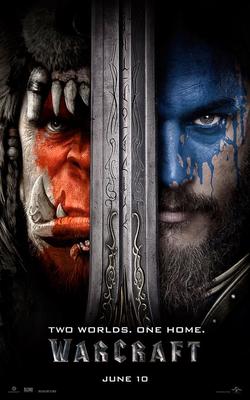
Warcraft


When Draenor, the orcs’ homeworld, begins to wither and die, orcish warlock Gul’dan (Daniel Wu) uses life-draining fel magic to open a portal to Azeroth to give the orcs a new land to conquer. Durotan (Toby Kebbel), chieftain of the Frostwolf Clan, is suspicious of Gul’dan and the fel, but he nevertheless joins a raiding party to ensure a future for his wife and child. On the other side of the portal, the use of fel magic is detected by Khadgar (Ben Schnetzer), a young human mage, who persuades military commander Anduin Lothar (Travis Fimmell) to alert his brother-in-law, King Llane (Dominic Cooper) as well as Medivh (Ben Foster), the mystic guardian of the realm. As battle lines are drawn between the humans and the invading orcs, there are those on both sides who realize that things aren’t quite what they seem.

Warcraft has been a popular computer game franchise for more than two decades, and a film adaptation has been in development for nearly half that long. Given the repeated delays, the required budget, the inevitable comparison to Lord of the Rings, and the dismal track record of movies based on video games, it’s a small miracle that a Warcraft movie was released at all. And while that much is a victory, not even the franchise’s most powerful mages can erase this flawed film’s many glaring blemishes.

Though the character design is inescapably cartoonish, on an aesthetic level, Warcraft acquits itself fairly well. The journey to Medivh’s spire in the sky provides some breathtaking views, battle scenes are competently choreographed, and Ramin Djawadi’s score evokes the grandeur of the games’ music without shamelessly mimicking it. On a superficial level, the movie delivers as expected.

Ironically, some of the film’s problems stem from a desire to transcend that superficiality. Director/co-writer Duncan Jones is an avid gamer, and though by necessity he streamlined and simplified some of the Warcraft mythos, he also showed a lot of reverence for the source material, which broke from some genre clichés (orcs here are a proud warrior society rather than simply dumb muscle for the forces of evil) while reinforcing plenty of others. Unfortunately, instead of 90 minutes of lightweight fun, this fidelity resulted in a solemn, occasionally leaden two-plus hours that still felt underdone.

Jones wasn’t helped by uninspired, cliché-ridden dialogue, thin characterization, and questionable casting decisions. Ethiopian-Irish Ruth Negga and white Australian Travis Fimmell are unconvincing as siblings, and Ben Foster’s American accent sounds very out of place. Among the few cast members who come off well here are those who take more liberties with the source material: Cooper plays Llayne with heroic gusto while Schnetzer’s Khadgar is somewhat bumbling (at first) and constantly disrespected and underestimated, a needed counterpoint to the stone-fisted solemnity.

Ultimately, Warcraft is unlikely to win over anyone who isn’t already a fan of the franchise, and even the latter group may find themselves disappointed. But there between the nostalgia factor and the visual flair, there is enough here to make it worth their time, albeit barely.


6.5/10

Sunday, December 21, 2014

The Hobbit: The Battle of the Five Armies

After the menacing dragon Smaug (voice of Benedict Cumberbatch) is slain by Bard the Bowman (Luke Evans), a displaced company of dwarves is finally free to reclaim its former home in the Lonely Mountain. Having a vast treasure at his disposal, however, turns dwarf king Thorin Oakenshield (Richard Armitage) greedy and paranoid. When his refusal to compensate his human and elven allies puts their forces at the brink of war, hobbit thief Bilbo Baggins (Martin Freeman) must take drastic action. Meanwhile, an orc army seeks to capitalize by launching a massive invasion.

The third and final film in Peter Jackson’s Hobbit trilogy, The Battle of the Five Armies is less a standalone work and more a reward to fans for their exceptional patience. After shamelessly padding the previous two installments, the finale clocks in at a relatively lean 144 minutes, and much of that running time is filled with action. The thinness and predictability of the plot would ordinarily be a major demerit, but in context, it makes for a satisfying conclusion to a sprawling saga.

Like all of Jackson’s Tolkien adaptations, The Battle of the Five Armies is well-shot and visually immersive. There are some places where the CGI is a bit too conspicuous (witness a puff of smoke frozen perfectly in place), but for the most part, the film successfully brings Middle Earth to life. The action sequences are similarly well-crafted. Though nothing here quite matches the previous film’s barrel scene, a late battle lets Legolas (Orlando Bloom) demonstrate some innovative swashbuckling. It’s also quite satisfying to watch Ian McKellen (Gandalf the Grey) and Christopher Lee (Saruman the White) beat down foes with wizard staffs at 75 and 92 years old, respectively.

As mentioned previously, the plotting here fails to inspire. Everything that transpires reads as a mere prelude to the inevitable battle, but the lulls in the action do allow for some character development: namely, Thorin loses and regains his honor, and elf warrior Tauriel (Evangeline Lilly) learns that pain comes with love. Her ill-fated romance with dwarf Kili (Aidan Turner) remains improbable and divisive, but it does fulfill the function of giving the film a “B” story.

For all its ridiculous moments - Thorin’s declaration that he won’t part with a single coin is inexplicably delivered in slow motion, and the film’s fauna are something else (a dwarf chieftain rides a boar while elf king Thranduil favors a war elk as his mount) – The Battle of the Five Armies entertains more often than it frustrates. It is by no means Jackson’s finest work, but it succeeds ably at bridging the gap from one trilogy to another and should satisfy fans of both.


8/10

Sunday, December 15, 2013

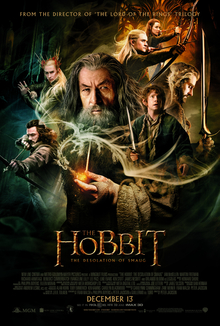
The Hobbit: The Desolation of Smaug

Accompanied by the hobbit Bilbo Baggins (Martin Freeman), the company of dwarves under the command of deposed king Thorin Oakenshield (Richard Armitage) continues its quest to reclaim the Lonely Mountain and the treasure within from the destructive dragon Smaug (Benedict Cumberbatch). Pursued by vengeful orcs, the dwarves must also deal with the elves of Mirkwood and the men of Laketown, all of whom want a share of the treasure. Meanwhile, their friend and guide Gandalf (Ian McKellen) must leave them to uncover a Necromancer’s sinister plot.

The second of three Hobbit films, The Desolation of Smaug is unlikely to win over anyone who found its predecessor unnecessarily long. Clocking in at 160 minutes, the film perpetuates Peter Jackson’s love-it-or-leave it approach to epic fantasy filmmaking. But those who found An Unexpected Journey at the very least tolerable will likely see this middle installment as an all-around improvement.

Though only a few minutes shorter than the previous film, The Desolation of Smaug passes the time much more quickly due to improved pacing. Giant spiders, giant dragons, elf fights, orc fights, evil spirits, and more create peril at every turn and lend a sense of urgency to the quest. However, this is not action for action’s sake. It shapes characterization as well. As Bilbo continues to use the ring he gained in the last film, he becomes more and more aggressive. And as Thorin gets closer and closer to reclaiming his birthright, he becomes more and more ruthless. While these developments risk turning the nominal protagonists unlikeable, they also provide complexity and set up the third installment fall from grace.

Another upgrade here takes the form of the chief antagonist, Smaug. Whereas the previous film’s orcs were a constant nuisance, Smaug is a menace on a much grander scale. Cumberbatch’s vocal performance is exaggerated at times but on the whole, quite appropriate for the character. Cunning, authoritative, and malevolent, the dragon is entirely believable as a force to be reckoned with. Again, this works to raise the stakes.

Of course, this isn’t a film without blemish. Even with better pacing, it still feels bloated in comparison to the source material. The addition of a romantic subplot involving young dwarf Kili (Aidan Turner) and elvish archer Tauriel (Evangeline Lilly) is nothing if not contrived. And the increased prominence of the Necromancer (aka Sauron) as an attempt to strengthen Lord of the Rings ties is distracting. Overall, however, Jackson and company have not worn out their welcome. If anything, they’ve built considerable momentum for what one can only hope is the final installment.


8.25/10

Saturday, December 22, 2012

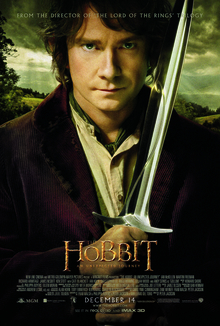
The Hobbit: An Unexpected Journey


Years ago, the dwarvish kingdom of Erebor was renowned for its great prosperity. The kingdom accumulated so much gold, in fact, that it attracted the attention of the dragon Smaug, who promptly took it over and exiled all the dwarves. Sixty years later, thirteen dwarves under the command of Thorin (Richard Armitage) join forces with the wizard Gandalf (Ian McKellen) and the hobbit Bilbo Baggins (Martin Henderson) to retake Erebor. Along the way, they will encounter trolls, goblins, the dreaded orcs, and a number of other dangers.

It seems utterly insane to stretch J.R.R. Tolkien’s 300-page novel into an epic three-film trilogy, but director Peter Jackson was never one for restraint. The same formula that won him so much acclaim for the Lord of the Rings trilogy can be found again here. Breathtaking visuals, rousing action, and a spirit of triumph are tempered by loads of characters to keep track of and a somewhat oppressive (nearly three hours) run time.

The extent to which The Hobbit shares common DNA with LOTR is both a blessing and a curse. On the one hand, the wealth of familiar faces (in addition to McKellen, Ian Holm, Elijah Wood, Hugo Weaving, Cate Blanchett, Christopher Lee, and Andy Serkis all reprise their roles) helps establish continuity and eases in those unfamiliar with the novel. On the other hand, a lengthy scene that introduces us to Gollum feels like a misplaced distraction.

As a self-contained work, The Hobbit features a fine performance from Henderson as the fastidious, self-doubting younger Bilbo. McKellen could play Gandalf in his sleep, but the septuagenarian continues to bring vigor and a commanding presence to the role. On the other hand, Armitage doesn’t look very much like a dwarf, and his Thorin, at times, feels like a second-rate stand-in for Aragorn.

From mass melee battles to death-defying journeys across rocky chasms, the film is not lacking in excitement. The combat is balanced by a good amount of humor, often at the expense of the easily perturbed Bilbo. In spite of this, watching The Hobbit is still an exhaustive experience. The film feels long, and reaching the end and knowing that something resembling closure is still two movies away makes it seem even longer.

The Hobbit: An Unexpected Journey is a visual marvel with ample talent on both sides of the camera, but watching it is as much a burden as it is a reward.

8/10