Showing posts with label War Films. Show all posts

Wednesday, June 17, 2020

Da 5 Bloods


During the Vietnam War, five African American soldiers lead by Norman (Chadwick Boseman) seize a cache of gold from a crashed CIA plane and conspire to keep it as repayment for injustices they have faced. They bury the gold so they can retrieve it later, but their markers are destroyed and Norman is killed in the combat that follows. Decades later, the four survivors – Paul, Otis, Eddie, and Melvin – return to Vietnam to retrieve the gold and Norman’s remains. Otis (Clarke Peters) reconnects with an old girlfriend, Tien, who puts the group in contact with a French businessman (Jean Reno), who is willing to buy the gold from them. They are also joined by a guide, Vinh (Johnny Tri Nguyen), and by Paul’s estranged son David (Jonathan Majors). Internal tensions threaten to tear the group apart if mine-laced terrain and opportunistic mercenaries don’t do so first.

Spike Lee’s first Netflix film is ambitious and messy, blending elements of a war film and heist film with his usual sociopolitical commentary. The crossgenre combination doesn’t sink Da 5 Bloods – if anything, it’s a selling point – but a bloated run time, tonal whiplash, and stylistic inconsistencies detract from a powerfully acted and timely film.

While the same cannot be said of the stereotyped supporting roles, most of the leads do a phenomenal job. Lindo makes Paul uneasily sympathetic: despite him being an angry xenophobe and terrible father, he’s racked with both guilt and PTSD and is painfully aware of his own mortality. Peters and Isiah Whitlock Jr., veterans of The Wire, do solid work as Otis and Melvin as well, adding tension and camaraderie as needed. Only Eddie isn’t quite up to par: Norm Lewis is about a decade too young for the role and overacts when given any dialogue almost as if to compensate. On the other hand, Boseman radiates charismatic leadership during his brief screentime.

Da 5 Bloods weaves together past and present and, like previous Lee films, uses archival footage and historical cut-aways. That much works to give the movie a coherent message and sense of purpose, but there is a lot here that is simply off. The war-era flashback scenes are shot in 16-mm film for a retro look, but the authenticity is undone by having the 20-something soldiers still played by 60-something actors who look every bit their age. At times, Da 5 Bloods borrows documentary techniques such as a traveling handheld camera or Paul offering an up-close confessional/monologue. At other times, however, it both looks and plays like an 80s/90s B movie. Despite the characters being named for The Temptations and despite the film being scored by a jazz trumpeter (Terence Blanchard), the soundtrack borrows heavily from Marvin Gaye’s What’s Going On.

These inconsistencies and a sense of ending fatigue can make Da 5 Bloods a bit of a chore to get through at times, but it has enough powerful moments to make it worthwhile.

Monday, January 20, 2020

1917


Following a German retreat from the front lines in France, British Gen. Erinmore (Colin Firth) receives aerial intelligence that indicates that the Germans are laying in wait to ambush the pursuing British forces. He dispatches two lance corporals, Tom Blake (Dean-Charles Chapman) and Will Schofield (George MacKay) to send word to the pursuers to call off their attack lest they lose more than 1,000 men, Blake’s brother among them. Though Blake is eager to help, Schofield is hesitant. As they get closer to their objective, however, the way forward becomes more and more perilous.

Basing the film on his grandfather’s war stories, writer/director Sam Mendes has crafted an ostensibly personal film that still manages to feel overly familiar. During the past few decades, The Great War has not received nearly as much cinematic attention as World War II, so this lack of novelty can, to an extent, be forgiven. Even so, missions to relay news (Saving Private Ryan) and following a few select soldiers as they hop from dangerous situation to dangerous situation (Dunkirk) have been shown before, and what 1917 offers thematically (war is hell, you fight for the person beside you, etc.) is hardly revelatory.

Aesthetically, however, 1917 is masterful. With very few cuts, Roger Deakins’ cinematography is meant to evoke one long take, and while that lends the film a distinctive fluidity, it is hardly the only noteworthy aspect of the film’s style. Wreckage and carnage under blank grey-white skies evoke sorrow while dark, claustrophobic entries into former German-occupied buildings and trenches are shot like a horror movie. Add to this the sinister awe of a city aflame at night, the pristine beauty of cherry trees amid green hills, Thomas Newman’s foreboding score and sharp editing, and 1917 is powerful and immersive in a way that belies its narrative simplicity.

The acting isn’t quite as jaw-dropping, but it is far from a letdown. While Firth, Benedict Cumberbatch, and Mark Strong have small roles as officers, Chapman and especially MacKay carry this movie. The former’s affability contrasts with the latter’s initial sourness though Schofield undergoes quite a turn as his mettle is tested time and time again.

1917 might not have anything new to say about war, but the technically dazzling way in which it says it rightly commands an audience’s attention the whole way through.

Thursday, August 3, 2017

Dunkirk

In 1940 in Occupied France, Allied soldiers are pushed to the coastal town of Dunkirk where they await evacuation. Tommy (Fionn Whitehead), a British Army private meets fellow soldier Gibson (Aneurin Barnard) on the beach, and the two try to gain access to a ship that will take them across the channel. Meanwhile, Mr. Dawson (Mark Rylance) volunteers his yacht to aid the war effort, and he, his son Peter (Tom Glynn-Carney), and Peter’s younger friend George (Barry Keoughan) set out aboard the vessel toward Dunkirk to provide life jackets and rescue survivors along the way. In the air, a group of Spitfires piloted by Farrier (Tom Hardy) and Collins (Jack Lowden) attempt to shoot down Luftwaffe bombers before they can attack the troops waiting at Dunkirk.

Nearly two decades ago, Steven Spielberg’s Saving Private Ryan set the gold standard for wartime realism with its brutal depiction of the Allied Invasion of Normandy. Though Christopher Nolan’s Dunkirk shares some surface elements with it (Allied soldiers on a French beach during World War II), it is very nearly the former film’s antithesis. It is also, in many ways, its equal.

After a brief glimpse of a frame story, Saving Private Ryan promptly offered twenty minutes of frenzied carnage before developing its characters and conflict and contemplating the value of sacrifice. Dunkirk does virtually none of that. Rather than offering a focused narrative, Nolan presents the film asynchronously. The overlapping land, sea, and air segments are meant to depict one week, one day, and one hour, respectively, which can make it a chore to keep up with. The PG-13 rating also ensures that Dunkirk is light on gore. Most of the action takes the form of aerial dogfights and troops swimming away from imminent doom. Lastly, instead of humanizing its characters by delving into their backstories, Dunkirk keeps them relatively anonymous: they work as everymen because they could be any men.

Despite these departures from war film conventions, Dunkirk is very much not a pretentious or sanitized affair. As with many of Nolan’s previous films, it is stylistically breathtaking, be it the plumes of smoke rising over the bombarded beach or the sweeping maneuvers of the Spitfires. Hans Zimmer’s score also leaves quite an impression. In lieu of valorous reveries, he offers a ticking clock, ominous strings, and compositions befitting a horror movie, an appropriate (if unexpected) choice given the subject matter.

The film’s style works to impart a near-constant sense of dread. Though the audience never sees the face of the enemy, we are constantly reminded that the enemy is out there. We know that it is only a matter of time before the next attack, and the characters know it too. They are trapped in their own existential hells, whether it is Tommy going from sinking ship to sinking ship or Farrier running across one German plane after another as his fuel supply dwindles. Like previous Nolan films, Dunkirk reaches a hopeful note – in this case, a surviving character reads a Winston Churchill speech in a newspaper – but it makes both the characters and the audience suffer for it.

Speaking of characters, the cast of largely lesser-known actors does a lot with a little. As Tommy, Whitehead is wholly believable as a scared young man who just wants to get home in one piece. A lesser film would have him start that way and “grow” into something of a sacrificial action hero by the end, but Nolan wisely avoided that pitfall. The cast does boast a more conventional action hero in Hardy, and while he plays Farrier with cool competence, his escapades do not strain credulity. On the opposite end of the spectrum, the two Allied characters positioned most antagonistically – a shell-shocked survivor (Cillian Murphy) rescued by Dawson and a hotblooded Scottish soldier (Harry Styles) – are driven by the same thing that drives Tommy: survival. Aside from Hardy and Murphy, the two biggest “names” are Rylance and Kenneth Branagh. The former plays Dawson with uncompromising bravery and integrity while the latter, as a Navy commander, personifies the British stiff upper lip. All of these actors get by with very little dialogue, and even the Shakespearean Branagh avoids spotlight-hogging showiness.

Traditionally, war movies dramatize victory, however much they show of its often-steep costs. Dunkirk, on the other hand, dramatizes a long retreat. In doing so, however, it does not slander its subjects but rather affirms their humanity and their service (conscious or not) to the greater good. After all, dying en masse in Britain’s name would have meant little if there was no one left to defend the homeland (curiously, the contributions of French soldiers are downplayed, much in the way that British contributions are diminished in American WW II films), and the evacuation directly led to Churchill’s rousing speech. It is unknown if Dunkirk will seem as tense, refreshingly unorthodox, and stylistically masterful in the years to come as it does today, but it’s so far among the best films that 2017 has to offer.


8.5/10

Saturday, June 14, 2014

The Monuments Men

In 1943, art conservator Lt. Frank Stokes (George Clooney) organizes a group of Monuments Men to safeguard Europe’s artistic and cultural treasures from the ravages of war. Working with the French resistance, the group must thwart the Nazi effort to first horde and later destroy priceless works of art.

History is full of untold and undertold stories, and the Monuments, Fine Arts, and Archives program is one such tale. But Clooney, who also directed, wrote, and produced, does a disservice to the subject here. From a sloppy script with inept pacing and underwritten characters to a bewildering tone, The Monuments Men is also Hollywood history at its worst.

This disappointment doubles in light of the supremely talented cast. Matt Damon, Bill Murray, and John Goodman are all part of Stokes’ team while Cate Blanchett plays a fictionalized Rose Valland, a curator working behind the Nazis’ backs in occupied France. No one does a particularly bad job here, but the actors fail to elevate these characters above the level of mere functionaries. The only one with any complexity is Donald Jefferies (Hugh Bonneville), a formerly alcoholic British officer in search of redemption. It’s also telling that despite the comic credibility of the cast, the funniest lines go not to Goodman or Murray, but to Bob Balaban.

Characterization, however, is only one of several significant problems. The film has a hard time deciding what’s at stake. This is acknowledged in the narrative itself: the morality of risking lives for the sake of art and culture is debated several times. And while the film wants us to conclude that the sacrifices made were worthwhile, it doesn’t do nearly enough to win the audience over to that position. This shortcoming is abetted by the film’s often-goofy tone, which makes its more serious moments seem inauthentic and jarring. Imagine if the framing device from Saving Private Ryan was applied to a surviving member of The Dirty Dozen, and you’ll get a sense of why this doesn’t work.

With laggy pacing and wildly ahistorical Amerocentrism, The Monuments Men leaves a lot else to be desired. It isn’t a total loss – the cinematography is sharp, and the film does raise awareness of an overlooked subject – but for Clooney and everyone else involved, The Monuments Men is a monumental disappointment.


6.25/10

Sunday, June 20, 2010

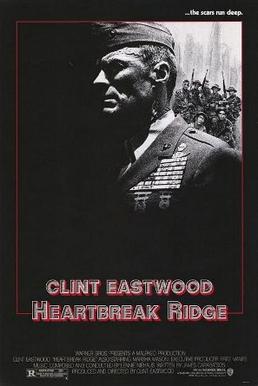
Heartbreak Ridge

Gny. Sgt. Tom Highway (Clint Eastwood) is a highly decorated but chronically insubordinate Marine nearing retirement age. He is sent back to his old stomping grounds to train a group of ragtag Marines in preparation for the invasion of Grenada. Neither his charges, his inexperienced commanding officers or his ex-wife (Marsha Mason) expect him to succeed, but Highway is determined not to quit.


Named for a Korean War battle, the film’s title pulls double duty as Highway tries to get his ex back. Eastwood’s in good form as the tough, hard-drinking Gunny, but the material and supporting cast are beneath him. Mason does her fair share of pushing away before inevitably giving in and Everett McGill is one dimensional as an antagonistic, by-the-book major. Mario Van Peebles at least livens things up as a corporal who moonlights as a rock musician, but he’s hard to take seriously as a fighting man.


The film’s whole problem is one of tone. For the first two thirds of the film, Highway’s Recon Marines are depicted as rejects and losers (who the veteran sergeant will turn around using some unorthodox methods, of course). As a comedy in the Major League/Bad News Bears vein, this would have been derivative and a bit tasteless, but it might have worked. Instead, the film does away with all notions of farce by launching into full-scale combat during the final third. Despite being written by a Vietnam vet and loosely inspired by true events, the war scenes felt preposterous and cartoonish. Amid heavy gunfire and tank, only one friendly bites the dust and you know it’s not going to be Clint.


As mindless entertainment, Heartbreak Ridge delivers with its sense of fun intact. But as a war film, it makes a mockery of our armed forces and falls incredibly flat. The fault doesn’t lie with Eastwood, but even he’s not a miracle worker.


6.25/10