Thursday, June 21, 2012

What We Talk About When We Talk About Anne Frank


Holocaust survivors, Israeli settlers, affluent Americanized Jews, and bullied children grapple with faith, guilt, morality, history, cultural identity, and more in Nathan Englander’s 2012 short story collection.

Much like Michael Chabon, Nathan Englander can both be called a “Jewish writer” and so much more than that. But while Chabon uses ingenious settings (the Khazar Empire, an alt-history Alaska, etc.) to explore Jewish themes, the Long Island-born, Orthodox-raised Englander takes a more straightforward approach. The results aren’t always as entertaining, but they at least try to be enlightening.

In Englander’s latest collection, there are successes and failures both. The strongest offering here is the title story. Named in homage to Raymond Carver’s “What We Talk About When We Talk About Love” (in which two middle-aged couples exchange uninhibited banter while drunk on cheap gin), “What We Talk About When We Talk About Anne Frank” features an awkward rendezvous between secular Jews and Hassidim that takes on new dimensions when an intoxicant is brought into play. The piece is as quirky and slyly humorous as it is weighty and tense, and if the whole collection was as well put-together, the copious amount of blurbs on the book’s outer jacket would be considerably more understandable.

Strangely enough for the U.S.-born Englander, the two other stories that stand out here are set in Israel. “Sister Hills” features a resolute settler woman who has lost both husband and sons and clings fiercely to what she has left. The juxtaposition of her attitude with the views of those around her offers some insight into the fragmented nature of Israeli society. The final story in the collection, “Free Fruit for Young Widows,” leaves a war veteran to explain to his son his deference to a seemingly callous colleague who survived the Holocaust. Here, Englander gives us a stark accounting of just how much the Holocaust sucked the humanity from all that it affected.

The remainder of the collection falters for a variety of reasons. “How We Avenged the Blums” is a humorous take on underdogs fighting back, but it feels slight. “Peep Show” goes for shock value: a gentrified Jew confronts the ghosts of his past (in the form of rabbis) in a nudie booth. It’s original, but not particularly coherent. “Everything I Know About My Family on My Mother’s Side" tries to tell a family’s history in list form, a gimmick that never seems justified here. “Camp Sundown” has probably the best premise of the lot – a group of elderly Jews at a summer camp suspect one of their own of being a concentration camp guard – but squanders it by hitching the narrative to a weak protagonist and vacillating between humor and horror with little finesse.  

Though there is thematic overlap between all of the stories here, it would not be fair to dismiss Englander as a one-note writer. However, there is something to be said for broadening one’s focus instead of trying different, only partly successful permutations of the same ideas.

7.25/10

Saturday, June 9, 2012

Storm Front


Storm Front

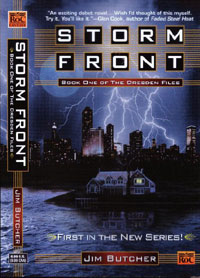
Chicago-based wizard-for-hire Harry Dresden is called upon to help a woman locate her magic-using husband. Not long thereafter, a mob enforcer and his consort end up dead, and the police are looking to Harry for answers. As if that isn’t enough, the magic world’s rule-keepers are convinced that he is up to no good and are determined to bring him to justice.

The first book in Jim Butcher’s The Dresden Files series, Storm Front lets us into Dresden’s world and gives us shades of his backstory while still maintaining an aura of mystery about him. That may be a reason to read the follow-ups because the writing here certainly is not.

Though intended, undoubtedly, as an homage to classic noir, Storm Front parrots the worst of the genres clichés. Dresden himself is the archetypical brooding, sarcastic, down-on-his luck antihero. The magical elements do add a sense of novelty to his character, but he comes across far too often as a third-rate Philip Marlowe ripoff with a pentagram and a staff. Unfortunately, his supporting cast is no better. His tough-but-fair-minded police contact, Karrin Murphy, is basically Marlowe’s Bernie Ohls in a skirt, and the sympathetic bartender, the smooth Mafioso, the skeptical cop, the client withholding information, and the (in this case, literal) hard-bitten vamp are all stock characters we’ve seen before.

Alas, the familiarity extends to the plotting as well. As per genre conventions, the people Dresden talks to for information have a way of ending up dead shortly thereafter, to the surprise of absolutely no one. Also, one would have to be an idiot (or Dresden himself for half of the book) to not wonder if the wizard’s two cases are in some way related. To top it all off, there’s even an “all’s well that ends well” wrap-up at the end.

Two things save this book from being a total bust. One, the oddity of the magic/mystery mashup lends itself to some amusement. There’s Bob, the horny ghost that Dresden keeps in a skull, and there’s a fairy that randomly craves pizza. Secondly, Butcher has a decent eye for detail and renders Chicago’s cityscape in appropriately dreary hues.

Given that Butcher wrote Storm Front at age 25, there is reason to believe that his work has gained polish and complexity in the years since (he’s now 40). But if Storm Front is indeed a harbinger of things to come, then the much-ballyhooed series seems like less than a magical reading experience.

6.75/10

Tuesday, May 22, 2012

The Marriage Plot


The Marriage Plot

It’s 1982, and Madeleine Hanna is about the graduate Brown University. The English major finds herself drawn to Victorian literature and its battle of suitors for a heroine’s favor. Meanwhile, her own life is not without parallels. Madeleine struggles with an on-again, off-again relationship with brilliant-but-unstable science major Leonard Bankhead while being pined for by religious studies major Mitchell Grammaticus, whom she hopes to keep as a platonic friend. The prospect of graduation, the stress of the real world, and the expectations of friends and family threaten to bring everything to a head.

Based on both his formidable talents and his infrequent publication, it is easy to view Jeffrey Eugenides as a semi-mythical figure in literature. You may not hear much from him for most of a decade, but every nine years, a new novel shall drop, and it shall be a big deal. The seeds of this reputation were sewn in 1993 when he debuted with The Virgin Suicides, a mixture of coming-of-age and tragedy that featured one of the more ambitious points of view (anonymous third person plural, akin to a Greek chorus) ever attempted. He further established his reputation in 2002 with Middlesex, a sweeping, thematically rich (but stylistically more conventional) family history that netted him a Pulitzer. 2011’s The Marriage Plot now adds another wrinkle to the Eugenides legend.

The defining feature of this book is its intimacy. Whereas Eugenides’ previous efforts were at some remove from their focal characters, The Marriage Plot gets up close and personal with Madeleine, Mitchell, and Leonard. Eugenides, who attended Brown in the early 80s, uses these characters to deftly skewer literary deconstructionism and other elitist fads of the day (backpacking through Europe) with authority. In Leonard’s case, we are also treated to a horrifyingly personal look at mental illness. Watching him struggle – and Madeleine struggle with him – gives the book some much-needed heft; without it, we would be subjected to hundreds of pages of triviality.

Unfortunately, the other two leads are less strikingly defined. Mitchell’s dual quest for Madeleine and for religious truth makes him a compelling character, but our interest is tempered by the knowledge that he is a likely stand-in for the author (Michigan origin, Greek surname, etc.). Comparatively, Madeleine seems almost empty. She has a rich backstory (pseudo-upper class parents, a history of failed relationships, the slow realization that being pretty isn’t enough, etc.), but it is never entirely clear what is driving her. Her interest in Victorian lit comes to the forefront briefly but is a background element for most of the novel. Meanwhile, the depth of her devotion to Leonard seems at times unjustified.

Despite such flaws, The Marriage Plot is a difficult book to put down. We might not be affected as much here as we were by the revelations of The Virgin Suicides or Middlesex, but the immersive settings, fitfully funny moments, and skewering of academic pomposity make it worth a read. Moreover, its slight disappointment is illuminating. Now that we all know that Eugenides is human after all, perhaps the nine-year cycle will end, and he’ll publish more frequently.

8/10

Zali Mongolian Grill (CLOSED)


NOTE: Zali has since closed. Xtreme Grill operated in its location but may now be closed as well.

Located at 4929 West Market Street in Greensboro’s Fantacity International Shopping Center, Zali Mongolian Grill offers a wide variety of meats, vegetables, seasonings, and sauces stir-fried over your choice of starch. There is also a salad bar and a full-service bar with drink specials.

Mongolian barbecue is one of food’s ultimate misnomers. It is neither Mongolian nor barbecue, but that doesn’t stop it from attracting its share of followers. The main draw is the hands-on customizability of a meal, and Zali delivers that in spades. The selection here is simply unmatched. In addition to the expected chicken, beef, pork, and seafood, you can make a stir fry with frog’s legs, goat, or lamb. There are also tons of seasonings and a few sauces to choose from that allow you to control how sweet or spicy your dish is. If you tire of eating over rice, noodles and tortillas (!) are also available options.

While the quality does not match the selection, Zali fares well by buffet standards. The shrimp were put out in a big frozen block – not exactly appealing – but everything tasted fine once cooked. The flavors you experience are ultimately your call, and it may take some experimentation to strike the right balance. Fortunately, a screw-up won’t prove costly: dinner at Zali is $11.95, quite the reasonable pricetag for all-you-can eat.

 Zali’s staff seems to be equal parts competent and courteous. Our server not only gave us a tour, but checked up on us frequently and suggested sauce combinations. The grill cooks are likewise friendly and non-judgmental when it comes to the contents of your bowl.

With its blue-lit bar and inoffensive music, Zali delivers an atmosphere that is casual and comfortable. But at the same time, it is all too easy to picture the comfort level dropping precipitously during a lunch rush. This isn’t to say that Zali is cramped, but rather that the prospect of lines at the buffet does not inspire good vibes.

Like any Mongolian barbecue, Zali carries with it a certain degree of novelty that is bound to wear off. The sheer number of permutations of tastes and textures, however, makes this establishment more than a one-trick pony.

8.25/10
Zali Mongolian Grill on Urbanspoon

Sunday, May 13, 2012

Raylan


There’s never a dull day for no-nonsense U.S. Marshal Raylan Givens. First, he is tasked with finding out who in Kentucky has been trafficking in stolen kidneys. Signs point to a pair of redneck brothers, but someone higher up is clearly the brains of the operation. Next, Raylan, a former coal miner, finds himself caught in a conflict between mining folk – one of whom has been shot under suspicious circumstances – and a mining company, represented by a hardnosed businesswoman and Raylan’s old friend/nemesis, Boyd. Lastly, he must track down a college-age poker prodigy who skipped a court appearance while determining if she has also been dabbling in bank robbery.

Two things have happened to Elmore Leonard since he reached his mid-80s. One: he received some long overdue recognition thanks to the popularity of the TV show Justified (which centers on that very same Raylan Givens). Two: his writing has become a lot sparser and more inconsistent. In Raylan, both of these phenomena converge.

Raylan is not a novel in the traditional sense. There is no overarching plot, and it reads more like three novellas lumped together. One can’t help but wonder why Leonard didn’t simply structure it that way. True, Raylan’s three cases relate and refer to one another, but the episodic nature of each one causes the book to meander and lose tension. Judging from this effort, you would never have guessed that Leonard was once as great at plotting as he is at dialogue (which remains as sharp and colorful as ever).

No, the best way to read Raylan is as a bizarre companion piece to Justified. Many of the series’ characters – beleaguered boss Art Mullen, conniving Boyd Crowder – show up here intact. That’s good news for series fans, but for those looking for a stand-alone adventure, you may find the supporting cast to be somewhat thinly drawn.

These criticisms aside, Raylan does have its high points. The title character takes on a little more depth here while remaining the hat-wearing gun-slinging badass many of us have come to appreciate. The imbecilic Crowe family (seen in a number of Leonard’s other works) lends some levity through their impossibly dumb criminal antics, and the conclusion, while the conclusion puts a refreshingly outrageous spin on the “final showdown” cliché.

Raylan is far from Leonard’s best work, and it would be a shame if this is the last we see of the character in print. But as literary “add-on content,” it entertains and preserves our interest.

7.5/10

Sunday, May 6, 2012

The Avengers


Asgardian trickster god Loki (Tom Hiddleston) comes to Earth to steal the Tesseract, a powerful energy source of mystical origin. He plans to use it to open a dimensional portal to allow an alien army to assist him in conquering the planet. To stop him, SHIELD director Nick Fury (Samuel L. Jackson) calls together recently re-animated super soldier Steve Rogers (Chris Evans), genius industrialist Tony Stark (Robert Downey Jr.), and reclusive gamma radiation expert Bruce Banner (Mark Ruffalo). But will these heroes be able to see past their differences to stop Loki’s plan?

The 2003-04 Los Angeles Lakers proved that it is possible to have too much of a good thing. That team featured four Hall of Fame-caliber players and a Hall of Fame coach, yet it could never fully gel and fell short in the finals. Thankfully, The Avengers does not suffer the same fate. The film comes with some lofty expectations. Years in the making, it builds on the individual successes of Marvel’s Iron Man, Incredible Hulk, Thor, and Captain America franchises. It brings together the talents of A-listers Downey Jr., Jackson, and Scarlett Johansson as well as Gwyneth Paltrow, Jeremy Renner, and several other names. Hell, it even led Soundgarden to record its first new song in more than a decade for the soundtrack.

With such promise, it is all too easy to disappoint, and a lot of the credit for not falling short goes to writer/director Joss Whedon. Whedon is known for putting is own distinctive stamp on projects, and while some of his conventions (don’t get too attatched to all of the characters) are present here, he is also appropriately defferential to the source material. His top-notch script includes plenty of humor, expected in the case of Iron Man but pleasantly surprising coming from deadpan Captain America and Thor. There is also a strong emphasis on character development as each of the heroes has his or her own inner struggle to contend with. These trials and tribulations range from adapting to the modern world to atoning for past sins to literally containing a monster within. Even the villain’s scheme is given some depth as Loki is looking to escape older brother Thor’s (Chris Hemsworth) tall shadow.

The cast takes these roles and runs with them. Hiddleston’s Loki is infinitely more menacing than he was in his last appearance, Downey Jr.’s stark/Iron Man threatens to steal every scene, and Ruffalo effortlessly slips into the Banner character (previously played by Edward Norton). For such an action-driven movie, it’s somewhat surprising that this is also a showcase for Johansson, who brings a trace of vulnerability and guilt to Black Widow, a hyper-competent SHIELD spy. Even Jackson gets something to do here besides give brief inspirational speeches. He plays Fury (a character modeled after his likeness in the comics) as manipulative, unflappable, and resolute.

Visually, The Avengers acquits itself well. Despite bringing together characters from very different settings, the integration is seamless. Thor’s command of lightning here is awe-inspiring rather than cartoonish (as was the case in his solo film), and Iron Man’s flying sequences offer typically splendid aerial views. Only the alien Chitauri – perhaps due to their sheer number – seemed generic and uninspired, a video game enemy run amok in an otherwise realistic-looking film.

There is something undeniably old-fashioned about a group of heroes coming together to fight the good fight. The film itself remarks on this, and perhaps there are a few who will be let down by this bowing to convention. But when the execution is this outstanding and when the expectations are this ably met, is being a throwback such a bad thing?

9/10

Thai Corner Kitchen


NOTE: Thai Corner Kitchen has opened a second location at 3741B Battleground Avenue in Greensboro.

Located at 2600 High Point Road, Thai Corner Kitchen offers authentic Thai cuisine. A drive through window is available as is delivery for orders over $15. Coupons may be found at the restaurant’s Web site.

Since I first arrived in Greensboro, this location has been home to Vietnamese, Thai, Greek, and now Thai again. Hopefully, another change in ownership is not in the works; on food alone, Thai Corner Kitchen would be sorely missed. The quality ranges from competent (the Pad Thai – tasty, but nothing special) to phenomenal (the shrimp/pork/corn dumplings – sweet, perfectly balanced, and addictive). In between, you will find all levels of satisfying. The panang curry was full of sweet peanut flavor while the pad kapow packed a spicy punch. The menu is full of traditional favorites (Thai fried rice, mango and sticky rice, tom ga), and there is enough variety to cover newbies and Thaiphiles alike.

Thai Corner Kitchen’s High Point Road location is sketchy though not to the point of being a deterrent. The inside is far from spacious but not nearly as cramped as Bangkok Café. The flora and wall art add touches of class to an otherwise dated interior. Let’s be honest, though: people come here for the food. If you seek ambiance, A Taste of Thai will probably suit your needs, albeit at the expense of more muted flavors.

Though I am primarily a take-out patron, my last visit to Thai Corner Kitchen was dine-in. Our server was attentive and knowledgeable. He offered recommendations that proved to be home runs, and he also showcased his singing chops for a nearby table. Wait time for the food was minimal.

Whether you eat in or take your food to go, don’t expect to break the bank. Most of Thai Corner Kitchen’s entrees run $8 to $12, depending on the protein, and lunch prices are $2 to $3 less. For the quality of the food and size of the portions, the value is (pardon the pun) Thai-riffic.

All told, Thai Corner Kitchen has the trappings of a local institution. But only time will tell if it sticks around long enough to cement its reputation.

8.25/10
Thai Corner kitchen on Urbanspoon