Showing posts with label Sports Films. Show all posts

Monday, April 29, 2013

42


In the mid-1940s, Brooklyn Dodgers executive Branch Rickey (Harrison Ford) makes it his goal to break baseball’s color barrier. To do so, he signs World War II veteran and Negro League star Jackie Robinson (Chadwick Boseman). Robinson’s debut causes an uproar, and he has to contend not only with racist fans and opponents but a frosty reception from his own teammates. With the encouragement of Rickey, wife Rachel (Nicole Beharie), and sportswriter Wendell Smith (Andre Holland), he is able to earn respect on and off the field.

Sports movies lend themselves all too easily to cliché. Many are underdog stories, and in recent years, several have been made that honor coaches and athletes who confronted America’s ugly racial history head-on. In that sense, 42 – a movie about sportsdom’s best-known racial pioneer – is a definite throwback, but being conventional doesn’t mean it can’t also be compelling.

Directed and written by Brian Helgeland, 42 seeps itself in the spirit, if not the letter, of historicity. Granted, a few details were changed – the antics of fiery Brooklyn manager Leo Durocher (Christopher Meloni) were toned down, for instance – but there is plenty of period detail to admire, and, for baseball fans, plenty of trivia. Witness, for instance, Rickey decide against signing Satchel Paige (who would pitch into his 50s) because he was “too old.”

But 42 is more than just a sepia-toned photograph. Earnest performances bring the movie to life. Boseman, who is a good physical match for the young Robinson, plays him as both extraordinarily determined and prideful. Ford, under heavy makeup, provides the film’s moral anchor: his Rickey claims to be in it for the money but comes across as pious and guilt-ridden. The supporting performers, which include Lucas Black as Dodgers captain Pee Wee Reese and John C. McGinley as broadcaster Red Barber, all solidly fill their limited screen time. Only Alan Tudyk feels out of place. He plays Phillies manager Ben Chapman, a virulent racist, as a Southern-fried clown. No one is asking him to don Klan robes, but Tudyk’s jocular turn comes across as disconcerting.

Ultimately, that may be the only thing unexpected about this movie. Despite the well-crafted delivery, the film fails to shine any new light on its subjects. It does exactly what we expect it to. History plays out here as it might in a book. As slightly Hollywoodized biography, 42 does Robinson et al justice. As entertainment, however, this is more akin to a solid base hit than a thunderous home run.

7.75/10

Sunday, April 7, 2013

Trouble With the Curve


Gus Lobel (Clint Eastwood) is a veteran Atlanta Braves scout with a legendary reputation. He is also a stubborn traditionalist who refuses to acknowledge changes to the game or his own failing eyesight. When Gus is sent to North Carolina on what could be his final scouting mission, he is accompanied by Mickey (Amy Adams), his headstrong attorney daughter with whom he has a strained relationship. As they check out a top high school prospect, they are joined by Johnny (Justin Timberlake), a former ballplayer that Gus scouted who is now a scout himself for the Boston Red Sox.

Directed by Robert Lorenz, Trouble With the Curve is a failure on two fronts. As a message movie about forgiveness and adapting to change (curveball = learning curve, as if that wasn’t obvious enough), it’s predictable fluff. As a baseball movie, it’s patently ridiculous. The names of famous ballplayers are bandied about, but that’s as close to the actual game as the movie gets. The main antagonist, a rival Braves scout portrayed by Matthew Lillard, is a flimsy caricature of sabremetrics and modern scouting approaches. He exists only so Gus and his old-school methods can feel vindicated by the end. Of course, this anti-Moneyball message doesn’t jibe well with reality, and Gus’ vindication owes more to dumb luck than the superiority of his methods.

Such oblivious heavy-handedness permeates the script. Any character who is meant to be one of the good guys (Gus, Mickey, Johnny) is given a stock sympathetic backstory to cover for their otherwise jerkish behavior. Meanwhile, the supporting roles are as one-dimensional as Lillard’s. John Goodman is wasted as Gus’ longtime supporter and director of scouting as is Robert Patrick as the Braves’ noncommittal GM. Bob Gunton shows up here as a higher-up from Mickey’s law firm, a mildly antagonistic role he could have recorded in his sleep.

Despite this, Eastwood and especially Adams rise above the material. Though Eastwood has “grumpy old man” down to an art form, he is still able to ring genuine emotion out of his role. Whether he’s mourning his wife or struggling to explain his absentee parenting, you get the sense that there is a real (and really hurt) person swimming behind the tough guy façade. Adams likewise balances tough and sassy with deeply concerned and hurt, giving Mickey both an edge and a heart. Timberlake, on the other hand, is clearly not in the same league. He may not be dreadful here, but it’s still hard to take him seriously.

With a little more verisimilitude and imagination, Trouble With the Curve could have overcome its predictable premise. Instead, it’s an utterly forgettable clunker that strikes out despite its talented cast.

6/10

Sunday, October 9, 2011

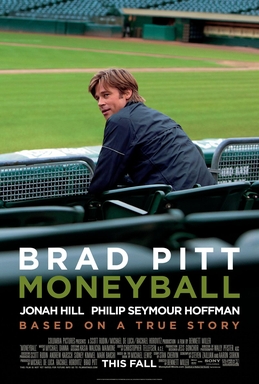
Moneyball

After the Oakland As are knocked out of the 2001 playoffs and lose key players through free agency, general manager Billy Beane (Brad Pitt) decides a new way of thinking is in order. To that end, he hires Peter Brand (Jonah Hill), a Yale-educated stats geek, and the two of them go about reshaping the roster. In doing so, they butt heads with old-school baseball men like manager Art Howe (Philip Seymour Hoffman), but as the season progresses, their radical thinking catches on.

Produced by Pitt, directed by Bennett Miller, and scripted by Aaron Sorkin from Michael Lewis’ influential book, Moneyball comes to the plate with an impressive pedigree. Still, it faces a sizeable limitation from the get-go: how do you make the story of a team that never won anything into a compelling cinematic narrative?

The answer is zeitgeist. Moneyball is set at a point in time where baseball’s biggest worry was not steroid abuse but financial disparities and contraction fears. In that context, the struggle of the As to stay afloat takes on new importance, and the stakes are raised. It is no longer just a baseball movie, but a fight-the-system resistance piece.

It also helps that Pitt comes out swinging as Beane. To be certain, some of his “maverick” moments seem manufactured, but Beane’s personal demons – choosing professional baseball over college, never succeeding as a player, struggling to be an adequate father – are fully realized. As for the rest of the lineup, Hill gets some funny lines as Brand (loosely based on the less nerdy Paul DePodesta), young Kerris Dorsey shows some musical ability as Beane’s admiring daughter, and Hoffman is solid if somewhat bland in a largely thankless, vaguely antagonistic role as Howe (a successful manager not cut out for 21st century baseball).

Compared to the book (and, presumably, reality), the film version of Moneyball takes a lot of liberties and cuts a lot of corners. No mention is made on-screen of the As then-emerging rotation (Tim Hudson, Barry Zito, and Mark Mulder), for instance. In terms of making the book filmable, however, the alterations are probably for the best.

Ultimately, Moneyball’s biggest weakness is the pesky intrusion of real life events. The film ends after the 2002 season with Beane turning down an offer from the Red Sox in order to remain in Oakland. Knowing that the As still haven’t made it to (let alone won) a World Series in the past 20 years, that Beane’s worship of on base percentage has not produced a particularly dynamic offense (to say the least), and that DePodesta flopped as general manager of the Dodgers goes against a lot of what this film stands for. And while such knowledge can’t be simply cast aside, it shouldn’t be enough to completely mar what is otherwise a quirky, compelling tale that transcends the ballpark.

8/10