Showing posts with label horror films. Show all posts

Monday, August 4, 2025

Sinners


In 1932, Elijah “Smoke” and Elias “Stack” Moore (Michael B. Jordan), twin veterans of World War I and the Chicago underworld, return to Clarksdale, Mississippi to open up a juke joint. They recruit their younger cousin Sammie (Miles Caton), an aspiring musician, against the wishes of his preacher father (Saul Williams) and bring old friends and lovers into the fold. While the opening of their establishment draws out the Black community, it also attracts the attention of Remmick (Jack O’Connell), an Irish vampire who sees in Sammie a way to connect to his ancestors.

Writer-director Ryan Coogler has never been one to be constrained by genre. To a body of work that includes the hard-hitting biopic Fruitvale Station, the franchise-rejuvenating Rocky spinoff Creed, and the Afro-futurist spectacle Black Panther, he adds a mashup of neo-noir and Southern Gothic horror. The craftsmanship, the thematic focus on the dispossessed, and several recurring collaborators remain constants, but to a greater extent than his previous films, Sinners sees Coogler taking more cinematic risks. For the most part, they pay off bountifully.

Both visually and narratively, Sinners is full of striking period detail. The promise of the open road that the Moores traverse is punctuated by the sights of chain gangs and segregated stores while the raucous dancing of their opening-night celebration is darkly mirrored by the jig-performing vampires massing outside. Ludwig Gonarsson, Coogler’s go-to composer, outdoes himself here, offering a soundtrack that honors the Delta blues while reaching well beyond them. It features contributions from the likes of blues legends Buddy Guy (who also has a rare acting role) and Bobby Rush but also folk singer Rhiannon Giddens and Metallica drummer Lars Ulrich as well as several of the musically inclined members of the cast (Caton, O’Connell, Hailee Steinfeld, and Lola Kirke, among others).

The cast is rock-solid as well. Jordan – Coogler’s regular leading man – overdoes the Mississippi accent at times, but he otherwise succeeds in giving two very different performances as the cold, quiet, resolute Smoke and the friendlier, more charismatic Stack. In shades of one of Jordan’s best-known roles (Black Panther’s Erik “Killmonger” Stevens), O’Connell brings a sense of tragedy to a ruthless character willing to commit reprehensible acts. Even the supporting roles that seem stereotypical at first glance – a conjure woman who knows how to ward off evil and a perpetually drunk old bluesman — are given touches of complexity thanks to both Coogler’s script and the work of capable actors like Wunmi Mosaku and Delroy Lindo.

Speaking of the script, it manages to weave together many disparate influences (fans of Devil in a Blue Dress and From Dusk Till Dawn take note) without collapsing. The Moores’ names are pointedly Biblical and Sammie is loosely based on Robert Johnson, but Coogler wisely avoids making Remmick one-dimensionally devilish. The Irish vampire, who fled the English and many others since, tries to sell turning his victims as a means of providing them the egalitarianism that society will forever deny African Americans…albeit at the cost of their individuality. It’s a pointed critique, but thanks to the film’s energy, Sinners never slows down enough to feel pedantic. It isn’t until the prolonged final quarter or so when the contrived coincidences and conveniences begin to pile up to the point of distraction, but even the comparatively weak ending doesn’t come close to torpedoing the movie.

Some might argue that there is enough horror in history to make Coogler’s metaphorical marriage of the two unnecessary. However, it is unlikely that a more straightforward period drama would be able to captivate to the extent that Sinners does.


Monday, October 17, 2022

Werewolf by Night


When Ulysses Bloodstone, leader of a group of monster hunters, dies, the other group members are enlisted to compete in a hunt to determine who will replace him and wield the powerful Bloodstone. The aspirants include Ulysses’s daughter Elsa (Laura Donnelly), who had forsaken her family’s legacy, as well as Jack Russell (Gael Garcia Bernal), who boasts an impressive track record and harbors more than a few secrets. As the hunt gets underway, it soon becomes clear that nothing is as it seems, including the monster the group is chasing.

Prolific composer Michael Giacchino’s directorial debut is billed as a Marvel Studios Special Presentation, occupying a middle ground between a feature-length film and an episode of a Marvel/Disney Plus streaming series. Tonally and aesthetically, however, it stands apart from either. Shot in black and white, it is a faithful homage to the monster movies of old. Far from being a mere nostalgia act, however, Werewolf by Night is a stylistic spectacle that highlights lesser-known Marvel characters.

The film’s 53-minute runtime is both a blessing and a curse. Werewolf by Night is tautly paced with nary a wasted moment, let alone a superfluous subplot or ham-handed declaration of theme (I’m looking at you, She-Hulk). However, because we follow them so briefly, we do not get to know most of the movie’s characters very well. The stakes will always be lower for red shirts led to slaughter than they will be for fan favorites biting the dust.

Despite these confines, however, Bernal and Donnelly do a decent job of fleshing their characters out. Bernal’s Russell is enigmatic, and though he is not the tortured soul of his comic book counterpart, he has more depth and morality than his initial appearance suggests. Donnelly exudes a cool competence verging on boredom at times, but this façade crumbles when she finds herself face-to-face with a monster she did not expect. As Elsa’s stepmother Verussa, Harriet Sansom Harris hams it up with aplomb, her demonstrativeness a throwback to the old monster flicks that inspired this one. “Ted” also makes quite an impression, but to say more would be to spoil one of the movie’s best-kept secrets.

Style, however, is where Werewolf by Night really shines. The use of black-and-white is striking, and it allows the bright red Bloodstone (the only bit of color throughout much of the run time) to take on a grandly sinister aura. It also helps mask the film’s brutality as Werewolf by Night is considerably gorier than typical Marvel fare. Practical effects rather than copious CGI further establish the movie’s old school bona fides. While Giacchino shows surprising flair from the director’s chair, he is still equally adept at his day job: the film’s score is a perfect fit for its mood.

If the worst that can be said for Werewolf by Night is that it is too short, then its creators must be doing something right. Don’t go looking for the reality-bending visuals of a Doctor Strange or the further development of Marvel’s increasingly complex interconnected mythology here. Do enjoy it on its own terms: a brief bit of distinctively rendered scary fun.

Thursday, May 7, 2020

The Lighthouse


In the late 1800s, Ephraim Winslow (Robert Pattinson) takes a contract job as an assistant lighthouse keeper on a remote island off the New England coast. The head lighthouse keeper, Thomas Wake (Willem Dafoe), is a demanding, unhygienic, boastful drunk. Winslow is also tormented by a one-eyed gull who seems to mock him at every turn. After learning about each other’s pasts, Winslow and Wake begin to get along better. However, the menace of a storm threatens to destroy their rations, their truce, and, ultimately, their sanity.

Directed by Robert Eggers (The Witch) and written by his brother Max, The Lighthouse is an exacting film that commands respect though not necessarily admiration. Ostensibly inspired by Edgar Allan Poe’s last story (“The Light House”), the film also takes cues from Melville and Coleridge, Greek mythology, the historic Smalls Lighthouse Tragedy, and, at least tonally, Lovecraft. It’s awash in symbolism that is refracted through Winslow’s dreams and hallucinations, some of which are revelatory (i.e. a vision of Wake’s one-eyed previous assistant - reincarnated in the gull, perhaps?) and some of which are just unsettling (giant octopus tentacles and mermaid sex). For every meaningful detail imparted, however strange or disturbing, The Lighthouse seems content to also offer us random shrieks and shouts and nonsense.

Questionable editing aside, The Lighthouse is aesthetically striking, and its two leads fully embrace their challenging roles. Eggers shot in black and white on 35-mm film to give the movie a vintage look, and Mark Korven’s score makes good use of appropriately ominous droning. As Wake, Dafoe sounds like the Sea Captain from The Simpsons with a puffed-up lexicon. He’s a grotesque and pathetic figure, equal parts controlling (he refuses to let Winslow anywhere near the lantern room) and desperate for approval. Speaking of desperation, a lean, Maine-accented Pattinson gives Winslow a past-haunted, repressed-violent quality that is evident even before his sanity starts to fray. It isn’t to Jack Nicholson in The Shining levels of crazy-gone-crazier, but it does lend tension to the abuse and misfortune that he endures in a subservient role in the film’s early going.

Thematically and symbolically rich and skillfully crafted, The Lighthouse is nearly undone by its excesses, but it’s still worth watching even if the experience makes you never want to watch it again.

Monday, June 17, 2019

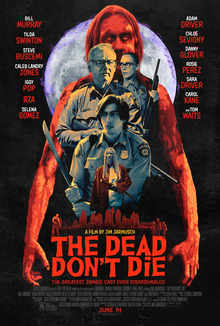
The Dead Don't Die


In small-town Centerville, police chief Cliff (Bill Murray) and deputies Ronnie (Adam Driver) and Mindy (Chloe Sevigny) face petty crimes, such as the alleged theft by survivalist Hermit Bob (Tom Waits) of ornery Farmer Miller’s (Steve Buscemi) chickens. But when polar fracking sends the earth off its axis, strange things begin to happen, culminating with the dead returning to life. Now facing a zombie epidemic, Centerville must rely on its overmatched police force, a film-loving gas station owner (Caleb Landry Jones), a well-provisioned hardware store owner (Danny Glover), and a bizarre, sword-wielding Scottish mortician (Tilda Swinton).

Though The Dead Don’t Die is the first wide theatrical release of writer/director Jim Jarmusch’s nearly four-decade career, it is no mainstream affair. Outrageous characters, lackadaisical pacing, dark humor work to preserve Jarmusch’s idiosyncratic style, and those who have grown to appreciate it will find plenty to like here. On the other hand, the uninitiated may find themselves wondering what the hell they just watched.

As mentioned, The Dead Don’t Die is not a tightly plotted film. It takes its time establishing characters and setting, the aesthetics never fully reinforce the danger that the story suggests, and it all builds to an abrupt conclusion many will find unsatisfying. It’s central conceit (polar fracking = purple moon and zombies) is ludicrous even by the standards of the genre, and its criticism of consumer culture – the zombies cry out for coffee and wifi rather than brains – is laughably (in both senses of the word) heavy-handed. One is better off viewing this as a parody of clumsy speculative message movies than such a movie in its own right.

Of course, there is an all-too-easy antidote to the film’s various lapses and transgressions: don’t take it too seriously. Freed from expectations, The Dead Don’t Die is a lot of fun. Murray is in peak deadpan form for most of the film until exasperation overtakes him at the end, and he is matched, underreaction for underreaction, by Driver. Swinton showcases her immense versatility by playing her insane (Zelda was practicing her swordplay before any inkling of zombies) role with gusto. Not only are there fine performances, but there are also recurring jokes (zombie victims are repeatedly speculated to be the results of predation by one or more wild animals by each party to discover them), visual gags (6’2” Driver speeds to the scene of a crime in small smart car, and amusing allusions (RZA plays a deliveryman for “WuPS.” Then there’s the oft-played (and, in-universe, oft-debated) title song by country crooner Sturgill Simpson. Love it or hate it, its presence is the glue that holds this film together.

Despite its higher-than-usual profile and very recognizable cast, The Dead Don’t Die is hardly Jarmusch’s opus, and those unaccustomed to his quirks will find it all the more trying. But for anyone inclined to forgive its meandering and goofiness, it’s a genuinely funny zombie comedy that is worth watching for the cast alone.

Wednesday, November 25, 2015

The Guest


After its oldest son, Caleb, dies in combat in Afghanistan, the Peterson family receives a visit from David Collins (Dan Stevens), one of Caleb’s brothers-in-arms. The family takes David in and at first finds him to be helpful and polite. However, it later becomes clear that David harbors several secrets and may not be all that he claims to be.

Directed by Adam Wingard and scripted by Simon Barrett, The Guest is both a throwback to 1980s-style thrillers (think The Stepfather with a dash of The Terminator thrown in for good measure) and one that fully engages more contemporary concerns. Neither of these things make it a truly good movie, but for the cheap thrills that it provides, it’s a lot better than it needs to be.

There are a number of elements present here that work to elevate The Guest above the B-movie fray. First, it uses what would have otherwise been an overly convenient plot point (David’s military background) to make a fairly effective statement about the dehumanizing nature of war. Next, it boasts a memorably idiosyncratic goth and indie-rock dominated soundtrack. Synths a la Clan of Xymox form an ironic counterweight to the onscreen carnage. Lastly, it benefits from some unexpectedly solid performances. Stevens’ seeming sincerity and well-mannered charisma make his eventual course of action all the more disconcerting while the always-reliable Lance Reddick exudes authority and competence as a military officer with connections to his past.

Despite these perks, The Guest also manages to fall prey to the worst conventions of the genre. When the danger increases, several characters display a naiveté and a lack of self-preservation that is annoying as it is predictable. The ambiguous final scene may have been intended as a Halloween homage, but it comes across as a dull surprise. In addition, some of the other performances – such as Maika Monroe’s flat rendition of the eldest Peterson daughter – simply aren’t good.

The Guest doesn’t shine enough to win over non-horror fans, but it is far more accomplished than the average time-filler.


7.25/10

Saturday, January 1, 2011

Black Swan

After winning the potentially star-making lead in a production of Swan Lake, ballet dancer Nina Sayers (Natalie Portman) struggles to keep her favored position. Her ethically challenged director (Vincent Cassel) berates her for a lack of passion while her ex-dancer mother (Barbara Hershey) seeks to shelter her from the world. The arrival of Lilly (Mila Kunis), a brash new dancer from California, sends Nina down a path of unexplored possibilities.


After toning down his trademark style to achieve documentary realism in The Wrestler, director once again ratchets sight and sound up to 11. There’s some call for this, as a movie about ballet should emphasize music and fluid motion. However, the persistent Clint Mansell score and overblown theatrics are a poor substitute for effective storytelling. Moreover, the body horror and mindscrew imagery that worked so wonderfully well in Requiem for a Dream feels out of place here. It’s one thing to indulge in the surreal when all the major characters are severely substance-addled, but as a reaction to stress, some of Black Swan’s visuals come off as downright ridiculous.


The single most irksome thing about this movie, however, is the implication that audiences wouldn’t understand it without the grandiosity. There are clear thematic parallels between Nina’s life and the show she’s a part of, and the Black Swan as a metaphor for repressed desire is easy enough to pick up. That doesn’t stop Aronofsky from beating the audience over the head to drive the point home, whether it’s a character telling Nina to loosen up every five minutes or so or some of the nightmares the girl herself experiences. These heavy-handed machinations leave the viewer with an urge to yell “We get it!” at the screen.


What salvages this film in a big way is the acting. Portman is terrific as Nina, portraying her as repressed, put-upon, and about-to-crack yet still graceful and doll-like. The supporting roles are all considerably more one-note, but the rival/vamp, the lecherous egotist of a director, the overbearing mother, and the washed-up former starlet are ably played by Kunis (for once, not a glaring weak link), Cassel, Hershey, and Winona Rider.

Further, even when he goes stylistically overboard, Aaronofsky proves himself quite capable at building and maintaining tension. That he can make a movie about ballet this exciting is a testament to his ability. The ending of film and show within are both depicted so powerfully that we are almost tempted to overlook the complete lack of plausibility in the waning moments.

Black Swan will likely please the type of viewer who equates evocation with brilliance. It’s a botched though noble effort, easily worth seeing for Portman’s performance as well as a glimpse of how much better it could have been.


7.5/10

Monday, November 9, 2009

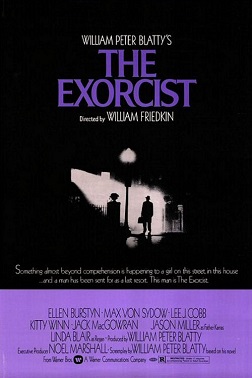
The Exorcist


When her 12-year-old Regan MacNeil (Linda Blair) shows signs of demonic possession, her actress mother (Ellen Burstyn) calls upon Fatherr Damian Karras (Jason Miller), a priest who has begun to lose his faith. They are eventually joined by Father Merrin (Max Von Sydow), the titular exorcist who previously encountered signs of the possessing spirit in the Middle East.


Based on a novel by William Peter Blatty, William Friedkin’s 1973 film carries with it the reputation of a horror classic. This, of course, is both a blessing and a curse. Good films often spawn imitators, to the point that what was once ingenious may now seem cliché. And what shocked and terrified audiences in 1973 may have little impact on the post-Saw, post-Hostel audiences of 2009.


That being said, The Exorcist proves itself worthy of its reputation. Along with The Omen, it is one of the pioneering films of the “evil kid” horror subgenre. But unlike subsequent imitators, there is nothing sinister or out-of-whack about the kid in question. Blair’s Regan is disarmingly normal from the start and that’s what lends pathos to her gradual transformation into an unholy terror.


It also helps that the movie has some legitimate shock power. Even though Regan’s supernatural antics (spider-walking down the stairs, spewing green vomit, etc.) have been lodged in popular imagination, you never know what is coming. Friedkin does not rely on sinister music to precursor to trauma (a shame in a sense – “Tubular Bells” is a hauntingly effective theme). Terrifying images are flashed on the screen with no warning at all.


While Eileen Dietz (face) and Mercedes McCambridge (voice) deserve the bulk of the credit for bringing the possessed Regan to life, the primary cast is game as well. Miller (a practicing Catholic) does a great job of fleshing out Karras’ inner struggle, while Von Sydow imbues Merrin with strength and determination in his too-brief screen time. Burstyn is credible as a mother who gains faith while losing hope. Only Lee J. Cobb rang a false note as a sympathetic police lieutenant, likely owing to his advanced age and his penchant for playing scumbags.


For all its disturbing imagery, The Exorcist is still a movie which relies heavily on the power of suggestion. What isn’t shown but only hinted at (a murder, for one) can be just as disarming as what is shown on screen. Though effective, this approach will undoubtedly leave some viewers to wonder what the fuss is all about. Likewise, the overtly religious themes could engender some eye-rolling from a non-theistic audience. But if you accept this film’s central contention – evil can be random and ordinary – you’ll likely find something to latch onto regardless of your beliefs.


8.5/10

Saturday, October 24, 2009

Ravenous


Cpt. Boyd (Guy Pearce), a highly decorated but cowardly Mexican-American War veteran, is assigned to Fort Spencer in the desolate mountains of California. He falls in with a group of misfits under the command of the bookish and jovial Col. Hart (Jeffrey Jones). A stranger named Colqhoun (Robert Carlyle) arrives, having narrowly escaped with his life. Spurred on by Colqhoun’s tale of cannibalism and desperation, the soldiers form a rescue party to seek out the remainder of his wagon train, with disastrous results.


Directed by Antonia Bird, “Ravenous” was marketed as a dark comedy, but it doesn’t really work on that level. The violence is gory rather than slapstick and the exaggerated sense of macabre comes off as convoluted and over-the-top rather than funny.


However, this isn’t to say that the film doesn’t work, period. Blur’s Damon Albarn provides a creepy, tense, sometimes idiosyncratic score. The aforementioned gruesomeness functions as an asset visually. If you’re trying to scare people, it’s better to be disgusting than cartoonish. The blood flows copiously, but it leans more toward chilling than silly.


Performances were a mixed bag. Carlyle overdoes it at times, but is consistently engaging to watch as the enigmatic Colqhoun. The normally strong Pearce turns in a subdued performance in the lead. Boyd is a character who is uncertain as to what he’s really made of and Pearce sometimes seems checked out as a result. Jones nails Hart’s perverse optimism, but it seems out of place in this film, as do comic relief turns by David Arquette and Jeremy Davies as bumbling privates. Neal McDonough fairs better as the only real soldier in the lot, though his screen time is brief. John Spencer, in his final big-screen role, brings the gravitas as Boyd’s skeptical superior.


Read as a commentary on consumerism, “Ravenous” fails because the metaphor is too deeply buried. But as a tonally-confused horror/Western/period piece, it delivers twists, tension and a taste (don’t slay me, pun gods) of entertainment.


7.5/10