Tuesday, September 5, 2017

Umami

Located at 3123 Garden Road in Burlington, Umami offers Japanese cuisine for lunch and dinner seven days a week. There are happy hour specials from 4:30-7:30 Monday-Wednesday as well as rotating food specials. Beer, wine, and sake are available.

Teppanyaki-style Japanese steakhouses, at least in this area of North Carolina, imply a tradeoff: you will pay a bit more than you think you should and eat shoulder-to-shoulder with strangers in exchange for watching food get diced before your eyes and set on fire. Even with this give-and-take firmly in mind, Umami walks a very thin line between delicious and disaster.

Some restaurants of this ilk aim for bright lighting, soothing music, and classy décor, but Umami has opted for a more accessible downmarket approach. The dark red walls are not unsightly, but the low lighting and the hip hop playing in the background run counter to expectations. The restaurant is divided into a sushi side and a teppanyaki side. Should you opt for the latter, you’ll find several tables each arranged around grills, each with its own wisecracking cook. Again, not necessarily a bad thing, but a firmly “family friendly” approach.

While Umami’s pricing (hibachi dinners starting in the mid-teens on up) is in line with competitors, it’s likely a better value: you get a lot of food for your money. My chicken, steak, and shrimp special ran $20 while my wife’s steak and chicken was slightly less. Both meals came with salad, soup, vegetables, rice, noodles, and sauce in plentiful portions.


The food offered more hits than misses. Though the salad was simple and its accompanying ginger dressing paste-like, it tasted better than it looked. The chicken-flavored broth is no substitute for miso but not bad in its own right. Our cook proved to be as good a culinary hand as he was a corny joke-teller: the vegetables were nicely cut, the chicken coated in a tasty teriyaki sauce, and the cooked-to-order steak was thankfully tender.

Our server/hostess was polite and left us with no room for complaint. Not so the couple beside us, however, whose hibachi order was forgotten (a problem quickly remedied) and whose request to add cream cheese to a sushi order resulted in dollops of the stuff placed atop (rather than inside of) a roll.  

All told, Umami offered a lot (definite leftovers) of fairly tasty food for the money charged, but its various quirks call a return into question.


7.25/10

The Defenders

When sinister ancient ninja organization The Hand sets its sights on the destruction of New York, its archenemy Danny Rand, aka The Immortal Iron Fist (Finn Jones) resolves to stop it at all costs. Meanwhile, superpowered private investigator Jessica Jones (Krysten Ritter) is hired to investigate a missing man who has knowledge of The Hand’s activities. When she attracts police attention, blind attorney Matt Murdock, secretly the masked vigilante Daredevil (Charlie Cox), bails her out. The Hand’s decision to hire local youths as a cleanup crew also attracts the attention of recently released Luke Cage (Mike Colter), a nigh invulnerable watchdog who was wrongly imprisoned. The four heroes are brought together by a common foe, but will they be able to set aside their considerable differences long enough to make a difference?

Fresh off disappointing fans with Iron Fist’s mediocre solo series, Marvel’s Netflix team has again gone out on a limb. This time, the risks include a shorter format, a mystical menace, and a decision to use The Defenders name for a team that doesn’t resemble its comic book counterpart. While not all of these risks paid off, they do show that Marvel is capable of adapting and responding to criticism rather than doubling down on past mistakes.

Series creator Douglas Petrie is an old television hand (Buffy the Vampire Slayer), and despite the short run, The Defenders has an episodic feel in the early going, gradually laying groundwork before ratcheting up the action in the latter episodes. This mitigates some of the pacing problems present in the characters’ solo series, but there is still some lag.

The decision to utilize The Hand as antagonists is both a blessing and a curse. The organization poses a threat of an appropriate scale to unite the heroes, and a look at its inner workings – there are five “fingers” that don’t always see eye to eye, mirroring the heroes’ dischord – humanizes the group to some extent. On the other hand (pun not intended), for a supposedly secretive organization, the group’s disruptive activities are laughably conspicuous.

The decision to involve the hand also places Rand front and center, a questionable move giving his poor reputation among fans. However, to the credit of all involved, he comes off better here than in his own show. His fight scenes are more fluid and convincing and his teammates regularly call him out on his stubbornness and immaturity. Still, the mysticism inherent in his plotline seems an odd fit for the grittier exploits of Daredevil, Cage, and Jones.

Though Rand (and Finn Jones’s portrayal of him) remains a point of contention, the rest of the cast generally comes off well. Luke and Jessica, a married couple in the comics, enjoy some nice banter, and their incredulity at the show’s supernatural turns casts them as audience surrogates. Matt reveals the difficulty of trying to compartmentalize as his worlds come perilously close to colliding. The supporting roles continue to showcase strong characters, from repentant ex-Hand swordswoman Colleen Wing (Jessica Henwick) to tough yet sympathetic cop Misty Knight (Simone Missick) to Matt’s crusty, badass mentor Stick (Scott Glenn) to everyone’s mutual acquaintance/favorite nurse Claire Temple (Rosario Dawson). On the villain side of the spectrum, Elodie Yung gives a nuanced, emotional performance as Elektra, a recently revived Hand assassin with conflicting loyalties while Wai Ching Ho continues to drop veiled insults with aplomb as the recurring foe Madame Gao. Though Sigourney Weaver lends star power and a touch of deadly class to the role of Hand honcho Alexandra, the character is bland and familiar, with some clichéd dialogue to boot.

These performances, coupled with some well-choreographed fight scenes and a lively soundtrack, make The Defenders consistently watchable though it never reaches the highs of the best of the characters’ solo outings. Those who have yet to break faith with Marvel’s Netflix offerings will not be driven to do so now, and by the groundwork is laid for further developments. However, The Avengers this is not.


7.5/10

Tuesday, August 22, 2017

Culichi Mexican Seafood Bar & Grill

Located at 4512 W. Market Street in Greensboro, Culichi serves Mexican fare for lunch and dinner seven days per week. There is a full bar and occasional live music.
Mexican restaurants in Greensboro never truly die; they merely rebrand. The Southwestern-style building that Culichi calls home was previously Los 3 Potrillos and before that Casa Don Lupe. While an emphasis on seafood sets Culichi apart from its predecessors, only time will tell if can enjoy greater longevity.
My wife and I made our first visit on a Sunday night. There was a largeish group there for a birthday party, and a mariachi band was playing, so it was loud but not unbearably so.  The interior layout was largely familiar (bar on the right, booths along the walls, tables in the middle) although the décor is more sedate than that of Los 3 Potrillos.
Culichi’s menu has a lot of the expected (carnitas, ACP, burritos, etc.) as well as some truly impressive-looking – and massive – seafood platters. I opted for the costa azul (shrimp, crab, and scallops with cheese, rice and salad) while my wife went with cazuelon tapatio (chicken and chorizo with rice, beans, and cheese) Wait times for the food were reasonable given the restaurant’s volume, and service left no room for complaint.


The food proved mostly satisfactory. The proteins were seasoned well, portion sizes were generous, and they didn’t skimp on the shrimp. On the other hand, the chicken in the cazuelon tapatio was dry, and the chips, salsa, and rice were all fairly pedestrian. Pricing was fair: seafood entrees run into the teens while plenty of menu items can be found for under $10.

Greensboro has so many Mexican restaurants that standing out from the pack is an uphill battle. In Culichi’s case, Mexico Mexican Restaurant, El Camino Real, and Carniceria el Mercandito are all a short distance up the road while Luna and Villa del Mar also offer a focus on seafood. That and the lack of a “wow” factor are definite challenges, but they are not proof positive that Culichi can’t compete. The food and service showed enough promise to suggest viability. As with many restaurants, consistency over time will ultimately be what makes or breaks this place. 

7.5/10

Monday, August 21, 2017

You Don't Have to Say You Love Me


            In the aftermath of his mother’s death in 2015, Sherman Alexie examines her influences on his life. He tries to reconcile her role as a healer in their Native community with her sometimes cruel parenting, and he explores the factors that made them both what they are.
            A Spokane-Couer d’Alene man who grew up not only in poverty on a reservation but also with seizure-inducing hydrocephalus, Alexie could fill volumes just on the suffering he and his family have endured. But Alexie has never been one to grab the low-hanging fruit, and therein lies his brilliance. While You Don’t Have to Say You Love Me does indeed catalog accounts of poverty, substance abuse, sexual abuse, bullying, and more, Alexie also weaves in moments of tenderness and quite a bit of his now-familiar dark humor. This willingness to confront life’s complexities can be found throughout this memoir. Alexie both slams the late Lillian Alexie for her anger and verbal abusiveness while also honoring her as a survivor and a stabilizing force. He condemns years of white oppression while also excoriating his Indian abusers and the stifling reservation climate of conformity that allows abuse to go unchecked. He blends bullying woes and basketball triumphs, alternates between recounting the facts of his life and imagining hypothetical lives unlived (i.e. “What if I had stayed on the reservation?”) and switches seamlessly between prose and poetry.
            This constant movement may prove disorienting and perhaps distracting for the uninitiated, and Alexie’s recounting does become thematically repetitive after a while. To the frustration of some, You Don’t Have to Say You Love Me is not a taut narrative but a sprawling, deeply personal work of introspection.
However, the honesty of Alexie’s insights provides adequate motivation to overlook the book’s structural lapses and idiosyncrasies. As a bonus, the author narrates the audiobook version and gives an impassioned reading throughout. This is a must-read (or listen) for those who want to see how adversity can be handled with compassion.


8.5/10

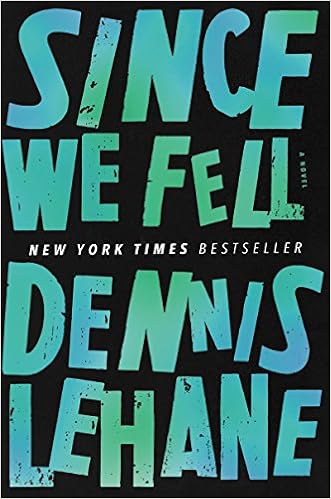
Since We Fell

          The daughter of a domineering psychology book author, reporter Rachel Childs grows up without knowing who her father is. Her quest to unmask his identity following her mother’s death leads her to Brian Delacroix, a Canadian lumber heir moonlighting as a private investigator. Though Brian’s search proves unsuccessful, this is not the last time their paths will cross. Later, a traumatic turn of events in Haiti prompts Rachel to have an on-air breakdown, rendering her jobless, divorced, and a virtual shut-in. Enter Brian, now active in his family’s business, who helps her heal. Though he seems at first like a godsend, over time, Rachel becomes increasingly convinced that Brian is not all that he claims to be. But will uncovering his secrets come at the cost of her sanity?
          Rightly or wrongly, when authors impress us, when they win our appreciation of their craft, we expect them to continue to do so. Dennis Lehane’s Kenzie and Gennaro novels deftly blended snarky narration and urban grit, Mystic River provided a haunting look at child abuse (and inspired one hell of a film adaptation), and The Given Day, the author’s first foray into historical fiction, proved his magnum opus. Since then, Lehane has achieved more recognition thanks to successful film adaptations of his work, but his books have entered a slow decline. The long-awaited sixth Kenzie-Gennaro novel, Moonlight Mile, did not equal the best of its predecessors and the two follow-ups to The Given Day (Live by Night and World Gone By) lacked the first book’s grandeur, offering instead a more personal tale of attempted redemption. In Since We Fell, Lehane tried to revitalize his writing by approaching it through a different lens. Rachel is his first female protagonist and is neither detective nor hoodlum. While this change of pace is commendable, Since We Fell still suffers from a series of missteps that the Lehane of twenty years ago would have known to avoid.
            To his credit, Lehane still has a good ear for dialogue (witness some of Rachel and Brian’s banter in the last third of the book), and he continues to capture New England settings with conviction, even when those settings are Provincetown or swankier Boston rather than blue-collar Dorchester. He also succeeds in creating suspense through paranoia. Though the book’s overall pacing is frustratingly inconsistent, when it finds its rhythm, it makes it difficult for readers to turn away.
            That said, Lehane’s choice of protagonist is a curious one. New for him does not, in this case, mean unfamiliar. A psychologically scarred, unemployed loner named Rachel who becomes suspicious of those around her fits The Girl on the Train as much as it does this book, and at times, the narrative plays like a gender-flipped Gone Girl. In an effort to complicate her characterization, Lehane also puts off delving into the roots of Rachel’s guilt until later in the novel and then ham-handedly wallows in it. His intent – giving a competent and courageous investigative journalist some inner demons to slay – is commendable, but drowning Rachel in recrimination makes her eventual recovery that much harder to take. Indeed, the action-heavy antics of the latter chapters, while breathlessly entertaining, seem at odds with certain aspects of prior characterization.
            Since We Fell also suffers from maddeningly uneven pacing and plotting. Plenty of books start off slowly before gaining momentum; few seem like entirely different novels grafted together. Rachel’s search for her father’s identity, which occupies much of the first few chapters, has little connection to anything later in the book and feels like filler once the pace quickens. Lehane’s decisions of where to begin the story, what to allude to in flashback vs. what to describe in basetime, and what to emphasize all invite second-guessing.
            Flawed as it is, Since We Fell is not an “Abandon ship!” call from Lehane to his longtime readers. There are enough turns and tension to make this book worth a read, and Lehane’s willingness to try something different is a risk that should be rewarded. On the other hand, those who are expecting a return to the rare form of Lehane’s earlier career will be disappointed.


7.5/10

Thursday, August 3, 2017

Dunkirk

In 1940 in Occupied France, Allied soldiers are pushed to the coastal town of Dunkirk where they await evacuation. Tommy (Fionn Whitehead), a British Army private meets fellow soldier Gibson (Aneurin Barnard) on the beach, and the two try to gain access to a ship that will take them across the channel. Meanwhile, Mr. Dawson (Mark Rylance) volunteers his yacht to aid the war effort, and he, his son Peter (Tom Glynn-Carney), and Peter’s younger friend George (Barry Keoughan) set out aboard the vessel toward Dunkirk to provide life jackets and rescue survivors along the way. In the air, a group of Spitfires piloted by Farrier (Tom Hardy) and Collins (Jack Lowden) attempt to shoot down Luftwaffe bombers before they can attack the troops waiting at Dunkirk.

Nearly two decades ago, Steven Spielberg’s Saving Private Ryan set the gold standard for wartime realism with its brutal depiction of the Allied Invasion of Normandy. Though Christopher Nolan’s Dunkirk shares some surface elements with it (Allied soldiers on a French beach during World War II), it is very nearly the former film’s antithesis. It is also, in many ways, its equal.

After a brief glimpse of a frame story, Saving Private Ryan promptly offered twenty minutes of frenzied carnage before developing its characters and conflict and contemplating the value of sacrifice. Dunkirk does virtually none of that. Rather than offering a focused narrative, Nolan presents the film asynchronously. The overlapping land, sea, and air segments are meant to depict one week, one day, and one hour, respectively, which can make it a chore to keep up with. The PG-13 rating also ensures that Dunkirk is light on gore. Most of the action takes the form of aerial dogfights and troops swimming away from imminent doom. Lastly, instead of humanizing its characters by delving into their backstories, Dunkirk keeps them relatively anonymous: they work as everymen because they could be any men.

Despite these departures from war film conventions, Dunkirk is very much not a pretentious or sanitized affair. As with many of Nolan’s previous films, it is stylistically breathtaking, be it the plumes of smoke rising over the bombarded beach or the sweeping maneuvers of the Spitfires. Hans Zimmer’s score also leaves quite an impression. In lieu of valorous reveries, he offers a ticking clock, ominous strings, and compositions befitting a horror movie, an appropriate (if unexpected) choice given the subject matter.

The film’s style works to impart a near-constant sense of dread. Though the audience never sees the face of the enemy, we are constantly reminded that the enemy is out there. We know that it is only a matter of time before the next attack, and the characters know it too. They are trapped in their own existential hells, whether it is Tommy going from sinking ship to sinking ship or Farrier running across one German plane after another as his fuel supply dwindles. Like previous Nolan films, Dunkirk reaches a hopeful note – in this case, a surviving character reads a Winston Churchill speech in a newspaper – but it makes both the characters and the audience suffer for it.

Speaking of characters, the cast of largely lesser-known actors does a lot with a little. As Tommy, Whitehead is wholly believable as a scared young man who just wants to get home in one piece. A lesser film would have him start that way and “grow” into something of a sacrificial action hero by the end, but Nolan wisely avoided that pitfall. The cast does boast a more conventional action hero in Hardy, and while he plays Farrier with cool competence, his escapades do not strain credulity. On the opposite end of the spectrum, the two Allied characters positioned most antagonistically – a shell-shocked survivor (Cillian Murphy) rescued by Dawson and a hotblooded Scottish soldier (Harry Styles) – are driven by the same thing that drives Tommy: survival. Aside from Hardy and Murphy, the two biggest “names” are Rylance and Kenneth Branagh. The former plays Dawson with uncompromising bravery and integrity while the latter, as a Navy commander, personifies the British stiff upper lip. All of these actors get by with very little dialogue, and even the Shakespearean Branagh avoids spotlight-hogging showiness.

Traditionally, war movies dramatize victory, however much they show of its often-steep costs. Dunkirk, on the other hand, dramatizes a long retreat. In doing so, however, it does not slander its subjects but rather affirms their humanity and their service (conscious or not) to the greater good. After all, dying en masse in Britain’s name would have meant little if there was no one left to defend the homeland (curiously, the contributions of French soldiers are downplayed, much in the way that British contributions are diminished in American WW II films), and the evacuation directly led to Churchill’s rousing speech. It is unknown if Dunkirk will seem as tense, refreshingly unorthodox, and stylistically masterful in the years to come as it does today, but it’s so far among the best films that 2017 has to offer.


8.5/10

High Point Korean BBQ

Located at 2017 Kirkwood Street in High Point, High Point Korean BBQ serves Korean fare for lunch and dinner seven days a week.

With limited Korean options in the area, High Point Korean BBQ filled a definite need when it opened this past spring. Though dining here proved to be an up and down experience, the restaurant is still a welcome addition.

Housed in a nondescript plaza, High Point Korean BBQ is much nicer inside than out. It’s tastefully appointed with a combination of booths and tables as well as semiprivate dining areas off to the side. Soothing music plays unobtrusively in the background.

Despite the restaurant’s name, do not come here expecting tableside grilling: everything is prepared in the kitchen. That aside, you will find a lot of recognizably Korean dishes: bulgogi, bimimbap, jjigae, jap che, galbi, and more. Pricing is all over the place, ranging from wallet-friendly $10 lunch specials all the way to $40/person group meals. There are enough protein options within that range to satisfy most patrons’ diets.

My first visit was a late lunch, and I went with a ttukbaegi bulgogi (beef and a broth-like sauce with glass noodles) lunch special. First and foremost, it proved to be a fantastic value. For a mere $10, I received not only bulgogi, but a small salad, miso, six banchan (side dishes, which included pickled vegetables and kimchi), a side of rice, and a cold cinnamon tea for dessert.


Among the offerings, there were more hits than misses. The miso held its own, the mild broth imparted the bulgogi with flavor, the kimchi was appropriately spicy, and the cinnamon tea was deliciously refreshing. On the other hand, the dressing atop the salad was offputtingly acidic (wherefore art thou, classic ginger?), and the beef in the bulgogi was rather chewy.

Throughout the meal, Matt proved to be a capable, polite, and attentive server. He clarified the differences between the different bulgogi variants, identified each of the banchan dishes, and generally seemed to be on top of things.

Given the ambiance and pricing, High Point Korean BBQ has the potential to be a very good lunch spot for the area. In order for it to take the leap, however, the kitchen needs more consistency.


7.75/10